- Physics Lab Equipment
- Chemistry Lab Equipment
- Biology Lab Equipment
- Anatomical Lab Equipment
- Learning
- Educational Lab Equipment
- Magnets
- Agriculture
- Astronomy
- Earth Science
- Geography Lab Equipment
- Safety Lab Coat
- Laboratory
- Meteorological
- Electricity & Magnetism
- Heat
- School Lab Equipment
- Lab Glassware
- Science Lab Equipment
- Tvet Lab Equipment
- Robotics Kits Supplier and Manufacturer for Schools India
- Math Lab Equipment Manufacturers and Exporters in Ambala
- STEM Kits Manufacturers and Supplier India
- Engineering Lab Equipment
- Hospital Lab Equipment
- Water, Sanitation & Hygiene Supplies
- Cold Chain, Solar & Communication Equipment
- Nutrition
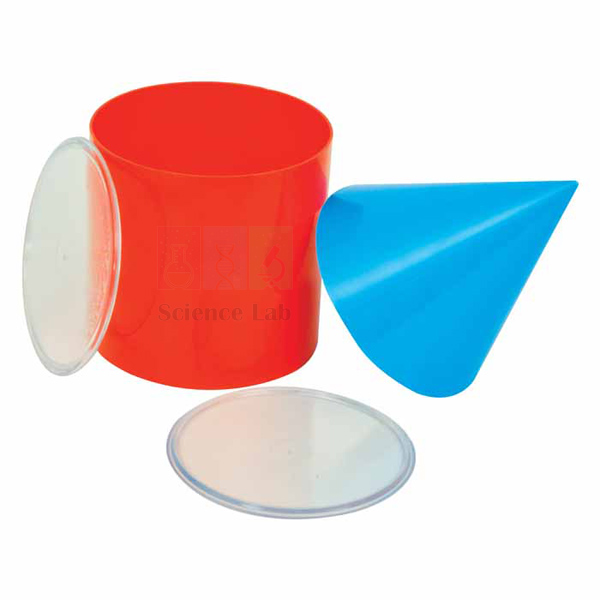
Volume Relation Between Cone and Cylinder
Volume Relation Between Cone and Cylinder (Product Code: SLE/MAT/65) is a two-piece demonstration set used to show how the volume of a cone compares with that of a cylinder of the same base and the same height in school maths labs. The set of 2 pieces comes with a lid and is listed at 10 cm x 10 cm. Jain Scientific Equipments Pvt Ltd (ScienceLab), an OEM school lab equipment manufacturer, makes it at its own factory in Ambala, India.
Specifications
| Parameter | Detail |
|---|---|
| Set contents | 2 pieces (cone and cylinder) with lid |
| Size | 10 cm x 10 cm |
| Geometry | Cone and cylinder of the same base and the same height |
| Purpose | Demonstrating the volume relationship between a cone and a cylinder |
| Product code | SLE/MAT/65 |
| Manufacturer | Jain Scientific Equipments Pvt Ltd (ScienceLab) — OEM |
| Country of origin | India (made in Ambala, Haryana) |
What Is the Cone and Cylinder Volume Set Used For?
The set answers a question students often ask: where does the one-third in the cone formula come from? A student fills the cone level to the rim with sand or rice and empties it into the cylinder, repeating until the cylinder is full. Because both pieces share the same base and height, the count of cone-fulls shows directly that the cone holds one third of the cylinder's volume.
Ask students to predict the number of pours before they start, and to level each cone-full with a ruler so the result is clean. Dry fillers pour neatly and are easy to collect afterwards. The activity links naturally to the formulae for the volume of a cylinder and a cone, and fits mensuration units in middle and secondary school.
OEM Manufacturer
ScienceLab, the trading name of Jain Scientific Equipments Private Limited, is the OEM (original equipment manufacturer) of the Volume Relation Between Cone and Cylinder set. The cone, cylinder and lid are produced at the company's own licensed factory at Saha, Ambala, Haryana, India, and sold factory-direct to schools, institutions, dealers and importers. For tender and vendor registration, the company's GSTIN is 06AAECJ8618A1ZT and its LEI is 3358004HRD1JIVXKYX49. More details are on our company profile.
Related Maths Lab Equipment
Useful companions for volume and mensuration lessons:
- Relational GeoSolids — fillable hollow shapes for comparing more volume relationships.
- Transparent 3D Solid Set — see-through solids for studying faces, edges and vertices.
- Measuring Cylinder, Polypropylene — for measuring the volume poured in each step.
- Volume Measuring Set — for general capacity and volume practice.
Explore more in our Maths Lab Equipment category.
Frequently Asked Questions
What does the Volume Relation Between Cone and Cylinder set demonstrate?
The Volume Relation Between Cone and Cylinder set demonstrates the volume relationship between a cone and a cylinder of the same base and the same height. Students fill the cone and pour it into the cylinder to find that the cylinder holds three cone-fulls.
What is included in the Volume Relation Between Cone and Cylinder set?
The Volume Relation Between Cone and Cylinder set is a set of 2 pieces, a cone and a cylinder, supplied with a lid. Its listed size is 10 cm x 10 cm, and both pieces share the same base and height.
What should I fill the cone and cylinder with?
Dry materials such as sand or rice work well with the Volume Relation Between Cone and Cylinder set because they pour cleanly and are easy to level. Ask us through our contact page before using water or other liquids.
Which classes use the Volume Relation Between Cone and Cylinder set?
The Volume Relation Between Cone and Cylinder set is used when classes study mensuration of solids, usually in middle and secondary school, to show where the one-third in the cone volume formula comes from before students apply it.
Who manufactures the Volume Relation Between Cone and Cylinder set?
The Volume Relation Between Cone and Cylinder set is manufactured by Jain Scientific Equipments Pvt Ltd (ScienceLab), the OEM, at its own licensed factory at Saha, Ambala, Haryana, India. Quotations and repeat orders come directly from the manufacturer.
Can the set be ordered in bulk for schools or export?
Yes, the Volume Relation Between Cone and Cylinder set can be quoted in bulk for schools, institutions and dealers in India and international markets. Send the quantity and delivery location to receive a quotation.
Request a Quote
Request a price for the Volume Relation Between Cone and Cylinder set through our contact page, or add it to the enquiry cart. Quotations are issued directly by the manufacturer.
Last updated: 24 September 2026