- Physics Lab Equipment
- Chemistry Lab Equipment
- Biology Lab Equipment
- Anatomical Lab Equipment
- Learning
- Educational Lab Equipment
- Magnets
- Agriculture
- Astronomy
- Earth Science
- Geography Lab Equipment
- Safety Lab Coat
- Laboratory
- Meteorological
- Electricity & Magnetism
- Heat
- School Lab Equipment
- Lab Glassware
- Science Lab Equipment
- Tvet Lab Equipment
- Robotics Kits Supplier and Manufacturer for Schools India
- Math Lab Equipment Manufacturers and Exporters in Ambala
- STEM Kits Manufacturers and Supplier India
- Engineering Lab Equipment
- Hospital Lab Equipment
- Water, Sanitation & Hygiene Supplies
- Cold Chain, Solar & Communication Equipment
- Nutrition
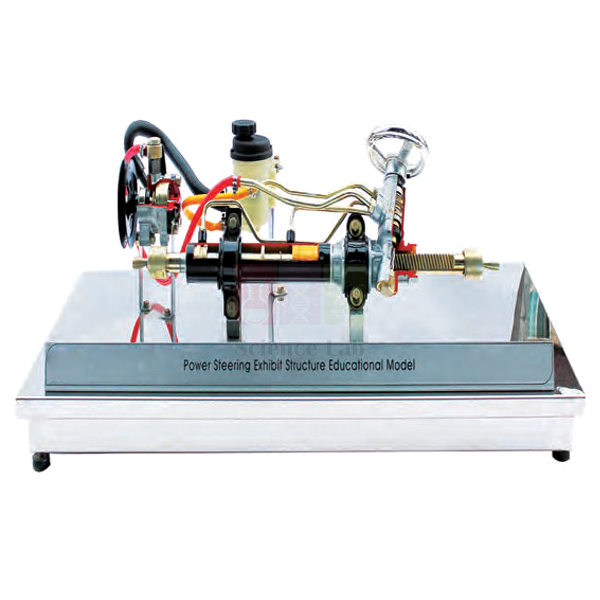
Power Steering Gear
The Power Steering Gear is a sectioned teaching unit made up of a vehicle power steering gear, its steering oil pump and the oil tank. Students move the gear by hand to watch the internal parts, check oil flow from the power pump, and pick out each component by the colour of its incised section.
Power steering gear cutaway specifications
| Parameter | Detail |
|---|---|
| Type | Structure education unit of a power steering gear (sectioned) |
| Composition | Power steering gear, steering oil pump, oil tank |
| Operation | Movement observed by manual operation; oil flow can be checked by power pump |
| Finish | Painted and coated with vehicle-only materials; incised sections painted in different colours |
| Weight | Approx. 45 kg |
| Size | Approx. 600 × 400 × 400 mm |
| Product code | SLE/ATE/12 |
| Minimum order | 10 units |
| Dispatch | Usually within 7 to 10 working days |
| Manufacturer | ScienceLab (Jain Scientific Equipments Pvt Ltd), Ambala, India |
Steering lessons on the power steering cutaway
Hand movement and oil flow. Students turn the gear by hand and describe the movement of the internal parts through the sectioned housing. The instructor then runs the oil flow check by the power pump as the supplied instructions describe, and the class relates the oil path to the help a driver would feel.
Colour-code identification. With the labels covered, the instructor points to each colour-painted incised section. Trainees name the part, say whether it belongs to the gear, the pump or the oil tank, and explain its job in one sentence.
Symptom tracing. The instructor reads out a complaint, such as a whine at idle, a moan at full lock or heavy steering when parking, and trainees point to the part of the unit where the cause would lie. The cut model of rack and pinion steering then shows the other common steering layout for comparison.
Two ways to use oil pressure. Compare this unit with the clutch structure trainer hydraulic manual. In the clutch, the driver's foot creates the oil pressure. In power steering on a vehicle, an engine-driven pump supplies it and a valve meters it to match the driver's effort.
Frequently Asked Questions About the Power Steering Gear
How does a hydraulic power steering gear decide how much help to give?
In a typical design, a torsion bar in the input shaft twists slightly as the driver turns the wheel. That twist opens a control valve, which sends pump oil to one side of the power piston and lets the other side drain to the tank. The harder the driver turns, the further the valve opens and the more help arrives.
Can a vehicle still be steered if the pump stops?
Yes. The steering wheel stays mechanically linked to the wheels through the gear, so only the hydraulic help is lost and the steering becomes much heavier. Turning this unit by hand shows the gear working on the mechanical path alone, before oil flow from the pump is added.
What makes a power steering pump whine?
The usual causes are a low oil level, air drawn in at a loose return hose or clamp, the wrong fluid, or a worn pump. Check the level in the oil tank first and look for foam, which shows trapped air. A whine that stays after topping up and bleeding points to the pump itself.
Why does the pump moan when the steering is held at full lock?
At full lock the gear cannot move any further, so pressure rises until the pressure relief valve in the pump opens. The oil then circulates under high pressure and heats up, which makes the moan. A short moan is normal, but holding full lock for long overheats the oil and wears the pump.
How is air bled from a hydraulic steering system?
Fill the tank to the mark and, with the front wheels off the ground, turn the steering slowly from lock to lock several times, first with the engine off and then running. Top up as the level falls and stop when no more bubbles rise in the tank. Avoid holding the steering at full lock while bleeding.
Which oil should go in a power steering system?
Use the fluid the vehicle maker specifies, which may be an automatic transmission fluid or a dedicated power steering fluid. Do not mix types, because some fluids attack seals or foam more easily. For this trainer, use the oil named in the supplied operating instructions.
Steering, brake, clutch and driveline trainers
- Cut Model Of Rack And Pinion Steering
- Clutch Structure Trainer Hydraulic Manual
- Working Model Of Hydraulic Braking System
- Differential Gear
- Vehicle Transmission 5 Speed Manual Gearbox
To request a quotation, send the product name, code and quantity through our contact page or add the item to your enquiry cart.
Last updated: 14 November 2026
