- Physics Lab Equipment
- Chemistry Lab Equipment
- Biology Lab Equipment
- Anatomical Lab Equipment
- Learning
- Educational Lab Equipment
- Magnets
- Agriculture
- Astronomy
- Earth Science
- Geography Lab Equipment
- Safety Lab Coat
- Laboratory
- Meteorological
- Electricity & Magnetism
- Heat
- School Lab Equipment
- Lab Glassware
- Science Lab Equipment
- Tvet Lab Equipment
- Robotics Kits Supplier and Manufacturer for Schools India
- Math Lab Equipment Manufacturers and Exporters in Ambala
- STEM Kits Manufacturers and Supplier India
- Engineering Lab Equipment
- Hospital Lab Equipment
- Water, Sanitation & Hygiene Supplies
- Cold Chain, Solar & Communication Equipment
- Nutrition
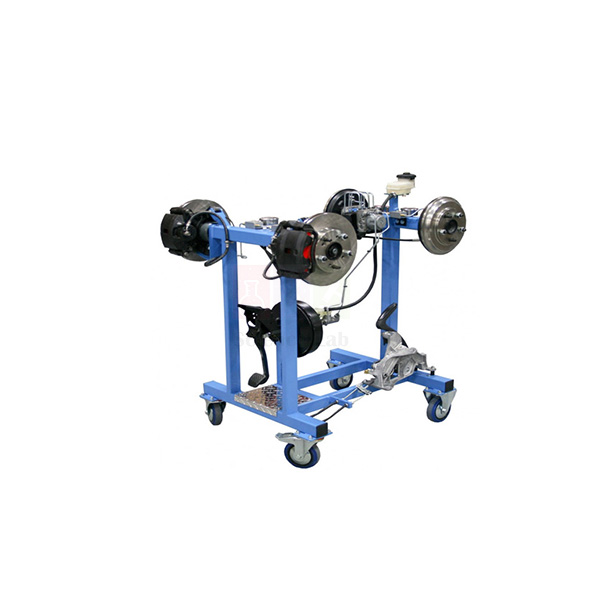
Working Model Of Hydraulic Braking System
The Working Model Of Hydraulic Braking System demonstrates a complete four-wheel hydraulic brake with disc and drum brakes, built from real automotive components on a metal stand with casters. A pressure gauge at each wheel shows the actual braking pressure, while the brake pedal, power brake booster and parking brake all work as they do on a vehicle.
Hydraulic brake model specifications
| Parameter | Detail |
|---|---|
| System | Fully functional four-wheel hydraulic braking system, disc and drum |
| Components | Real automotive components: all hydraulic components, brake pedal, power brake booster, parking brake pedal and parking brake components |
| Parking brake | Fully functional parking brake system |
| Pressure indication | Hydraulic pressure gauge at each wheel showing actual braking pressure |
| Access | All brake components within easy reach, without the confines of a real vehicle |
| Stand | Heavy-duty metal stand with casters |
| Dimensions | 1000 × 800 × 1200 mm |
| Weight | 140 kg (approx.) |
| Product code | SLE/MCE/68 |
| Minimum order | 10 units |
| Dispatch | Usually within 7 to 10 working days |
| Manufacturer | ScienceLab (Jain Scientific Equipments Pvt Ltd), Ambala, India |
Brake system practicals on the open stand
Pressure at every wheel. Press the brake pedal with steady effort and read all four pressure gauges. The readings show that the push at the pedal reaches every brake through the enclosed fluid, the idea students first meet on a Pascal's principle demonstrator. Repeat with a lighter and a firmer push and note how the gauges follow the pedal.
Disc and drum inspection. With the system at rest, students follow the hydraulic line from the pedal to each wheel. They compare how a disc brake clamps its rotor with how a drum brake presses its shoes outward, and note which of the two needs its clearance adjusted as the linings wear.
Bleeding practice. Bleed the system as the supplied operating instructions describe, with one student working the pedal and another at the wheel. Collect the fluid in a jar through a clear tube, keep the reservoir topped up between strokes, and repeat at each wheel until no bubbles appear.
Parking brake and next steps. Apply the parking brake pedal with the service brake released: the wheels are held while the gauges stay at rest, because this brake works mechanically. Follow on with the ABS braking system training board simulator for anti-lock control and the trailer air brake training equipment for heavy vehicles.
Frequently Asked Questions About the Working Model Of Hydraulic Braking System
Why can the pedal still feel soft after the brakes are bled?
Air is often still trapped somewhere in the system. Bleeding in the wrong order, letting the reservoir run low or opening the bleed point while the pedal is coming back up all let air in. Repeat the bleed carefully until the fluid runs clear of bubbles at every wheel.
In what order are the wheels bled?
Work from the wheel farthest from the master cylinder to the nearest one, unless the vehicle's service manual gives a different sequence. This pushes air out ahead of fresh fluid instead of leaving it in the longest line. Keep the reservoir topped up so no new air is drawn in.
How does Pascal's law apply to hydraulic brakes?
Pressure applied to an enclosed liquid is passed on equally in all directions. The pedal pushes a small piston in the master cylinder, and the same pressure acts on the pistons at each brake. A brake piston with a larger area, such as a disc caliper piston, gives a larger force. The four gauges on the model show that pressure arriving at every wheel.
What does a pedal that slowly sinks under steady pressure mean?
Fluid is escaping somewhere, either out of the system through a leak or past worn seals inside the master cylinder. Check every line, joint and brake for wet spots first. If none are found, internal leakage in the master cylinder is the likely cause.
Why does drum brake adjustment affect pedal travel?
Drum brake shoes pull back from the drum when released. As the linings wear, the gap grows and the pedal must travel further before the shoes touch the drum. Correct adjustment keeps that clearance small, while disc pads stay close to the disc and take up wear by themselves.
What does the power brake booster add?
It adds force to the driver's push before it reaches the master cylinder, so the same line pressure needs less foot effort. If the booster fails, the brakes still work through the hydraulics, but the pedal needs a much harder push to stop the vehicle.
Brake and chassis trainers
- ABS Braking System Training Board Simulator
- Trailer Air Brake Training Equipment
- Trailer Type Air Brake System Training Equipment
- Clutch Structure Trainer Hydraulics
- Cut Model Of Rack And Pinion Steering
To request a quotation, send the product name, code and quantity through our contact page or add the item to your enquiry cart.
Last updated: 14 November 2026