- Physics Lab Equipment
- Chemistry Lab Equipment
- Biology Lab Equipment
- Anatomical Lab Equipment
- Learning
- Educational Lab Equipment
- Magnets
- Agriculture
- Astronomy
- Earth Science
- Geography Lab Equipment
- Safety Lab Coat
- Laboratory
- Meteorological
- Electricity & Magnetism
- Heat
- School Lab Equipment
- Lab Glassware
- Science Lab Equipment
- Tvet Lab Equipment
- Robotics Kits Supplier and Manufacturer for Schools India
- Math Lab Equipment Manufacturers and Exporters in Ambala
- STEM Kits Manufacturers and Supplier India
- Engineering Lab Equipment
- Hospital Lab Equipment
- Water, Sanitation & Hygiene Supplies
- Cold Chain, Solar & Communication Equipment
- Nutrition
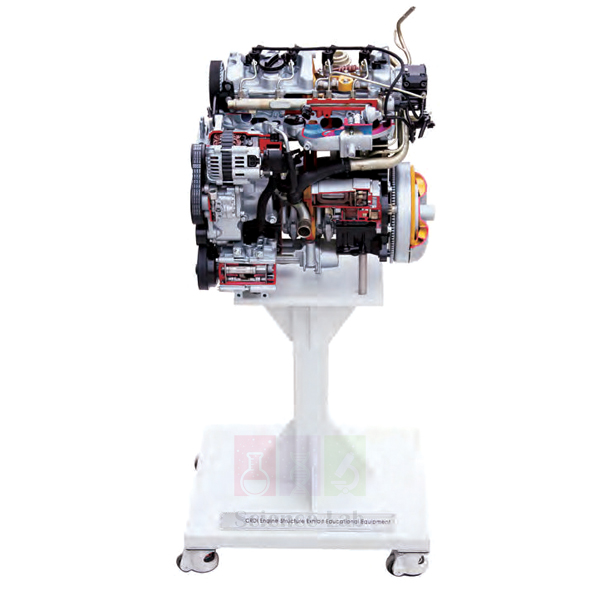
CRDI Diesel Engine SANTAFE D Engine, Stand
The CRDI Diesel Engine SANTAFE D Engine, Stand carries a 2,000cc CRDI BOSCH D engine, the same unit as fitted to the real vehicle, precisely cut so learners can watch pistons, valves and crank move. A 220V motor under an engine speed controller turns it. The fuel, cooling and lubrication systems are painted in separate colours, and the steel frame rolls on 4 braked wheels.
SANTAFE D engine stand specifications
| Parameter | Detail |
|---|---|
| Engine | 2,000cc CRDI BOSCH D engine, same as the real-vehicle unit, precisely cut to show internal movement |
| Engine ancillaries | Starting motor, generator, air conditioner compressor, intake manifold, torque converter |
| Systems shown | Fuel system, cooling system, lubrication system |
| Drive | 220V motor with engine speed controller |
| Electrical protection | Safety breaker, emergency switch, safety fuse |
| Stand | Steel frame with heat treatment painting; 4 wheels with brakes |
| Finish | Each incised section painted in a different colour |
| Weight and size | Approx. 250 kg; approx. 650 × 500 × 1,500 mm |
| Training contents | Attaching and detaching the generator and starting motor; replacing the timing belt and other belts; replacing the oil filter |
| Product code | SLE/ATE/15 |
| Minimum order | 10 units |
| Dispatch | Usually within 7 to 10 working days |
| Manufacturer | ScienceLab (Jain Scientific Equipments Pvt Ltd), Ambala, India |
Timing, belt and systems practicals on the D engine stand
Valve timing study. Set the speed controller to its slowest and follow one cylinder through a full cycle. Students note the piston position when each valve starts to open and when it closes, then draw a valve timing diagram. At higher speed, a xenon stroboscope seems to freeze the crank pulley and valve train so the same events can be checked.
Timing belt replacement. With the drive isolated at the safety breaker, trainees align the crankshaft and camshaft marks and change the belt. They set the tension, turn the engine by hand through two full turns and confirm that the marks line up again before the stand is switched on.
Starting motor and generator service. A group unbolts the starting motor and generator, inspects the mountings and refits them, tightening each bolt in turn. Before the stand is switched on again, they check that no tool or loose part is left near the belts and pulleys.
Colour-coded systems trace. Using the painted sections, students trace fuel, cooling and lubrication passages in turn and name each part they pass. Beginners can first study the basic cycle on a section model of a four-stroke diesel engine.
Frequently Asked Questions About the CRDI Diesel Engine SANTAFE D Engine, Stand
When should the timing belt on a diesel engine be replaced?
At the distance or age the engine maker sets, whichever comes first, even if the belt still looks good. Between changes, inspect it for cracks, glazing, missing teeth, oil contamination and frayed edges. The tensioner and idler pulleys are usually renewed at the same time.
What happens if the timing belt breaks on a diesel engine?
The camshaft stops while the crankshaft keeps turning. Diesel engines run very small clearances between pistons and valves, so the pistons usually strike any valves left open. The result is bent valves and often damaged pistons or guides, which means a major repair rather than just a new belt.
How is the timing belt different from the other belts on this engine?
The timing belt is toothed and runs behind a cover, keeping crankshaft and camshaft in step. The outer ribbed belt drives accessories such as the generator and air conditioner compressor. The training contents cover both, but only the timing belt needs its marks aligned before fitting.
What is valve overlap, and can students see it on this engine?
Valve overlap is the short period around top dead centre, at the end of the exhaust stroke, when the inlet and exhaust valves are both open. Outgoing exhaust helps draw in fresh air. With the motor turning the cut engine slowly, students can watch for the moment both valves of one cylinder stand open together.
Why is the oil filter changed together with the engine oil?
The lubrication system pumps oil from the sump through the filter to the bearings, camshaft and other moving parts. The filter traps soot and wear particles, and once it clogs, its bypass opens and dirty oil circulates. Changing both together keeps fresh oil clean for longer.
Why is a torque converter fitted to this engine stand?
It shows how this engine couples to an automatic transmission. The torque converter is driven from the rear of the crankshaft in place of a clutch and flywheel, so learners see the drive take-off point of an automatic-transmission vehicle on the same stand.
Diesel engine and CRDI teaching units
- CRDI Diesel Engine Stand, Motor Type
- CRDI (Common Rail Direct Injector) System
- Diesel Engine Fault Diagnosis Training Equipment Auto Fault
- Section Model Of Four-Stroke Diesel Engine
- 4 Stroke Diesel Engine
- Diesel Fuel Injection System VE pump
To request a quotation, send the product name, code and quantity through our contact page or add the item to your enquiry cart.
Last updated: 20 November 2026