- Physics Lab Equipment
- Chemistry Lab Equipment
- Biology Lab Equipment
- Anatomical Lab Equipment
- Learning
- Educational Lab Equipment
- Magnets
- Agriculture
- Astronomy
- Earth Science
- Geography Lab Equipment
- Safety Lab Coat
- Laboratory
- Meteorological
- Electricity & Magnetism
- Heat
- School Lab Equipment
- Lab Glassware
- Science Lab Equipment
- Tvet Lab Equipment
- Robotics Kits Supplier and Manufacturer for Schools India
- Math Lab Equipment Manufacturers and Exporters in Ambala
- STEM Kits Manufacturers and Supplier India
- Engineering Lab Equipment
- Hospital Lab Equipment
- Water, Sanitation & Hygiene Supplies
- Cold Chain, Solar & Communication Equipment
- Nutrition
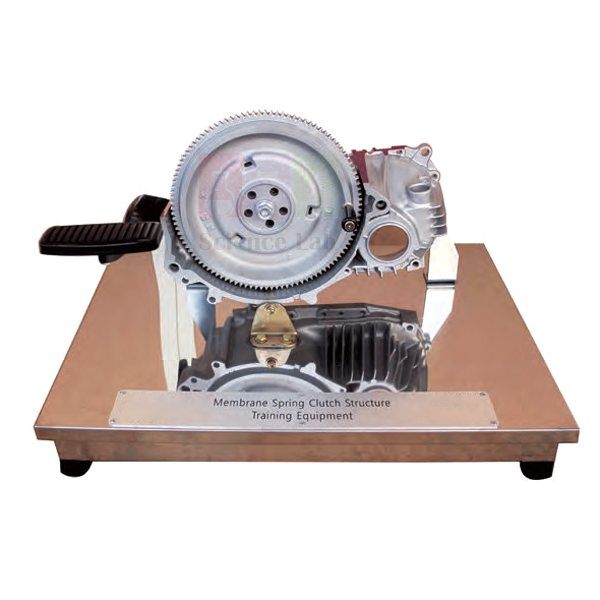
Clutch Structure Trainer Mechanical Manual
The Clutch Structure Trainer Mechanical Manual is a sectioned mechanical clutch that learners work by hand, watching the real movement through colour-painted cut sections. The parts on view are the clutch pedal, the clutch cylinder and the clutch pressing board. The unit weighs about 20 kg and measures about 400 × 300 × 300 mm, so it stores on a shelf between clutch lessons.
Mechanical manual clutch trainer specifications
| Parameter | Detail |
|---|---|
| Type | Education unit of mechanical clutch structure |
| Operation | Manual, real movement operated directly by hand |
| Composition | Clutch pressing board, clutch pedal, clutch cylinder |
| Sectioning | Each incised section painted in a different colour |
| Weight | Approx. 20 kg |
| Size | Approx. 400 × 300 × 300 mm |
| Product code | SLE/ATE/06 |
| Minimum order | 10 units |
| Dispatch | Usually within 7 to 10 working days |
| Manufacturer | ScienceLab (Jain Scientific Equipments Pvt Ltd), Ambala, India |
Free play and engagement lessons on the mechanical trainer
Stop-and-look engagement. Ask each learner to push the pedal down slowly and stop the moment resistance rises. That is the end of free play. Carry on in small steps and note where the pressing board starts to move and where drive would be fully cut.
Release sequence drawing. Students sketch the pedal and pressing board at rest and again at full release, colouring each part to match its cut section. Arrows on the second sketch show which way each part moves as the pedal goes down.
Pivot wear check. With the pedal at rest, students rock it gently and find each pivot or joint where lost motion builds up. They then repeat the check on the Clutch Structure Trainer Hydraulic Manual and compare where free movement appears on each unit.
Friction behind the clutch. On a friction slide apparatus, measure the coefficient of friction between two surfaces. Use the result to explain why clamping force and lining condition decide how much engine torque a clutch can carry before it slips.
Frequently Asked Questions About the Clutch Structure Trainer Mechanical Manual
What is clutch pedal free play?
It is the short pedal travel before the release mechanism starts to move the pressing board. That gap keeps the release bearing clear of the pressure plate while the pedal is up. On a cable or linkage clutch it is checked at the pedal pad and reset as the lining wears.
What happens if free play is too small or too large?
Too little, and the release bearing stays in contact, wears early and can hold the clutch partly released so it slips under load. Too much, and the clutch never releases fully, so it drags and gears clash when selected from rest.
How is a cable-operated clutch adjusted?
Measure free play at the pedal pad first. Then turn the adjuster on the cable or at the release lever until the travel matches the figure for that vehicle. Lock the adjuster and measure again with the pedal released.
How do clutch slip and clutch drag differ?
Slip means the clutch will not hold: engine speed rises but the vehicle does not pick up, often from a worn lining, oil on the faces or too little free play. Drag means it will not release fully, so the gearbox input keeps turning with the pedal down.
Why does a release bearing make noise only with the pedal pressed?
Pressing the pedal pushes the bearing against the spinning pressure plate fingers, so it turns under load. A dry or worn bearing then whirs or squeals. With the pedal up and free play correct, the bearing stops turning and the noise goes.
Can each student work the trainer without a power supply?
Yes. No electrical supply is listed, because the real movement is worked directly by hand. Any bench will do, and each learner can press the pedal, pause at any point and see how far the pressing board has moved.
Clutch, gearbox and final drive trainers
- Clutch Structure Trainer Hydraulics
- Clutch Structure Trainer Hydraulic Manual
- Vehicle Transmission 5 Speed Manual Gearbox
- Differential Gear
- Automotive Power Train Training Equipment SOHC Gasoline
- CRDI Diesel Engine Power Train System F/R Type
To request a quotation, send the product name, code and quantity through our contact page or add the item to your enquiry cart.
Last updated: 15 November 2026
