- Physics Lab Equipment
- Chemistry Lab Equipment
- Biology Lab Equipment
- Anatomical Lab Equipment
- Learning
- Educational Lab Equipment
- Magnets
- Agriculture
- Astronomy
- Earth Science
- Geography Lab Equipment
- Safety Lab Coat
- Laboratory
- Meteorological
- Electricity & Magnetism
- Heat
- School Lab Equipment
- Lab Glassware
- Science Lab Equipment
- Tvet Lab Equipment
- Robotics Kits Supplier and Manufacturer for Schools India
- Math Lab Equipment Manufacturers and Exporters in Ambala
- STEM Kits Manufacturers and Supplier India
- Engineering Lab Equipment
- Hospital Lab Equipment
- Water, Sanitation & Hygiene Supplies
- Cold Chain, Solar & Communication Equipment
- Nutrition
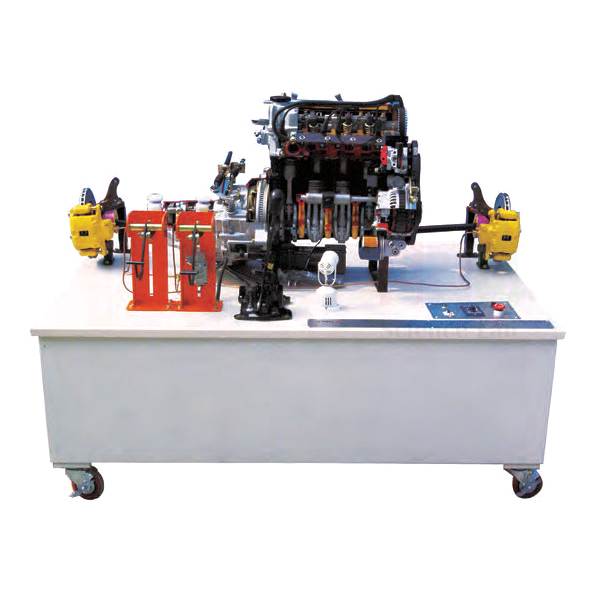
Automotive Power Train Training Equipment SOHC Gasoline
Students can follow an SOHC four-cylinder gasoline power train from camshaft to drive shaft on this cut-open rig. A single overhead camshaft gives a simpler valve train to trace than a twin-cam engine, and the engine class represented is 1,800~2,000cc. The rig is compact, at about 1,200 × 1,000 × 1,200 mm, and stands on wheels with brake lock.
SOHC gasoline power train trainer specifications
| Parameter | Detail |
|---|---|
| Engine | SOHC engine assembly, 4 cylinders |
| Engine class represented | 1,800~2,000cc gasoline |
| Transmission | FF-type manual, 5-speed forward and 1-speed reverse |
| Drive and controls | AC 220 V / 180 W motor, engine speed controller, emergency switch, safety fuse, light |
| Other assemblies | Clutch and brake system |
| Frame and mobility | Steel frame with heat-treatment painting; 4 wheels with brake lock |
| Finish | Incised sections painted in different colours; brake structure and engine parts painted specifically |
| Weight and size | Approx. 250 kg; approx. 1,200 × 1,000 × 1,200 mm |
| Build | Training stand and controls made in Ambala; SOHC engine and transmission are production units |
| Product code | SLE/ATE/02 |
| Minimum order | 10 units |
| Dispatch | Usually within 7 to 10 working days |
| Manufacturer | ScienceLab (Jain Scientific Equipments Pvt Ltd), Ambala, India |
Service practicals on the SOHC rig
Brake bleeding. Top up the reservoir, then bleed each wheel in the order the service data gives while a partner presses and holds the pedal. Close the bleed screw before the pedal comes back up, and keep checking the fluid level so no air is drawn in.
Disc and pad renewal. Remove the caliper, measure disc thickness and run-out against the service limits, fit new pads and refit the caliper. Pump the pedal to bring the pads up to the disc before the motor turns the wheels again.
Generator and starter motor. Isolate the mains supply, slacken and remove the auxiliary belt, then unbolt and lift out the generator. Take out the starter motor, inspect its pinion and the flywheel ring gear, refit both and reset belt tension.
Single-cam valve train. With the motor turning slowly on the speed controller, follow one cam lobe as it opens its valve and closes it again. Then compare the layout with the twin-cam engine on the DOHC power train trainer, and study clutch engagement by hand on the mechanical clutch structure trainer.
Frequently Asked Questions About the Automotive Power Train Training Equipment SOHC Gasoline
How does one camshaft work both the intake and exhaust valves?
The single camshaft in the head carries a lobe for every valve. It can act directly on one row of valves, while rocker arms carry the motion across to the other row. The result is fewer parts, a narrower head and a simpler timing drive than a twin-cam design.
Why does valve clearance matter on an overhead cam engine?
A small gap in the valve train lets parts expand as the engine warms. Too little clearance can hold a valve slightly open, costing compression and burning the valve face. Too much makes the train noisy and cuts valve lift. Engines with hydraulic tappets take up the gap on their own.
What is valve overlap, and how can students find it on the rig?
Near the end of the exhaust stroke the intake valve starts to open before the exhaust valve has closed, so both are open for a short time. Turn the engine slowly on the speed controller and watch the cam lobes for one cylinder around top dead centre to see it.
Why does the brake pedal still feel spongy after bleeding?
Air is usually still trapped somewhere. Bleed all four wheels in the order the service data gives, and never let the reservoir run low or air is drawn back in. A caliper refitted upside down can also trap a bubble. If the pedal keeps sinking with no leak, suspect worn master cylinder seals.
Can the SOHC trainer be held still during practicals?
Yes. The roughly 250 kg rig stands on four wheels with brake lock, so it can be rolled into a teaching bay and then locked while students work on the brakes, belts, generator and cylinder head.
How does this trainer differ from the DOHC version?
It uses a single overhead camshaft engine instead of a twin-cam one, so the valve train is easier to follow. Its frame is also more compact, at about 1,200 × 1,000 × 1,200 mm, which helps where workshop floor space is tight.
Power train, brake and engine trainers for an automobile lab
- Automotive Power Train Training Equipment DOHC Gasoline
- Clutch Structure Trainer Mechanical Manual
- Differential Gear
- Vehicle Transmission 5 Speed Manual Gearbox
- Working Model Of Hydraulic Braking System
- Engine management system (MPI)
To request a quotation, send the product name, code and quantity through our contact page or add the item to your enquiry cart.
Last updated: 20 November 2026
