- Physics Lab Equipment
- Chemistry Lab Equipment
- Biology Lab Equipment
- Anatomical Lab Equipment
- Learning
- Educational Lab Equipment
- Magnets
- Agriculture
- Astronomy
- Earth Science
- Geography Lab Equipment
- Safety Lab Coat
- Laboratory
- Meteorological
- Electricity & Magnetism
- Heat
- School Lab Equipment
- Lab Glassware
- Science Lab Equipment
- Tvet Lab Equipment
- Robotics Kits Supplier and Manufacturer for Schools India
- Math Lab Equipment Manufacturers and Exporters in Ambala
- STEM Kits Manufacturers and Supplier India
- Engineering Lab Equipment
- Hospital Lab Equipment
- Water, Sanitation & Hygiene Supplies
- Cold Chain, Solar & Communication Equipment
- Nutrition
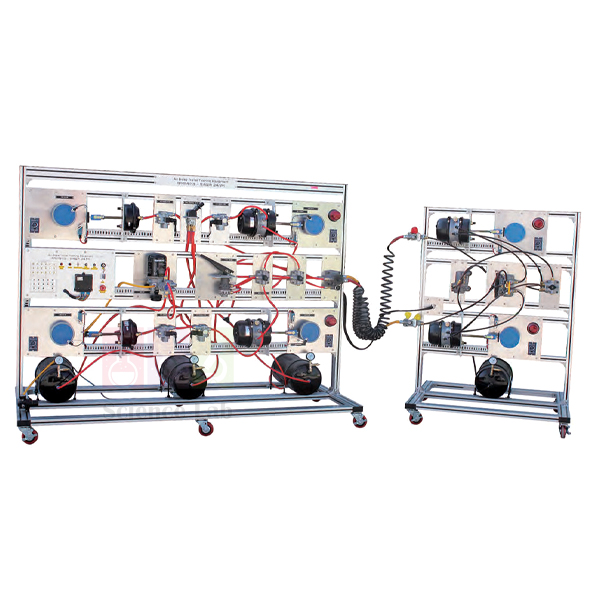
Trailer Type Air Brake System Training Equipment
Trainees connect a separate trailer unit to a truck-body air brake stand on the Trailer Type Air Brake System Training Equipment, then prove that a brake application reaches the trailer as well. The rig carries an air tank, ECU, PCV modulator and other ABS parts, and four 120W speed-controlled motors turn the wheels during the ABS tests.
Trailer-type air brake trainer specifications
| Parameter | Detail |
|---|---|
| Configuration | Brake system from the body part plus a separate trailer unit |
| Wheel drive | 4 motors, single phase 220V, 120W each, speed control type; wheel rotation and speed controlled with motor |
| Composition | Air tank, pressure regulator, brake pedal, air pressure gauge, single chamber (2 nos), double chamber (2 nos), ECU, parking brake valve, check valve, ABS pulse ring, PCV modulator, quick release valve, air dryer, double check valve, etc. |
| Control panel | Check terminal, power lamp, fuse holder, key switch, power switch, emergency switch |
| Testing | Tests run with the installed air tank and all components of the air brake system |
| Training contents | ABS waveform test; ABS modulator resistance test; use of the foot brake and hand control valve; completing the brake air line test; connecting the air line from the trailer brake system; output voltage test |
| Size | Approx. 2,400 × 600 × 1,800 mm (main unit) + 800 × 600 × 1,600 mm (trailer) |
| Weight | Approx. 150 kg (main unit) + 60 kg (trailer) |
| Product code | SLE/ATE/11 |
| Minimum order | 10 units |
| Dispatch | Usually within 7 to 10 working days |
| Manufacturer | ScienceLab (Jain Scientific Equipments Pvt Ltd), Ambala, India |
Coupling and testing the trailer brake circuit
Coupling the trailer. Park the trailer unit beside the main stand and connect the trailer air line as the supplied operating instructions describe. Charge the system, apply the foot brake and confirm that the trailer chambers apply together with those on the main unit. Repeat the application with the hand control valve and compare the gauge readings.
Losing the trailer supply. The instructor disconnects the trailer line again while trainees watch the gauge and both units. They then explain, with a circuit sketch, how the check valve and the double check valve keep air where it is needed when one part of the system loses supply.
Assessment on the rig. One air line connection is left open, and the trainee must find it, complete the brake air line and prove the circuit with a brake application. The same trainee then reads ABS modulator resistance at the check terminal with a standard digital multimeter and records the ABS waveform on an oscilloscope dual trace.
Choosing between rigs. Where a trailer exercise is not needed, the single-stand trailer air brake training equipment covers the same ABS tests. Setting either rig beside the working model of hydraulic braking system lets trainees compare truck air brakes with car hydraulic brakes.
Frequently Asked Questions About the Trailer Type Air Brake System Training Equipment
What are the service line and the emergency line on a truck-trailer air brake?
On a road vehicle, the service line carries the brake signal: its pressure rises and falls with the brake pedal or hand valve. The emergency or supply line keeps the trailer tank charged and holds the trailer spring brakes off. If the supply line breaks or comes apart, the trailer brakes apply.
What happens if the trailer air lines are crossed?
With the lines swapped, supply air goes to the service side and the trailer tank does not charge in the normal way. On a trailer with spring brakes, the brakes stay applied and it cannot be moved; an older trailer without them may have no brakes at all. Check the coupling before every test.
What is the hand control valve for, and why should it not be used for parking?
The hand control valve applies the trailer brakes on their own, which drivers use when testing the coupling. It should never hold a parked vehicle, because it depends on air pressure: if the air leaks away, the brakes release. Parking is done with the spring brakes through the parking brake valve.
Why might trailer brakes stay on after a hand valve application?
On a road trailer, the usual causes are a hand valve that does not exhaust fully, a blocked exhaust port or a sticking check valve. Moisture freezing in the lines or brakes can also hold them on. Trainees narrow it down by finding which side, truck or trailer, still holds pressure.
How is a coupled trailer's braking checked before moving off?
With the system charged, a driver applies the trailer brakes with the hand valve and pulls gently against them to confirm they hold, then checks for leaks at the couplings. On the trainer, trainees confirm the same result by watching the trailer chambers apply after the air line is connected.
What does a double check valve do in an air brake circuit?
It takes air from two sources and passes on whichever is at the higher pressure, while closing off the other. That stops air escaping back through the unused source. A typical use is feeding one brake line from either the foot valve or the hand valve, or from two separate tanks.
Trainers and test instruments for a truck and trailer training bay
- Trailer Air Brake Training Equipment
- Working Model Of Hydraulic Braking System
- ABS Braking System Training Board Simulator
- Large Yard Tractor Engine Fault Diagnosis System
- Standard Digital Multimeter
- Oscilloscope Dual Trace
To request a quotation, send the product name, code and quantity through our contact page or add the item to your enquiry cart.
Last updated: 14 November 2026
