- Physics Lab Equipment
- Chemistry Lab Equipment
- Biology Lab Equipment
- Anatomical Lab Equipment
- Learning
- Educational Lab Equipment
- Magnets
- Agriculture
- Astronomy
- Earth Science
- Geography Lab Equipment
- Safety Lab Coat
- Laboratory
- Meteorological
- Electricity & Magnetism
- Heat
- School Lab Equipment
- Lab Glassware
- Science Lab Equipment
- Tvet Lab Equipment
- Robotics Kits Supplier and Manufacturer for Schools India
- Math Lab Equipment Manufacturers and Exporters in Ambala
- STEM Kits Manufacturers and Supplier India
- Engineering Lab Equipment
- Hospital Lab Equipment
- Water, Sanitation & Hygiene Supplies
- Cold Chain, Solar & Communication Equipment
- Nutrition
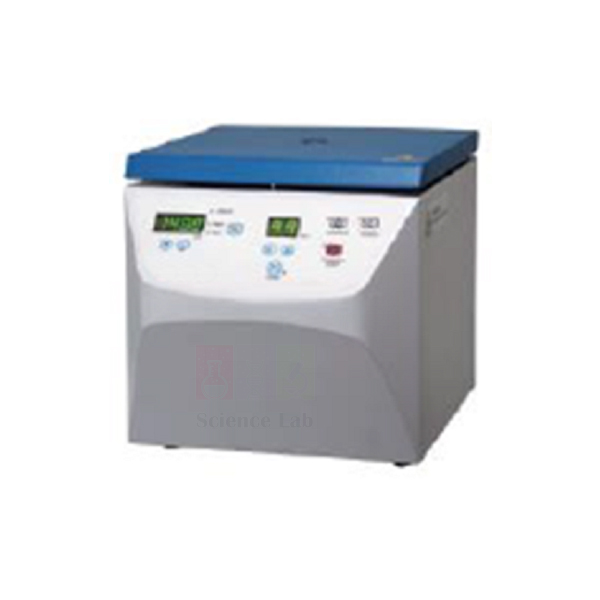
Haematocrit Centrifuge
Haematocrit Centrifuge (Product Code: SLE/CL/71) is a high-speed centrifuge designed for haematocrit capillary tubes, used to find the packed cell volume of a blood sample – the share of the sample occupied by red cells once they have been spun down. It runs at a fixed speed of approximately 13000rpm with a 1-99 minute timer, and an automatic brake and lid interlock make each run safer for the operator. Haematology benches, anaemia screening clinics, blood donation camps and medical laboratory technology courses rely on this simple test every day. It is made by Jain Scientific Equipments Pvt Ltd (ScienceLab), Ambala.
Specifications
| Parameter | Detail |
|---|---|
| Type | Haematocrit centrifuge |
| Tubes | Haematocrit capillary tubes |
| Speed | Fixed, approximately 13000rpm |
| Timer | 1-99 minutes |
| Safety features | Automatic brake and lid interlock |
| Construction | Stainless steel or coated steel casting |
| Power requirements | 220V/110V, 50/60Hz, with voltage surge protection |
Typical Use
A capillary tube is filled from a finger prick or from a well-mixed anticoagulated sample, one end is closed with sealant, and the tube is placed in the rotor with the sealed end facing outward. Tubes are loaded opposite one another to keep the rotor balanced, the timer is set to the time your procedure calls for, and the lid is closed. Because the speed is fixed, every run is spun at the same approximate 13000rpm, which helps keep results consistent between operators. Once the brake has stopped the rotor, the lengths of the packed red-cell column and the total column are read against a haematocrit reading scale.
Always record the tube position and patient identity before spinning, and discard any capillary that has leaked or cracked. Hospitals and training institutes looking for a laboratory equipment supplier in India often order this unit together with capillary tubes and sealant so the complete packed-cell-volume test is ready from the first day.
Manufacturer
This haematocrit centrifuge comes from Jain Scientific Equipments Private Limited in Ambala, Haryana, the company behind the ScienceLab brand of laboratory apparatus. ScienceLab is the trading name of this registered MSME enterprise, whose major activity is manufacturing (Udyam UDYAM-HR-01-0003714), and its export shipments are handled under Importer-Exporter Code AAECJ8618A issued by the DGFT. You can learn more on the ScienceLab company profile.
Related Clinical Laboratory Equipment
Consumables and equipment for the complete packed-cell-volume test:
- Capillary Heparin Tube — anticoagulated capillaries for direct finger-prick filling
- EDTA Capillary Tube — an alternative anticoagulant capillary for blood collection
- Capillary Tube Sealant — closes one end of each capillary before spinning
- Safety Lancet Disposable 2.4 mm — single-use lancet for the finger-prick sample
- Centrifuge Complete w/accessories — general bench-top centrifuge for larger sample tubes
Browse our Clinical Laboratory products for more haematology supplies.
Frequently Asked Questions
Which tubes does this centrifuge accept?
It is built for haematocrit capillary tubes. For ordinary sample tubes, a general bench-top centrifuge is the right choice.
Can the speed be adjusted?
No. The speed is fixed at approximately 13000rpm; you control the run with the 1-99 minute timer.
How many capillaries can be spun at once?
The rotor capacity is not stated in our listing. Please contact us to confirm the number of positions.
Is the casing stainless steel?
The listing gives stainless steel or coated steel casting. Ask us which finish applies to your order if this matters for your laboratory.
What protects the operator during a run?
An automatic brake and a lid interlock, together with voltage surge protection on the 220V/110V, 50/60Hz supply.
Can a calibration certificate or warranty be provided?
Neither is stated in our listing. Please discuss calibration certificate availability and warranty cover with us before you order.
Do you supply export and tender orders?
Yes. We quote for institutions in India and international markets; share the quantity, voltage and delivery location.
Request a Quote
Ask for a quotation for the Haematocrit Centrifuge through our contact page, or add it to your enquiry cart along with capillary tubes and sealant.
Last updated: 24 September 2026
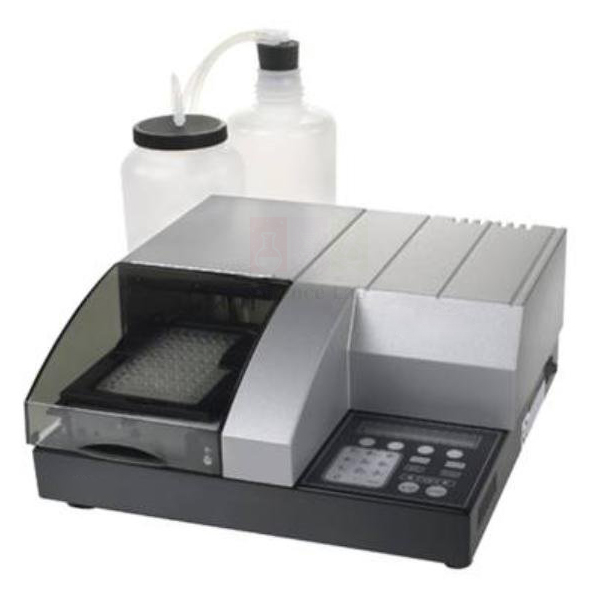
ELISA Washer 8 Channel
ELISA Washer 8 Channel (Product Code: SLE/CL/72) is an automatic bench-top washer that aspirates and dispenses wash solution across microplates or strips during ELISA (Enzyme-Linked Immunosorbent Assay) testing. Its 8-channel strip manifold works on eight wells per pass, a built-in vacuum and pressure pump drives the fluidics, and up to 75 wash protocols can be stored for different kits. Serology and immunology laboratories, blood banks, hospital diagnostic departments and research groups use it to replace tedious and variable hand washing. It is supplied by Jain Scientific Equipments Pvt Ltd (ScienceLab), Ambala, a laboratory analytical instruments supplier serving India and international markets.
Specifications
| Parameter | Detail |
|---|---|
| Type | Micro-plate or strip washer for ELISA |
| Platform | Bench-top, open and automatic system |
| Manifold | 8-channel strip manifold |
| Plate types | Flat, round, U or V-shaped bottom plates |
| Protocols | 75 user-definable protocols |
| Programmable parameters | 16-character assay name, number of cycles, wash volume, flow rate, variable soak times, aspiration and dispensing |
| Wash cycles | 1 to 10 |
| Dispensing volume | 25 to 3000ul |
| Fluid flow rate | 150 to 1000ul/well/second, to accommodate cellular assays |
| Soak time | 1-600 seconds |
| Aspiration | Crosswise/double aspiration of flat-bottom micro-plates for reduced residual liquid |
| Pump | Built-in vacuum and pressure pump assembly |
| Bottles | For waste, rinse and wash solutions |
| Protection | Spill-over protection; electronics isolated from fluidics |
| Operating conditions | Humidity up to 70%; operating temperature 15°C to 40°C |
| Power requirements | 220V/50Hz, with voltage surge protection |
| Included | Dust cover |
Typical Use
Every ELISA has several points where unbound sample, conjugate or substrate must be removed from the wells before the next reagent goes in, and incomplete washing is a leading cause of high background and false positives. With this washer, the user selects a stored protocol by its assay name, places the plate or strip holder on the carrier, and the instrument runs the programmed number of cycles, dispensing between 25 and 3000ul per well, soaking for the set time and aspirating again. For flat-bottom plates, crosswise or double aspiration pulls out more of the remaining liquid than a single central pass.
Gentler flow rates at the lower end of the 150 to 1000ul/well/second range help keep cell monolayers attached in cellular assays. Prime the lines with wash solution at the start of a session, run the rinse bottle through the manifold at the end of the day so salt does not crystallise in the pins, and empty the waste bottle as potentially infectious material. Keep the dust cover on when the washer is idle.
Supplier
The ELISA Washer 8 Channel is supplied by Jain Scientific Equipments Private Limited, the Ambala, Haryana company that trades as ScienceLab and equips diagnostic and teaching laboratories with instruments alongside its own apparatus. Visit the ScienceLab profile for more about the company.
Related Clinical Laboratory Equipment
Instruments and consumables that complete an ELISA workstation:
- ELISA Reader 8 Channel — reads the washed and developed plate
- Digital Pipette 8 Channels — adds samples and reagents to a full column of wells at once
- Reagent Reservoir 60ml — trough to feed the multichannel pipette
- Filter Pipette Tips — limit cross-contamination between patient samples
- Biohazard Bag — for disposal of used plates and tips
Our Clinical Laboratory category covers further immunoassay and sampling supplies.
Frequently Asked Questions
Which plate types can it wash?
Flat, round, U and V-shaped bottom plates, as whole micro-plates or as strips.
How many wash programmes can be stored?
75 user-definable protocols. Each can carry a 16-character assay name with its own cycles, wash volume, flow rate, soak time, aspiration and dispensing settings.
What volume, cycle and soak ranges are available?
Dispensing from 25 to 3000ul, 1 to 10 wash cycles, and soak times from 1 to 600 seconds.
Is it suitable for cell-based assays?
Yes. The fluid flow rate can be set from 150 to 1000ul/well/second so that gentle washing is possible for cellular assays.
What environment and power does it need?
It tolerates humidity up to 70% and operating temperatures from 15°C to 40°C, on a 220V/50Hz supply with voltage surge protection.
Are installation, calibration certificate and warranty provided?
These are not stated in our listing. Please contact us to discuss installation support, calibration certificate availability and warranty terms.
What should a tender or institutional enquiry include?
The number of units, delivery address, the ELISA kits you run and any documentation your procurement office needs. We quote for India and international markets.
Request a Quote
Request pricing for the ELISA Washer 8 Channel through our contact page, or add it to the enquiry cart with the matching reader and pipettes for a combined quotation.
Last updated: 24 September 2026
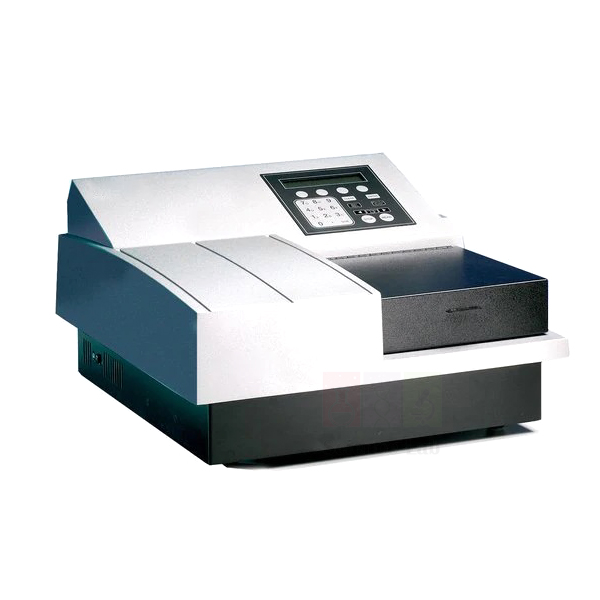
ELISA Reader 8 Channel
ELISA Reader 8 Channel (Product Code: SLE/CL/73) is a bench-top microplate photometer that measures the colour developed in ELISA (Enzyme-Linked Immunosorbent Assay) wells and turns those absorbance readings into qualitative or quantitative results with its on-board software. Eight measuring photo-detectors plus one reference detector read the plate, the optical range runs from 380 to 900nm, and built-in shaking mixes the wells before measurement. Hepatitis, HIV and other serology screening, hormone and antibody testing, and university immunology practicals all depend on this kind of reader. It is supplied by Jain Scientific Equipments Pvt Ltd (ScienceLab), Ambala.
Specifications
| Parameter | Detail |
|---|---|
| Type | Micro-plate reader for ELISA |
| Platform | Bench-top, open, automatic system |
| Detectors | Eight measuring plus one reference photo-detector |
| Wavelength range | Extended, 380-900nm |
| Absorbance range | 0.001-4.000 OD |
| Measuring modes | Single, dual and multi wavelength endpoint; endpoint and kinetic assay modes |
| Plates | All common 96-well microplates (flat, round, U or V-shaped bottom) |
| Shaking | Built-in; low, medium, high and variable speeds |
| Panel assays | Up to 8-panel assays in a single run |
| Formulas | Minimum 15 per assay (cut-off, transformation and validation) |
| Standards | Retained standards for assays spanning more than 1 micro-plate |
| Plate mapping | Automatic and manual |
| Result reporting | Plate matrix, table format, or both |
| Protocols | 50 user-definable assay protocols |
| Memory | Storage and recall of the last 10 micro-plate results |
| Sample identification | User-definable sample ID |
| Software | On-board qualitative and quantitative data reduction (English language) |
| Power requirements | 220V/50Hz, with voltage surge protection |
Typical Use
After the final wash and substrate step, the stopped plate is loaded into the reader, the matching protocol is called up, and the plate map tells the software which wells hold blanks, calibrators, controls and patient samples. The reader measures each well, applies the cut-off, transformation and validation formulas set for that assay, and reports results as a plate matrix, a table or both. Dual-wavelength reading, where a second reference wavelength is subtracted, helps cancel out scratches, fingerprints and plate imperfections. Kinetic mode, in which absorbance is followed over time, suits enzyme-rate work in research settings.
Panel assays let a laboratory read up to eight different tests on one plate in a single run, which saves plates when individual test volumes are small. Retained standards mean a large batch spread across more than one plate need not repeat the calibrators on every plate. Buyers comparing a laboratory instruments supplier in India for a full ELISA line often order the reader with the matching 8-channel washer so both instruments handle the same plate formats.
Supplier
Jain Scientific Equipments Private Limited supplies the ELISA Reader 8 Channel under its trading name ScienceLab, working from Ambala in Haryana to equip hospital, public-health and teaching laboratories. The company profile describes the business in more detail.
Related Clinical Laboratory Equipment
Equipment that works with the reader in a complete ELISA workflow:
- ELISA Washer 8 Channel — automated plate washing between assay steps
- Digital Pipette 8 Channels — fast reagent addition across a plate column
- Single Channel Pipettors — for pipetting individual samples and calibrators
- Incubator 30L, upto 80C — temperature-controlled plate incubation
- Pipette Tip Barrier Ster 200ul — sterile barrier tips for sample transfer
Find more diagnostic equipment in the Clinical Laboratory range.
Frequently Asked Questions
What wavelength and absorbance range does it cover?
380 to 900nm, with an absorbance range of 0.001 to 4.000 OD. The specific filter set supplied is not stated in our listing, so please tell us the wavelengths your kits require.
Can it perform kinetic as well as endpoint readings?
Yes. It offers endpoint and kinetic assay modes, and endpoint readings can be taken at a single, dual or multiple wavelengths.
How are results calculated?
On-board data reduction software (English language) applies at least 15 formulas per assay, covering cut-off, transformation and validation, and gives qualitative or quantitative results.
How much can it store?
50 user-definable assay protocols and the last 10 micro-plate results, each with user-definable sample IDs.
Does it connect to a printer or computer?
Printer and PC connections are not described in our listing. Please contact us to confirm output options before ordering.
Is a calibration certificate or warranty available?
Neither is stated in our listing. Discuss calibration certificate availability, installation and warranty terms with our team when requesting a quotation.
Request a Quote
For a quotation on the ELISA Reader 8 Channel, send your details through the contact page or add it to the enquiry cart. We supply laboratories in India and international markets.
Last updated: 24 September 2026
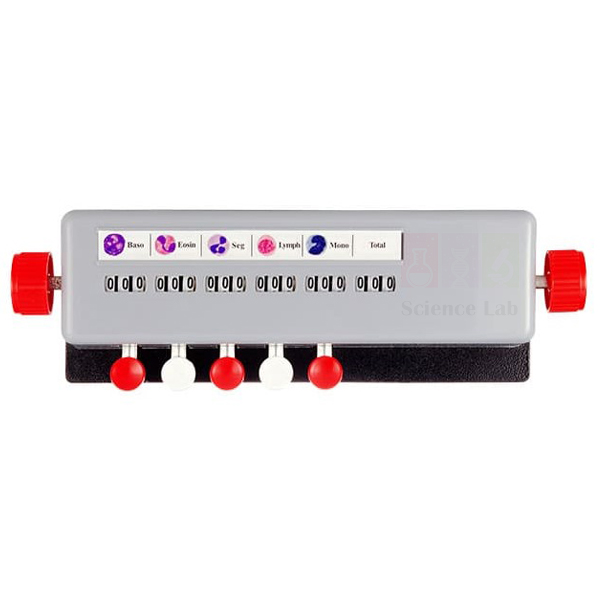
Manual Differential Cell Counter
Manual Differential Cell Counter (Product Code: SLE/CL/74) is a mechanical 5-unit tally counter with a totalizer, used to record each white blood cell by type while a stained blood smear is examined under the microscope. Its five keys cover the leucocyte classes – basophils, eosinophils, neutrophils, lymphocytes and monocytes – and the name and picture of each cell appear above its key, so the technician can keep an eye at the eyepiece and count by touch. Pathology laboratories, blood banks and medical laboratory technology colleges use it for the manual differential count. It is made by Jain Scientific Equipments Pvt Ltd (ScienceLab), Ambala.
Specifications
| Parameter | Detail |
|---|---|
| Type | Manual, mechanical 5-unit counter with totalizer |
| Application | Differential blood cell count |
| Keys | Five leucocyte keys: Baso, Eosin, Neutro, Lympho and Mono |
| Key labelling | Name and picture of the cell indicated above each key |
| Count capacity | Counts up to 100 cells |
| Readout | 3 digit |
| Signal | Audio signal when one hundred cells have been counted |
| Reset | Separate lever resets all figures to zero |
| Ergonomics | Soft key touch and convenient key placement to minimise fatigue |
Typical Use
With a well-spread, stained smear on the microscope stage, the examiner moves systematically across the thin area of the film and presses the matching key for every white cell seen. The totalizer keeps a running total, and when it reaches one hundred cells an audio signal sounds. Because the total is exactly one hundred, the figure on each key can be read directly as a percentage, ready to write onto the report. A single push on the separate reset lever returns every figure to zero for the next slide.
Soft-touch keys and a comfortable layout matter when a technician counts dozens of smears in a shift, and the cell pictures above each key are a helpful reminder for trainees still learning leucocyte morphology. Colleges setting up haematology practicals often list the counter among essential biology lab equipment in India, alongside staining racks and slide storage.
Manufacturer
ScienceLab counters are produced by Jain Scientific Equipments Private Limited, an Ambala, Haryana manufacturer of laboratory apparatus that trades under the ScienceLab name for clinical and educational customers. Read more on the ScienceLab profile page.
Related Clinical Laboratory Equipment
Items used to prepare, stain and store the smears you count:
- Rack Staining Slides Horizontal — holds smears level while stain is flooded on
- Coplin Staining Jar — for dip-staining several slides at once
- Slide Drying Rack — lets stained slides air-dry before examination
- Storage Box, 100 Slides — keeps counted slides for review or quality checks
- Counting Chamber Neubauer — for the total cell counts that accompany a differential
More haematology supplies are listed in the Clinical Laboratory category.
Frequently Asked Questions
Which cells can be counted?
The five leucocyte types: basophils, eosinophils, neutrophils, lymphocytes and monocytes, each on its own labelled key.
How does it tell me when the count is complete?
An audio signal sounds when one hundred cells have been counted. The totalizer has a 3-digit readout and counts up to 100 cells.
How are the figures cleared?
A separate lever resets all figures to zero in one movement.
Does it need batteries or mains power?
It is described as a manual, mechanical counter, and no power supply is listed. Please contact us if you need this confirmed for your order.
Can I record cell types beyond the five keys?
The keys are dedicated to the five leucocyte classes. Other findings, such as nucleated red cells, would need to be noted separately.
How should it be cleaned?
Wipe the keys and case with a lightly dampened cloth and keep liquids away from the mechanism.
Can colleges order several counters together?
Yes. Send the quantity and delivery location and we will quote for supply within India or to international markets.
Request a Quote
Order the Manual Differential Cell Counter by writing to us through the contact page or by adding it to the enquiry cart with your staining and slide supplies.
Last updated: 24 September 2026
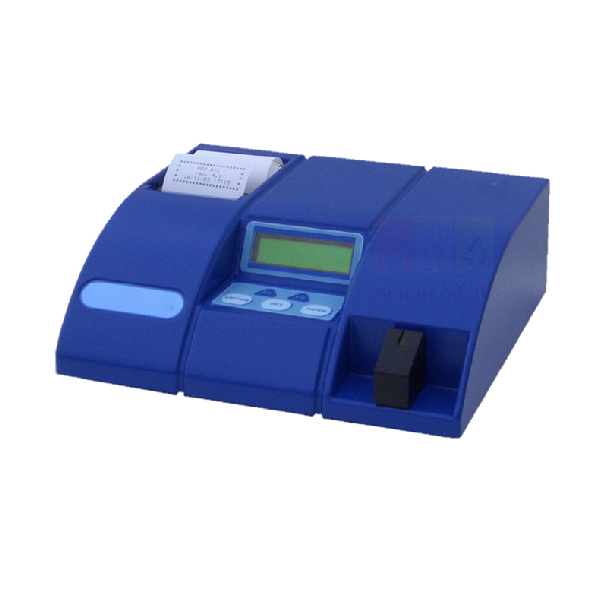
Bilirubin Meter
Bilirubin Meter (Product Code: SLE/CL/75) is a fully automatic bench-top analyser that measures bilirubin in just 10ul of whole blood and gives a result in 3 seconds, shown on a digital alphanumeric display and printed on its integrated printer. It is suited to intensive care, emergency departments and other low-volume settings in hospitals, and is widely used where newborns are monitored for jaundice. Auto-calibration, self-diagnosis and quality-control flags on abnormal results reduce routine upkeep. It is supplied by Jain Scientific Equipments Pvt Ltd (ScienceLab), Ambala, together with a starter set of accessories and consumables.
Specifications
| Parameter | Detail |
|---|---|
| Platform | Bench-top, open, fully automatic system |
| Sample type | Whole blood |
| Sample volume | 10ul |
| Analysis time | 3 seconds |
| Accuracy of measurement | Approximately 5% |
| Display and output | Digital alphanumeric display with integrated printer |
| Data management | Built-in software; data can be printed or sent to a PC |
| Quality control | Flags abnormal results; auto-calibration |
| Calibration | Automated calibration and self-diagnosis |
| Energy saving | Stand-by mode after 30 minutes |
| Operating conditions | Tolerates humidity up to 80%; operating temperature 15°C to 35°C |
| Power requirements | 220V/50Hz, with voltage surge protection |
| Suitable for | Intensive care, emergency departments or other low-volume hospital settings |
Standard accessories, consumables and parts supplied to operate the equipment:
- CD with user manual (English)
- 1 x thermal paper roll
- Fuse kit
- AC power cable
- Dust cover
- 100 x haematocrit micro capillary tubes
- 1 x plate of capillary sealing plasticine
Typical Use
A heel-prick or finger-prick drop, or a small venous sample, is drawn into one of the haematocrit micro capillary tubes, one end is closed with the sealing plasticine, and the sample is presented to the meter as described in the user manual. Three seconds later the bilirubin value appears on the display and can be printed straight onto thermal paper for the patient file, or passed to a PC through the built-in data management software. Because the meter calibrates itself, runs a self-diagnosis and flags abnormal results, nursing and laboratory staff can run it at the bedside area of a ward without a dedicated operator.
When hospitals ask a lab instruments supplier in India about a bilirubin meter, the usual questions concern sample volume, turnaround and running supplies. This unit needs only 10ul, reports in seconds, drops into stand-by after 30 minutes idle, and arrives with 100 capillaries and a paper roll so testing can start on the day of installation.
Supplier
Hospitals receive this meter from Jain Scientific Equipments Private Limited, which operates under the ScienceLab name from Ambala, Haryana and supplies clinical instruments alongside its laboratory apparatus. For institutional and tender buyers who need vendor registration details: GSTIN 06AAECJ8618A1ZT · LEI 3358004HRD1JIVXKYX49. More about the company is on the ScienceLab profile.
Related Clinical Laboratory Equipment
Items that support bilirubin sampling and testing:
- Safety Lancet Disposable 2.4 mm — single-use lancet for skin-puncture sampling
- Capillary Heparin Tube — additional capillaries for collection; confirm the type suits the meter
- Capillary Tube Sealant — for sealing capillaries once the supplied plasticine is used up
- Haematocrit Centrifuge — for units that also measure packed cell volume from capillary samples
- Gloves W/o Powder Nitrile Disposable — hand protection while handling blood
See our Clinical Laboratory range for more point-of-care and sampling items.
Frequently Asked Questions
How much blood does a test need?
10ul of whole blood per measurement.
How fast and how accurate is it?
Analysis takes 3 seconds, and the accuracy of measurement is approximately 5%.
What is included with the meter?
A CD with the English user manual, 1 thermal paper roll, a fuse kit, AC power cable, dust cover, 100 haematocrit micro capillary tubes and 1 plate of capillary sealing plasticine.
Can results be stored or transferred?
Yes. Built-in software handles data management, and results can be printed or sent to a PC.
Does it need manual calibration?
It performs automated calibration and self-diagnosis. If your laboratory needs a calibration certificate, please discuss its availability with us before ordering.
What conditions and power does it need?
It tolerates humidity up to 80% and operating temperatures from 15°C to 35°C, on a 220V/50Hz supply with voltage surge protection.
Can I reorder paper rolls and capillaries?
Please contact us with the quantities you need and we will confirm availability and warranty terms at the same time.
Request a Quote
To request a quotation for the Bilirubin Meter, use our contact page or add it to the enquiry cart. We supply hospitals and laboratories in India and international markets.
Last updated: 24 September 2026
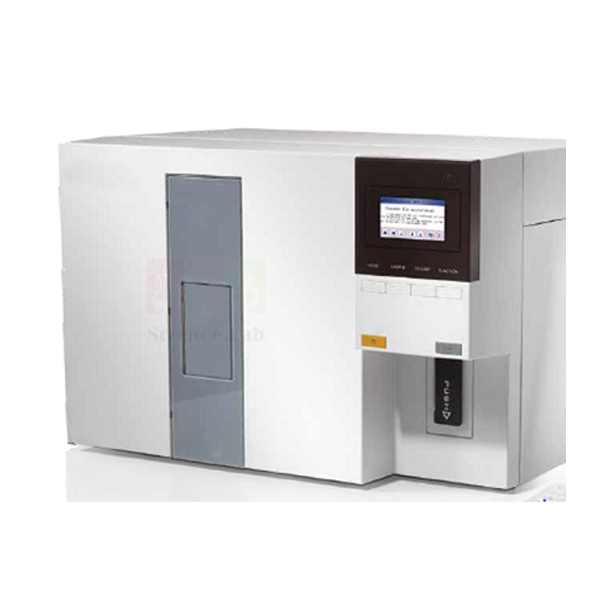
18 parameter Haematology Analyser
18 parameter Haematology Analyser (Product Code: SLE/CL/76) is an automated bench-top analyser for the complete blood count (CBC) with a 5-part white-cell differential, intended for routine haematology on whole blood. It combines flow-cytometry, colorimetry and electrical impedance to count and size red cells, white cells and platelets and to measure haemoglobin, processing 50 to 100 samples per hour. District and teaching hospitals, private diagnostic centres and larger clinics use this class of instrument as the core of their haematology bench. It is supplied by Jain Scientific Equipments Pvt Ltd (ScienceLab), Ambala.
Specifications
| Parameter | Detail |
|---|---|
| Method | Flow-cytometry, colorimetry, electrical impedance |
| Sample | Whole blood |
| Scope | Complete blood count (CBC) with 5-part differential, for routine haematology |
| Platform | Bench-top, open, automated system |
| Throughput | 50 to 100 samples per hour |
| Parameters listed | RBC, WBC, HGB, HCT, MCV, MCH, RDW-SD, RDW-CV, PLT, PDW-SD, PDW-CV, MPV and WBC differential (neutrophils, lymphocytes, monocytes, eosinophils, basophils) |
| Data management | Built in for analysis and reporting; stores at least 100 patient data, including quality control and calibrators |
| Reporting | Via external printer; printouts show sample ID, date and time, with graphs, histograms and scatter graphs |
| Quality control | Flags abnormal results; auto-calibration |
| Connectivity | External PC via USB; can interface to LIS (Laboratory Information System) |
| Casing | Corrosion-proof material |
| Environment | Tolerates harsh conditions such as high humidity; operating temperature 15°C to 35°C |
| Power requirements | 220V/50Hz, with voltage surge protection |
Typical Use
Venous blood collected into an anticoagulant tube is mixed gently, presented to the analyser and aspirated automatically. Within the run, impedance counting sizes red cells and platelets, colorimetry measures haemoglobin, and flow-cytometry separates the white cells into neutrophils, lymphocytes, monocytes, eosinophils and basophils. The printed report carries the sample ID, date and time together with histograms and scatter graphs, so a pathologist can see at a glance whether a sample needs a manual smear review. Abnormal results are flagged automatically, and quality-control and calibrator data are kept in the analyser's memory with the patient results.
With a USB link to a PC and the ability to interface with a Laboratory Information System, results can flow straight into hospital records instead of being re-typed. Institutions drafting a lab equipment tender in India should specify the power arrangements, the reagent supply they intend to use with this open system, and the printer and LIS details, so installation goes smoothly.
Supplier
This haematology analyser is offered by Jain Scientific Equipments Private Limited, the Ambala, Haryana business known to customers as ScienceLab, which supplies instruments for hospital and diagnostic laboratories in addition to its own laboratory apparatus. Company information is available on the ScienceLab profile page.
Related Clinical Laboratory Equipment
Collection and review items that sit alongside a haematology analyser:
- EDTA Vacuum Tube — anticoagulated tubes for CBC samples
- Blood Specimen Rotator — keeps samples gently mixed while they wait to be run
- Tourniquet With Buckle — for venous blood collection
- Manual Differential Cell Counter — for manual smear review of flagged samples
The full Clinical Laboratory catalogue lists more haematology and sampling products.
Frequently Asked Questions
Which parameters does it report?
Our listing names RBC, WBC, HGB, HCT, MCV, MCH, RDW-SD, RDW-CV, PLT, PDW-SD, PDW-CV, MPV and the 5-part WBC differential. Please contact us for the complete reportable parameter list of the model supplied.
What measuring principles does it use?
Flow-cytometry, colorimetry and electrical impedance, on whole blood samples.
How many samples can it process?
50 to 100 samples per hour.
Can it connect to our computer system?
Yes. It connects to an external PC via USB and can interface to an LIS. Results are printed through an external printer; whether a printer is included is not stated in our listing, so ask us to confirm.
Which reagents does it use?
It is described as an open system, but reagent types and consumption are not given in our listing. Please ask us for the reagent list before ordering.
What working conditions does it tolerate?
High humidity and operating temperatures from 15°C to 35°C. The casing is made of corrosion-proof material, and the 220V/50Hz supply has voltage surge protection.
Are installation, training, calibration certificate and warranty available?
These are not stated in our listing. Please discuss installation, user training, calibration certificate availability and warranty terms with us when you request a quotation.
Request a Quote
Send your requirement for the 18 parameter Haematology Analyser through our contact page, or add it to the enquiry cart. We quote for laboratories in India and international markets.
Last updated: 24 September 2026
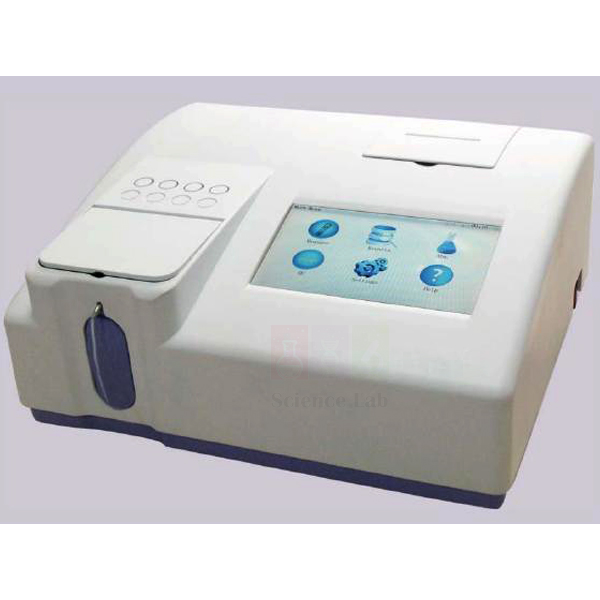
Clinical Chemistry Analyzer
Clinical Chemistry Analyzer (Product Code: SLE/CL/77) is a bench-top, open, automatic analyser for batch determination of routine biochemistry tests on serum, plasma and urine. It handles substrates such as glucose and urea, electrolytes, enzymes, lipids and immunoturbidimetric assays, running end point, differential, fixed time, kinetic, immunoturbidimetric and multi-standard methods at 60 to 100 tests per hour. Auto-sampling, auto-dilution and auto-calibration take much of the manual pipetting out of the day, which is why hospital, district and private laboratories treat it as one of the core analytical lab instruments in India's diagnostic services. It is supplied by Jain Scientific Equipments Pvt Ltd (ScienceLab), Ambala.
Specifications
| Parameter | Detail |
|---|---|
| Parameters | Routine chemistry analytes: substrates, electrolytes, enzymes, lipids, immunoturbidimetric |
| Methods | End point, differential, fixed time, kinetic, immunoturbidimetric, multi standard |
| Programming | Pre-programmed and user-programmable routines and profiles |
| Processing | Batch determination of routine clinical chemistry parameters |
| Platform | Bench-top, open, automatic system |
| Throughput | 60 to 100 tests per hour |
| Sample types | Serum, plasma, urine |
| Automation | Auto-sampling, auto-dilution, auto-calibration |
| Quality control | Flags abnormal results |
| Data management | Built in for analysis and reporting; stores at least 100 patient data, including quality control and calibrators |
| Reporting | Via external printer; printouts show sample ID, date and time |
| Connectivity | External PC via USB |
| Casing | Corrosion-proof material |
| Environment | Tolerates harsh conditions, including high humidity, some fungi and spikes; operating temperature 15°C to 40°C |
| Power requirements | 220V/50Hz, with voltage surge protection |
Typical Use
Blood is centrifuged to obtain serum or plasma, which is then loaded with any urine samples and the day's calibrators and controls. The operator selects individual tests or a stored profile – for example a liver, kidney or lipid panel – and the analyser samples, dilutes where necessary, reads each reaction by the method assigned to that test, and calculates the result. Kinetic and fixed-time methods suit enzyme and creatinine-type reactions, while end-point methods cover most substrate tests; immunoturbidimetric assays extend the menu to specific proteins. Results carrying the sample ID, date and time are printed through an external printer or sent to a PC over USB.
Because the platform is open, laboratories can programme their own routines for the reagent kits they prefer, subject to kit compatibility. Run controls at the start of every batch and review any flagged result before it is released. Keeping serum separation, pipetting and the analyser in one workflow shortens turnaround for outpatient clinics.
Supplier
Jain Scientific Equipments Private Limited, trading as ScienceLab and headquartered in Ambala, Haryana, supplies this chemistry analyser to hospital and diagnostic laboratories as part of its wider clinical range. The ScienceLab company profile has further details.
Related Clinical Laboratory Equipment
Equipment and consumables for the pre-analytical steps of chemistry testing:
- Tube Vacuum Serum Gel — collection tubes that give clean serum after spinning
- Centrifuge Complete w/accessories — bench-top centrifuge for serum and plasma separation
- Container Sample 50 ml — for collecting urine samples
- Single Channel Pipettors — for preparing calibrators, controls and manual dilutions
- Distillation Unit With Tank — distilled water for reagent preparation and rinsing
Visit the Clinical Laboratory section for the rest of our diagnostic range.
Frequently Asked Questions
What kinds of tests can it run?
Routine chemistry analytes: substrates, electrolytes, enzymes, lipids and immunoturbidimetric assays. The actual test menu depends on the reagent kits you use, so please share your list with us.
Which sample types are accepted?
Serum, plasma and urine.
How many tests per hour?
60 to 100 tests per hour, processed in batches.
Can we add our own test methods?
Yes. It offers pre-programmed as well as user-programmable routines and profiles on an open platform.
How are results stored and printed?
Built-in data management keeps at least 100 patient data, including quality control and calibrators. Results go to an external printer or to a PC via USB; whether a printer is included is not stated in our listing.
What environment can it work in?
It tolerates high humidity, some fungi and spikes, and operating temperatures from 15°C to 40°C. The casing is corrosion-proof and the 220V/50Hz supply has surge protection.
Are installation, calibration certificate and warranty provided?
These are not stated in our listing. Please contact us to discuss installation, calibration certificate availability, training and warranty.
Request a Quote
Ask for a quotation on the Clinical Chemistry Analyzer via our contact page or add it to the enquiry cart; include your expected daily test load and delivery location in India or abroad.
Last updated: 24 September 2026
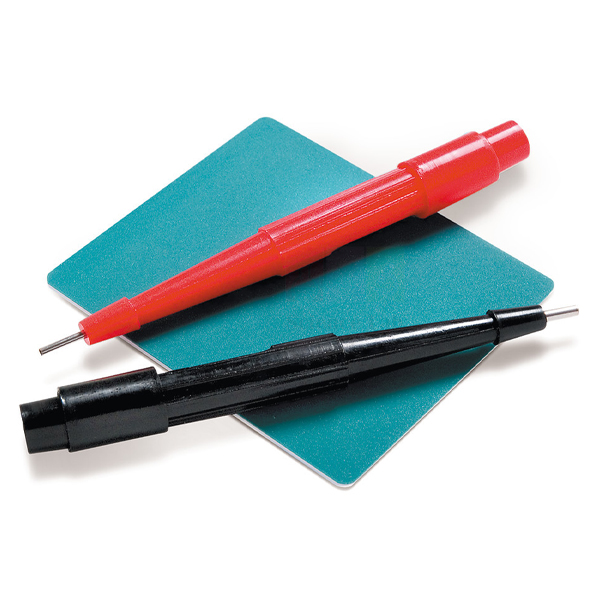
Punch DBS 3.0mm
Punch DBS 3.0mm (Product Code: SLE/CL/78) is a hand punch that cuts small discs, approximately 3.0mm in diameter, out of dried blood spot (DBS) filter-paper cards so that each disc can be dropped into a tube or plate well for elution and testing. Dried blood spots are widely used in newborn screening, early infant HIV diagnosis, surveillance studies and research, because the cards are easy to collect in the field and to post to a central laboratory. The punch is reusable, can be sterilised by autoclaving, and is replaced after a set number of punches. It is supplied by Jain Scientific Equipments Pvt Ltd (ScienceLab), Ambala, as part of its clinical range from a lab consumables supplier in India.
Specifications
| Parameter | Detail |
|---|---|
| Type | Punch for dried blood spot (DBS) filter papers |
| Punching diameter | Approximately 3.0mm |
| Sterilisation | Can be sterilised by autoclaving |
| Re-use | Reusable; intended to be disposed of after a set number of punches |
| Application | Punching samples from DBS filter-paper cards |
Typical Use
Once a DBS card has dried completely, lay it on a clean, firm surface and punch from the centre of a well-filled spot rather than its edge, where blood distribution is less even. Each 3.0mm disc is transferred into a labelled tube or the correct well of a plate, and the position is recorded against the card number. Many laboratories punch one or more discs from clean blank filter paper between patient samples, which helps limit carry-over of material from one card to the next.
At the end of a session, clean the punch and autoclave it so it is ready for the next batch. Track how many punches each tool has made, and replace it at the end of its service life so that cut edges stay clean and disc size stays consistent.
Supplier
The DBS punch is supplied by Jain Scientific Equipments Private Limited, which is based in Ambala, Haryana and trades under the ScienceLab name, providing sampling tools and consumables to screening programmes and diagnostic laboratories. More about the company can be found on the ScienceLab profile page.
Related Clinical Laboratory Items
Products used through the dried blood spot workflow, from collection to analysis:
- Dry Blood Spot Paper — filter-paper cards for collecting the blood spots
- Rack Drying DBS Cards — holds cards apart while they air-dry
- Bag Resealable Small Plastic — for storing and transporting dried cards
- PCR Microplate — plate wells to receive punched discs for molecular testing
- Safety Lancet Disposable 2.4 mm — single-use lancet for collecting the spot
Explore the Clinical Laboratory range for more sampling supplies.
Frequently Asked Questions
What size disc does it cut?
Approximately 3.0mm in diameter.
Can the punch be sterilised?
Yes. It can be sterilised by autoclaving between sessions.
How many punches can it make before replacement?
It is reusable but intended to be disposed of after a set number of punches. Our listing does not state that number, so please contact us for the recommended service life.
Which cards can it be used with?
It is designed for dried blood spot filter papers. If you use a particular card type, tell us so we can confirm suitability.
How can carry-over between samples be reduced?
Punching clean blank filter paper between patient cards and cleaning the punch regularly are common practices; follow the procedure set by your testing laboratory.
Can you supply punches for a screening programme?
Yes. Share the quantity required and the delivery location, and we will quote for India or international markets.
Request a Quote
To order the Punch DBS 3.0mm, reach us through the contact page or add it to the enquiry cart together with DBS cards and drying racks.
Last updated: 24 September 2026