- Physics Lab Equipment
- Chemistry Lab Equipment
- Biology Lab Equipment
- Anatomical Lab Equipment
- Learning
- Educational Lab Equipment
- Magnets
- Agriculture
- Astronomy
- Earth Science
- Geography Lab Equipment
- Safety Lab Coat
- Laboratory
- Meteorological
- Electricity & Magnetism
- Heat
- School Lab Equipment
- Lab Glassware
- Science Lab Equipment
- Tvet Lab Equipment
- Robotics Kits Supplier and Manufacturer for Schools India
- Math Lab Equipment Manufacturers and Exporters in Ambala
- STEM Kits Manufacturers and Supplier India
- Engineering Lab Equipment
- Hospital Lab Equipment
- Water, Sanitation & Hygiene Supplies
- Cold Chain, Solar & Communication Equipment
- Nutrition
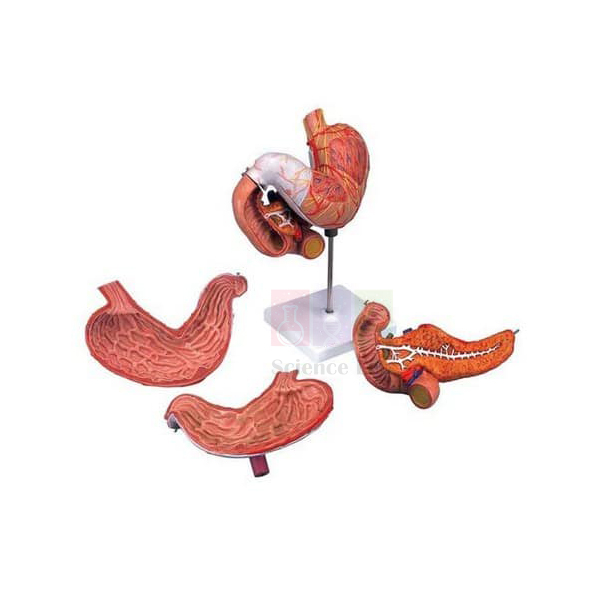
Stomach Model 2 Part
Stomach Model 2 Part (Product Code: SLE/DS/01) is an anatomical replica of the human stomach that shows the different, individual layers of the stomach wall. Its front half is removable for detailed study of the interior, and the model also depicts vessels, nerves and the lower esophagus. Delivered on a stand and weighing 0.6 kg, it is light enough to move between a classroom and a doctor’s consulting room. It is manufactured by Jain Scientific Equipments Pvt Ltd (ScienceLab), Ambala, as part of its human biology model set range for the digestive system.
Specifications
| Parameter | Detail |
|---|---|
| Construction | 2 parts; front half removable |
| Stomach wall | Different and individual layers shown |
| Structures depicted | Vessels, nerves, lower esophagus |
| Mounting | Delivered on stand |
| Weight | 0.6 kg |
| Size | 25 x 22 x 12 cm |
| Suitable for | Doctor’s office or classroom |
Typical Use
The layered wall is the feature that sets this model apart. With the front half lifted away, tutors can show how the stomach wall is built up from its inner lining to its outer covering, which is the basis for explaining how ulcers and inflammation affect different depths of tissue. The vessels and nerves show how the organ is supplied and controlled, and the lower esophagus marks where swallowed food enters.
In a clinic, a doctor can hold the model up during a consultation to explain a gastroscopy finding or a diagnosis in plain language; in the classroom it supports digestion lessons for biology and nursing students. Refit the front half carefully after use and keep the model on its stand to avoid knocks.
Manufacturer
This two-part stomach is made by Jain Scientific Equipments Private Limited of Ambala, Haryana, India, whose anatomy models and laboratory products carry the ScienceLab name. Our company profile has more about who we are.
Related Digestive System Models
Items often chosen together with this stomach model:
- Gastric Band Model — a two-part stomach with an added gastric band, for bariatric counselling
- Human Stomach Model — a life-size 2-part stomach with numbered key for general anatomy
- Human Stomach, on Stand — another stand-mounted stomach option
- Digestive System Model 2 part — shows where the stomach sits in the complete digestive tract
Explore the full Digestive System category.
Frequently Asked Questions
What does the removable front half reveal?
Removing it opens the stomach for detailed study of its interior and of the individual layers of the stomach wall.
Which other structures are shown?
The model depicts vessels, nerves and the lower esophagus.
Is it heavy to carry around?
No. It weighs 0.6 kg and measures 25 x 22 x 12 cm, so it moves easily between rooms.
Does it include a stand?
Yes, the stomach is delivered on a stand.
Is a numbered key provided?
A key is not listed in our description of this model. Please contact us if you need one.
Can hospitals and training centres order several units?
Yes. We quote for single pieces and multiple units for clinics, colleges and distributors in India and international markets.
Request a Quote
To order the Stomach Model 2 Part, send your quantity and delivery details through our contact page, or add it to your enquiry cart for a combined quotation.
Last updated: 24 September 2026
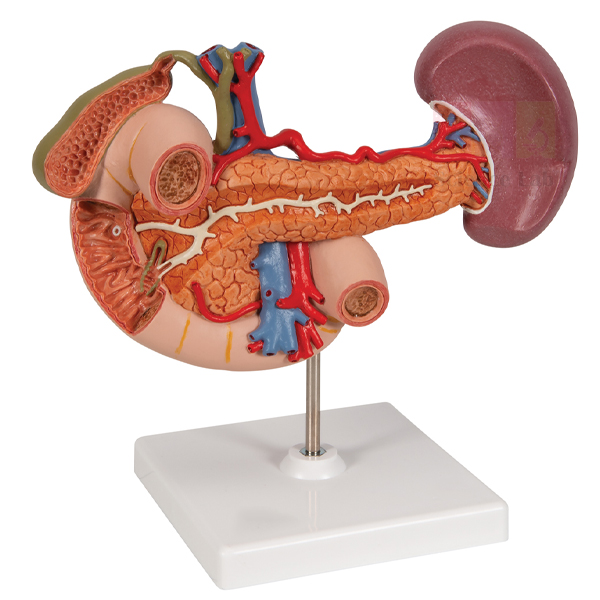
Rear Organs of the Upper Abdomen
Rear Organs of the Upper Abdomen (Product Code: SLE/DS/02) is a natural-size anatomical model of the organs that lie at the back of the upper abdomen: the duodenum (partially opened), the gall bladder and bile ducts (both opened), the pancreas with its large ducts revealed, the spleen and the surrounding vessels. It is manufactured by Jain Scientific Equipments Pvt Ltd (ScienceLab), Ambala, for anatomy, surgery and gastroenterology teaching in medical and nursing colleges and for advanced biology lab equipment in India where the biliary and pancreatic systems are studied.
Specifications
| Parameter | Detail |
|---|---|
| Scale | Natural size |
| Region | Rear organs of the upper abdomen |
| Duodenum | Partially opened |
| Gall bladder and bile ducts | Opened |
| Pancreas | Shown revealing its large ducts |
| Also shown | Spleen and surrounding vessels |
Typical Use
These organs sit deep in the abdomen and are hidden behind the stomach and intestines on most torso models, so a dedicated model makes them far easier to teach. With the bile ducts, gall bladder and duodenum opened and the pancreatic ducts exposed, students can trace how bile and pancreatic juice travel into the duodenum, which is central to understanding fat digestion and conditions such as gallstones, bile duct obstruction and pancreatitis.
Surgical tutors use the model to explain the close relationships between the duodenum, pancreas, bile ducts and major vessels before students see them in theatre or on imaging. Place it where it can be viewed from the front at eye level, and wipe it with a dry cloth after handling.
Manufacturer
Behind the ScienceLab brand is Jain Scientific Equipments Private Limited, a model and laboratory equipment maker located in Ambala, Haryana. The company is enrolled as an MSME (Udyam UDYAM-HR-01-0003714) and ships international orders under its DGFT Importer-Exporter Code AAECJ8618A. More about us on the company profile.
Related Digestive System Models
Models that cover the same hepatobiliary and pancreatic topics:
- Gallstone Model — shows typical gallstone sites along the biliary system
- Pathology of the Human Pancreas, Duodenum, and Gallbladder Model — disease changes in the same organ group
- Human Liver and Gallbladder Model — the liver side of the biliary system in enlarged form
- Digestive System Model 2 part — the complete digestive tract for orientation
View all models in our Digestive System category.
Frequently Asked Questions
Which organs are included?
The duodenum, gall bladder, bile ducts, pancreas and spleen, together with the surrounding vessels.
What does “natural size” mean here?
The organs are shown at the size they are in the body, so students get a realistic sense of their proportions.
Which parts are opened?
The duodenum is partially opened, the gall bladder and bile ducts are opened, and the pancreas reveals its large ducts.
What are the model’s dimensions and mounting?
Overall dimensions and base details are not given in our current description. Contact us and we will confirm them before you order.
Is it suitable for school use?
It is aimed mainly at medical, nursing and advanced biology courses, though senior school teachers can use it to extend a digestion lesson beyond the stomach.
Which registration details can you share for vendor onboarding?
Our Udyam and IEC numbers are given above; other documents your institution requires can be requested through the contact page.
Request a Quote
To receive pricing for the Rear Organs of the Upper Abdomen model, write to us via the contact page or add it to your enquiry cart with any related biliary models.
Last updated: 24 September 2026
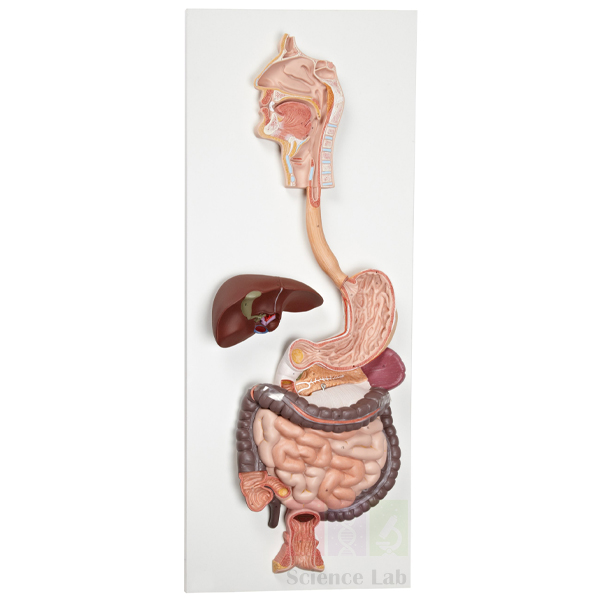
Digestive System Model 2 part
Digestive System Model 2 part (Product Code: SLE/DS/03) is a life-size model that presents the entire human digestive system in graphic relief on a baseboard, from the nose, mouth cavity and pharynx through the esophagus and GI tract, with the liver and gall bladder, spleen and pancreas in place. The duodenum, caecum and rectum are opened to show their interior, and the transverse colon is removable. Manufactured by Jain Scientific Equipments Pvt Ltd (ScienceLab), Ambala, it is a core wall or bench model for schools and colleges choosing biology teaching aids in India for the digestion syllabus.
Specifications
| Parameter | Detail |
|---|---|
| Scale | Life size |
| Format | Graphic relief, mounted on baseboard |
| Features | Nose, mouth cavity and pharynx, esophagus, GI tract, liver with gall bladder, spleen, pancreas |
| Opened sections | Duodenum, caecum and rectum |
| Removable part | Transverse colon |
| Weight | 4.4 kg |
| Dimensions | 81 x 33 x 10 cm |
Typical Use
Because the whole tract is laid out in one relief, teachers can follow a meal step by step: chewing in the mouth cavity, swallowing through the pharynx and esophagus, storage and mixing in the stomach, digestion and absorption in the small intestine, and water recovery in the large intestine down to the rectum. The opened duodenum, caecum and rectum let students see inside key sections, while lifting off the transverse colon gives a clearer view of the organs it normally covers.
The flat baseboard format suits permanent display in a biology room or corridor, where it acts as a reference for the whole digestion unit, and it works equally well laid on a bench for small-group revision. At 4.4 kg it is best lifted with both hands by the baseboard, not by the organs.
Manufacturer
The model is a product of Jain Scientific Equipments Private Limited, an Ambala, Haryana company that builds educational models and laboratory equipment under the ScienceLab name. Read about the company on our profile page.
Related Digestive System Models
Organ-level models that zoom in on parts of this system:
- Stomach Model 2 Part — detailed wall layers of the stomach
- Rear Organs of the Upper Abdomen — duodenum, pancreas, bile ducts and spleen at natural size
- Human Liver and Gallbladder Model — enlarged internal anatomy of the liver
- Human Stomach Model — a life-size stomach that opens into 2 parts
- Gallstone Model — adds a common digestive disorder to the lesson
See every model in the Digestive System category.
Frequently Asked Questions
What does the model cover?
The entire digestive system in relief: nose, mouth cavity and pharynx, esophagus, GI tract, liver with gall bladder, spleen and pancreas.
Which part is removable?
The transverse colon can be removed. The duodenum, caecum and rectum are shown opened.
How big and heavy is it?
It measures 81 x 33 x 10 cm and weighs 4.4 kg.
Can it be hung on a wall?
It is mounted on a baseboard. Wall-fixing hardware is not listed in our description, so contact us to confirm how it is supplied.
Is a key or teaching guide included?
Our description does not mention one; please ask at enquiry stage if you need labelling support.
Do you pack it safely for long-distance delivery?
Packing is arranged for each order, including export consignments to international markets, and is described in the quotation.
Request a Quote
For a quotation on the Digestive System Model 2 part, message us through the contact page, or add it to the enquiry cart with any organ-level models you need.
Last updated: 24 September 2026

Gastric Band Model
Gastric Band Model (Product Code: SLE/DS/04) is a two-part stomach model to which a gastric band has been added, created to explain this surgical device to patients. A gastric band is inserted surgically to treat morbid obesity when conservative treatments have not been successful, and the model lets a surgeon, dietitian or nurse show exactly where the band sits on the stomach. It is manufactured by Jain Scientific Equipments Pvt Ltd (ScienceLab), Ambala, for bariatric clinics, hospitals and medical and nursing colleges, and is one of the more specialised items among biology teaching aids in India.
Specifications
| Parameter | Detail |
|---|---|
| Base model | Two-part stomach model |
| Added feature | Gastric band |
| Clinical context | Gastric band inserted surgically to treat morbid obesity if conservative treatments are unsuccessful |
| Main purpose | Explaining the gastric band device to patients |
| Weight | 0.51 kg |
| Dimensions | 18 x 16 x 25 cm |
Typical Use
Patients considering weight-loss surgery often find it hard to picture what a band does. In a pre-operative consultation the clinician can point to the band on the stomach, explain how it restricts the upper part of the organ so that smaller meals bring a feeling of fullness, and answer questions about eating after surgery. Because the base is a two-part stomach model, the stomach can also be opened to discuss its normal anatomy in the same conversation.
In nursing and medical education the model supports lectures on obesity management and on the care of patients after bariatric procedures. At 0.51 kg it is easy to hold up during a consultation or pass round a seminar table. Wipe it with a soft cloth between patients and store it away from direct sunlight.
Manufacturer
Jain Scientific Equipments Private Limited, trading as ScienceLab, manufactures this model in Ambala, Haryana, alongside its wider line of anatomical models and laboratory apparatus for customers in India and international markets. Our company profile tells you more.
Related Digestive System Models
Useful companions for patient education and stomach anatomy:
- Stomach Model 2 Part — a two-part stomach without a band, for explaining normal anatomy and wall layers
- Human Stomach Model — a life-size 2-part stomach with numbered key
- Human Stomach, on Stand — a stand-mounted stomach for clinic or classroom display
- Digestive System Model 2 part — shows how the stomach connects to the rest of the digestive tract
Find more in our Digestive System category.
Frequently Asked Questions
Is this a medical device?
No. It is an educational model for explaining a gastric band; it is not a band for surgical use.
What is the model based on?
It was developed from a two-part stomach model, with a gastric band added.
How large and heavy is it?
It measures 18 x 16 x 25 cm and weighs 0.51 kg.
Can the band be removed from the stomach?
Our description does not say whether the band detaches. Contact us if you need a removable band for demonstrations.
Is it appropriate for school biology classes?
It is designed mainly for patient explanation and clinical education; schools teaching basic stomach anatomy usually choose a standard stomach model instead.
Can clinics order more than one?
Yes. Hospital groups and distributors can request multiple units; share the quantity and delivery locations in your enquiry.
Request a Quote
For pricing on the Gastric Band Model, contact our team through the contact page or add it to the enquiry cart to request it with other patient-education models.
Last updated: 24 September 2026

Gallstone Model
Gallstone Model (Product Code: SLE/DS/05) is a patient-education model, mounted on a base, that shows the anatomy of the biliary system and its surroundings at half natural size. It explains where gallstones are typically found — in the fundus of the gall bladder, around the spiral valve, in the common bile duct and at the papillary opening into the small intestine — and lets viewers identify both acute inflammation (cholecystitis) and the tissue changes of chronic inflammation in the gallbladder wall. It is manufactured by Jain Scientific Equipments Pvt Ltd (ScienceLab), Ambala, for surgical and gastroenterology clinics and for medical and nursing teaching, extending a human biology model set into common digestive disease.
Specifications
| Parameter | Detail |
|---|---|
| Scale | Half natural size |
| Mounting | Mounted on base |
| Anatomy shown | Biliary system and its surroundings |
| Typical gallstone locations | Fundus area of the gall bladder; area of the spiral valve; common bile duct; papillary opening to the small intestine |
| Gallbladder wall | Acute inflammation (cholecystitis) and tissue changes caused by chronic inflammation |
| Intended use | Patient education and clinical teaching |
Typical Use
The model is built around the questions patients ask after a gallstone diagnosis: where the stones are, why they cause pain and what surgery would involve. A clinician can move along the biliary system from the fundus of the gall bladder, past the spiral valve and down the common bile duct to the papillary opening, explaining why a stone in each position produces different symptoms. The inflamed gallbladder wall helps explain the difference between a sudden attack of cholecystitis and long-standing chronic inflammation.
For students, the model links biliary anatomy to one of the most frequently encountered digestive conditions. Keep it on its base on a consulting-room desk or in a teaching cabinet, and wipe it clean with a dry cloth.
Manufacturer
ScienceLab gallstone models are made by Jain Scientific Equipments Private Limited, whose production and offices are in Ambala, Haryana, India, and which supplies clinics, colleges and distributors under the ScienceLab brand. Visit the company profile for more.
Related Digestive System Models
Models used alongside this one in biliary and hepatobiliary teaching:
- Rear Organs of the Upper Abdomen — the opened gall bladder, bile ducts, duodenum and pancreas at natural size
- Human Liver and Gallbladder Model — enlarged normal anatomy of the liver with gallbladder
- Human Liver Pathology Model — common pathologies of the liver and gallbladder with a key card
- Pathology of the Human Pancreas, Duodenum, and Gallbladder Model — related disease changes in neighbouring organs
Browse our Digestive System category for further models.
Frequently Asked Questions
Where are the typical gallstone locations on this model?
In the fundus area of the gall bladder, the area of the spiral valve, the common bile duct and the papillary opening to the small intestine.
What scale is the model?
It shows the biliary system and its surroundings at half natural size.
Does it show inflammation?
Yes. Acute inflammation (cholecystitis) and the tissue changes caused by chronic inflammation can be identified in the gallbladder wall.
Is it mounted?
Yes, the model is mounted on a base.
What are the overall dimensions?
These are not listed in our current description. Please contact us for the measurements.
Can distributors stock this model?
Yes. We work with distributors and institutional buyers in India and international markets; ask for a quotation based on your volumes.
Request a Quote
To price the Gallstone Model for your clinic or college, get in touch via the contact page, or add it to your enquiry cart with other biliary models.
Last updated: 24 September 2026
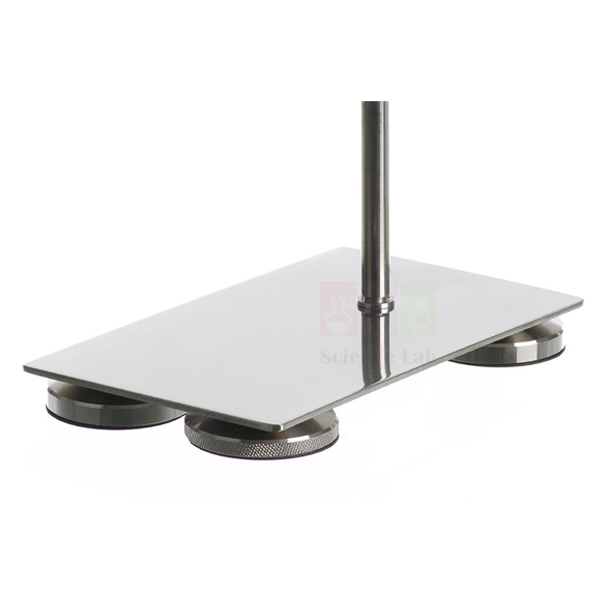
Stand bases 18/10 Stainless Steel
Stand bases 18/10 Stainless Steel (Product Code: SLE/LR/01) is a heavy, flat laboratory stand base in 18/10 stainless steel used to hold a threaded support rod upright for clamps, rings and glassware set-ups in chemistry, physics and biology labs. It has antislide rubber protection, expanded flat feet for extra stability and one adjustable foot, and is listed in four sizes weighing 1.6 to 2.4 kg. It is made by Jain Scientific Equipments Pvt Ltd (ScienceLab), an OEM manufacturer, at its own factory in Ambala, India.
Specifications
| Parameter | Detail |
|---|---|
| Material | 18/10 stainless steel |
| Feet | Expanded, flat and heavy, for extra stability |
| Levelling | 1 adjustable foot |
| Bench protection | Antislide rubber protection |
| Rod fitting | Thread |
| Sizes (A length × B width × C height, as listed) and weight | 210 × 130 × 3 — 1.6 kg 250 × 160 × 3 — 1.9 kg 300 × 150 × 3 — 2.0 kg 315 × 200 × 3 — 2.4 kg |
| Product code | SLE/LR/01 |
| Manufacturer | Jain Scientific Equipments Pvt Ltd (ScienceLab) — OEM |
| Country of origin | India (made in Ambala, Haryana) |
What Is the Stainless Steel Stand Base Used For?
A stand base is the foundation of every retort stand assembly. A support rod is screwed into the thread, then bossheads, clamps and rings are added to hold burettes, flasks, condensers or funnels at the right height. The wider and heavier the base, the less likely a tall or top-heavy set-up is to tip, which is why these bases use expanded, flat, heavy feet, while the antislide rubber keeps them from creeping across a smooth bench and the adjustable foot stops rocking on an uneven surface.
18/10 stainless steel, an alloy of roughly 18% chromium and 10% nickel, stands up well to everyday spills and repeated cleaning, so these bases suit wet chemistry, pharmacy and microbiology benches as well as school labs. Keep the heaviest part of an assembly above the footprint of the base, screw the rod fully home before loading it, and check the adjustable foot whenever the stand is moved. It suits anyone equipping a retort stand lab in India who wants stainless fittings throughout.
What to Specify When Ordering
- Which of the four sizes you need, by its A × B × C figures or its weight (1.6, 1.9, 2.0 or 2.4 kg).
- How many bases are required per bench or per lab.
- Whether support rods, bossheads and clamps should be quoted in the same enquiry.
- The delivery location for the order.
OEM Manufacturer
Jain Scientific Equipments Private Limited, trading as ScienceLab, is the OEM (original equipment manufacturer) of these stainless steel stand bases and makes them at its own licensed factory in Saha, Ambala, Haryana, India. Laboratories, schools, colleges, dealers and importers can order bases, rods and fittings together, factory-direct, from one manufacturer.
Tender and vendor-registration forms can quote the company's GSTIN 06AAECJ8618A1ZT and Legal Entity Identifier 3358004HRD1JIVXKYX49. For repeat orders or a replacement adjustable foot, ask us. Company background is on the ScienceLab profile.
Related Stand bases, Rods and Rings
Items that complete a stainless steel retort stand set-up:
- Rods For Stand Bases — the upright rod that screws into the base.
- Bossheads 18/10 Stainless Steel — fix clamps and rings to the rod in the same grade of steel.
- Retort Clamp Standard 18/10 Stainless Steel — holds flasks, condensers and tubes on the stand.
- Stand Bases Steel Varnished — a varnished steel alternative in more sizes and weights.
- Base Frame tube, 18/10 Stainless Steel — V- or H-form frames for wider apparatus.
See the full Stand bases, Rods and Rings category for more supports and fittings.
Frequently Asked Questions
What sizes does the Stand bases 18/10 Stainless Steel come in?
The Stand bases 18/10 Stainless Steel is listed in four sizes (A length × B width × C height): 210 × 130 × 3 at 1.6 kg, 250 × 160 × 3 at 1.9 kg, 300 × 150 × 3 at 2.0 kg and 315 × 200 × 3 at 2.4 kg. Exact dimensions are confirmed with each quotation.
How does the Stand bases 18/10 Stainless Steel stay stable?
The Stand bases 18/10 Stainless Steel stays steady thanks to expanded, flat and heavy feet, antislide rubber protection that grips the bench, and one adjustable foot that can be set to stop the base rocking on an uneven work surface.
Why is the Stand bases 18/10 Stainless Steel made from 18/10 steel?
The Stand bases 18/10 Stainless Steel uses 18/10 stainless steel, roughly 18% chromium and 10% nickel, because this alloy resists corrosion from everyday spills and frequent cleaning. That makes the base well suited to wet chemistry, pharmacy and biology labs.
Is a support rod included with the Stand bases 18/10 Stainless Steel?
Support rods are offered as a separate catalogue item, Rods For Stand Bases. When enquiring about the Stand bases 18/10 Stainless Steel, mention the size you need and we will confirm a compatible rod in the quotation.
Who manufactures the Stand bases 18/10 Stainless Steel?
The Stand bases 18/10 Stainless Steel is manufactured by Jain Scientific Equipments Pvt Ltd (ScienceLab), the OEM, at its own licensed factory at Saha, Ambala, Haryana, India. Quotations and repeat orders come directly from the manufacturer.
Can the Stand bases 18/10 Stainless Steel be ordered in bulk?
Yes. The Stand bases 18/10 Stainless Steel can be ordered in quantity for new laboratories, dealers and importers in India and international markets. State the sizes, quantities and delivery location, and the manufacturer will prepare a combined quotation.
Request a Quote
Send your stand base requirements through our contact page or add the item to the enquiry cart, listing the sizes you need. Quotations come direct from the manufacturer.
Last updated: 24 September 2026
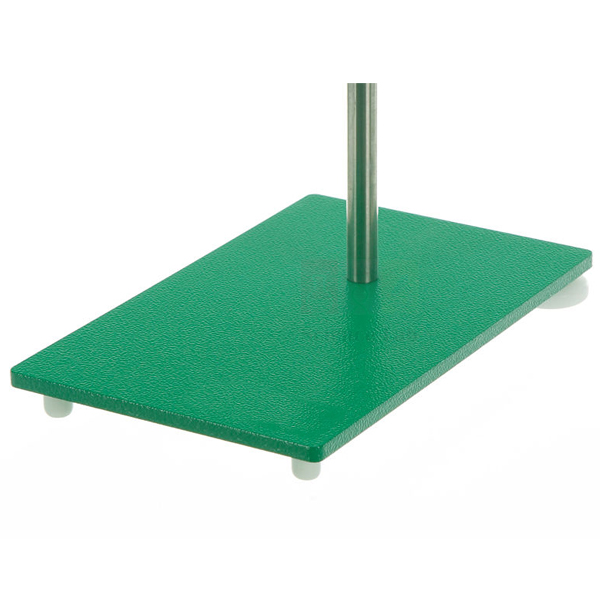
Stand Bases Steel Varnished
Stand Bases Steel Varnished (Product Code: SLE/LR/02) is a varnished steel laboratory stand base used as the weighted foot of a retort stand, holding a threaded support rod for clamps, rings and glassware in school and college labs. It is listed in nine sizes weighing from 0.8 kg to 5.0 kg, each with a thread for the rod and one adjustable foot. It is made by Jain Scientific Equipments Pvt Ltd (ScienceLab), an OEM manufacturer, at its own factory in Ambala, India.
Specifications
| Parameter | Detail |
|---|---|
| Material | Steel, varnished |
| Rod fitting | Thread |
| Levelling | 1 adjustable foot |
| Sizes (A length × B width × C height, as listed) and weight | 180 × 100 × 6 — 0.8 kg 210 × 130 × 6 — 1.3 kg 250 × 160 × 6 — 2.0 kg 300 × 150 × 6 — 2.2 kg 315 × 200 × 6 — 3.0 kg 210 × 130 × 8 — 1.8 kg 250 × 160 × 8 — 2.6 kg 315 × 200 × 8 — 4.0 kg 315 × 200 × 10 — 5.0 kg |
| Product code | SLE/LR/02 |
| Manufacturer | Jain Scientific Equipments Pvt Ltd (ScienceLab) — OEM |
| Country of origin | India (made in Ambala, Haryana) |
What Are Varnished Steel Stand Bases Used For?
Every retort stand needs a base heavy enough for the load it carries, and the wide spread of weights here lets a lab match the base to the job. A light 0.8 kg base is enough for a single test-tube clamp on a student bench, while the 4.0 kg and 5.0 kg bases give a tall distillation or reflux assembly, or two clamps reaching out sideways, a much lower risk of tipping. Several footprints are offered in more than one C height, so the same bench space can take a lighter or heavier base.
The varnish coats the steel, helping to protect its surface from moisture in everyday use. Wipe chemical spills off promptly, dry the base after cleaning, and keep it out of burner flames. Screw the support rod fully into the thread and turn the adjustable foot until the base sits without rocking. For schools furnishing chemistry lab equipment in India across many benches, these bases are a practical, bench-by-bench choice.
What to Specify When Ordering
- The size by its A × B × C figures; note that the 210 × 130, 250 × 160 and 315 × 200 footprints come in more than one C height.
- The weight needed for your heaviest set-up, from 0.8 kg up to 5.0 kg.
- How many bases of each size are needed per lab.
- Any support rods, bossheads or rings to be quoted alongside the bases.
OEM Manufacturer
These varnished bases are manufactured by Jain Scientific Equipments Private Limited, the company trading as ScienceLab, which is their OEM (original equipment manufacturer) and produces them at its own licensed factory at Saha, Ambala, Haryana, India. Schools fitting out several benches, colleges, dealers and importers receive quotations for mixed sizes straight from the maker.
Repeat orders in the same sizes, or a replacement adjustable foot, can be requested directly; just ask us. Read about the company on the ScienceLab profile.
Related Stand bases, Rods and Rings
Parts and alternatives that go with a varnished steel stand base:
- Rods For Stand Bases — the upright rod that screws into the base thread.
- Bosshead Malleable Cast Iron Chromium Plated — joins clamps and rings to the rod.
- Crucible Retort Ring — supports crucibles, funnels or gauze on the stand.
- Stand bases 18/10 Stainless Steel — a stainless option with antislide rubber for wet benches.
- Tripod Cast Iron Varnished — a three-legged cast iron base for the same rods.
Browse the Stand bases, Rods and Rings category for all supports and rings.
Frequently Asked Questions
What sizes are available for Stand Bases Steel Varnished?
Stand Bases Steel Varnished is listed in nine sizes (A × B × C): 180 × 100 × 6, 210 × 130 × 6 or 8, 250 × 160 × 6 or 8, 300 × 150 × 6, and 315 × 200 × 6, 8 or 10. Weights range from 0.8 to 5.0 kg.
Which Stand Bases Steel Varnished size is the heaviest?
The heaviest Stand Bases Steel Varnished option is 315 × 200 × 10 at 5.0 kg, followed by 315 × 200 × 8 at 4.0 kg. These heavier bases suit tall or top-heavy assemblies, such as distillation or reflux set-ups, where tipping is a concern.
Can Stand Bases Steel Varnished be levelled on an uneven bench?
Yes. Each Stand Bases Steel Varnished has 1 adjustable foot, which can be turned to stop the base rocking on an uneven bench, so the support rod stands vertical and clamped glassware stays properly aligned.
How should the varnished finish of Stand Bases Steel Varnished be cared for?
To keep the finish of Stand Bases Steel Varnished in good condition, wipe off chemical spills promptly, dry the base after cleaning, and avoid placing it in a burner flame or on a hot plate, where heat can damage the varnish.
How do Stand Bases Steel Varnished compare with the stainless steel bases?
Stand Bases Steel Varnished is made of varnished steel and offers nine sizes up to 5.0 kg, while the Stand bases 18/10 Stainless Steel comes in four sizes and adds antislide rubber protection. Stainless bases suit benches that are wet or cleaned very often.
Who manufactures Stand Bases Steel Varnished?
Stand Bases Steel Varnished is manufactured by Jain Scientific Equipments Pvt Ltd (ScienceLab), the OEM, at its own licensed factory at Saha, Ambala, Haryana, India. Quotations for single sizes or mixed sets come directly from the manufacturer.
Request a Quote
List the sizes and quantities you need on our contact page or add the item to the enquiry cart. The manufacturer will quote each size directly.
Last updated: 24 September 2026
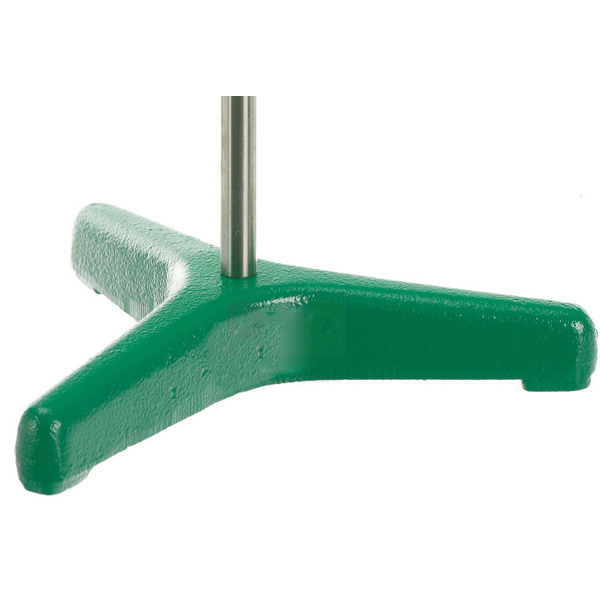
Tripod Cast Iron Varnished
Tripod Cast Iron Varnished (Product Code: SLE/LR/03) is a three-legged, varnished cast iron stand base with a thread that takes a support rod, used to build retort stands for clamps, rings and glassware in school, college and research labs. It is listed in two sizes, length 105 at 1.2 kg and length 145 at 2.0 kg, and the rod is ordered separately. It is made by Jain Scientific Equipments Pvt Ltd (ScienceLab), an OEM manufacturer, at its own factory in Ambala, India.
Specifications
| Parameter | Detail |
|---|---|
| Type | Tripod (three-legged) stand base |
| Material | Cast iron, varnished |
| Rod fitting | Thread; rod ordered separately |
| Sizes (A length, as listed) and weight | 105 — 1.2 kg 145 — 2.0 kg |
| Product code | SLE/LR/03 |
| Manufacturer | Jain Scientific Equipments Pvt Ltd (ScienceLab) — OEM |
| Country of origin | India (made in Ambala, Haryana) |
What Is the Cast Iron Tripod Base Used For?
A base that stands on three legs touches the bench at only three points, so it sits firmly without rocking even when the work surface is not perfectly flat. That makes this tripod a steady foundation for a retort stand: screw a support rod into the thread, fit bossheads and clamps, and hold flasks, funnels or condensers above the bench. The open space between the legs also leaves room to place a burner, beaker or small hot plate close beneath the rod.
Choose the 2.0 kg size for taller rods and heavier glassware, and the 1.2 kg size for compact set-ups on student benches. Keep the load above the legs rather than reaching far outside them, and tighten the rod fully before use. Anyone looking for a tripod stand for the lab in India should note that this is a rod base, not a burner tripod for gauze. Cast iron is strong under load but can crack if dropped, so lift it with both hands.
What to Specify When Ordering
- The size: length 105 (1.2 kg) or length 145 (2.0 kg).
- The support rods to go with it, since the rod is ordered separately.
- Any bossheads, clamps or rings for the complete stand.
- Quantity and delivery location.
OEM Manufacturer
ScienceLab, the trading name of Jain Scientific Equipments Private Limited, is the OEM (original equipment manufacturer) of this cast iron tripod and makes it at its own licensed factory in Saha, Ambala, Haryana, India. Since the tripod and the rods it needs are both offered by the same manufacturer, a lab can order a complete stand in one enquiry and receive the quotation from the source.
For repeat orders or advice on matching fittings, ask us directly. The ScienceLab profile has more about the company.
Related Stand bases, Rods and Rings
Parts needed to turn the tripod into a working stand, plus alternative bases:
- Rods For Stand Bases — the rod that screws into the tripod, ordered separately.
- Bosshead Malleable Cast Iron Chromium Plated — fixes clamps and rings to the rod.
- Crucible Retort Ring — holds a crucible, funnel or gauze on the stand.
- Stand Bases Steel Varnished — rectangular steel bases in nine sizes.
See every base and fitting in the Stand bases, Rods and Rings category.
Frequently Asked Questions
Is a rod included with the Tripod Cast Iron Varnished?
No. The rod is ordered separately for the Tripod Cast Iron Varnished. The tripod has a thread for the rod, so add Rods For Stand Bases to your enquiry and both items can be quoted together.
What sizes is the Tripod Cast Iron Varnished available in?
The Tripod Cast Iron Varnished is listed in two sizes by length (A): 105, weighing 1.2 kg, and 145, weighing 2.0 kg. The heavier size suits taller rods and larger loads; exact dimensions are confirmed with your quotation.
Why choose a tripod base like the Tripod Cast Iron Varnished?
A tripod base like the Tripod Cast Iron Varnished rests on three points, so it sits without rocking even on a bench that is not perfectly flat, and the space between its legs leaves room for a burner or vessel close to the rod.
Is the Tripod Cast Iron Varnished a burner tripod?
No. The Tripod Cast Iron Varnished is a stand base with a thread for a support rod, used to build retort stands. If you need a tripod that holds gauze over a burner, ask us through the contact page and we will suggest a suitable item.
How should the Tripod Cast Iron Varnished be looked after?
Keep the Tripod Cast Iron Varnished dry and wipe spills off the varnish promptly. Cast iron is strong under load but can crack if dropped on a hard floor, so lift it with both hands and store it on a low shelf.
Who manufactures the Tripod Cast Iron Varnished?
The Tripod Cast Iron Varnished is manufactured by Jain Scientific Equipments Pvt Ltd (ScienceLab), the OEM, at its own licensed factory at Saha, Ambala, Haryana, India. Quotations and repeat orders are handled by the manufacturer itself.
Request a Quote
Request a price for the Tripod Cast Iron Varnished, together with its rods, on our contact page or through the enquiry cart. The quotation comes straight from the manufacturer.
Last updated: 24 September 2026