- Physics Lab Equipment
- Chemistry Lab Equipment
- Biology Lab Equipment
- Anatomical Lab Equipment
- Learning
- Educational Lab Equipment
- Magnets
- Agriculture
- Astronomy
- Earth Science
- Geography Lab Equipment
- Safety Lab Coat
- Laboratory
- Meteorological
- Electricity & Magnetism
- Heat
- School Lab Equipment
- Lab Glassware
- Science Lab Equipment
- Tvet Lab Equipment
- Robotics Kits Supplier and Manufacturer for Schools India
- Math Lab Equipment Manufacturers and Exporters in Ambala
- STEM Kits Manufacturers and Supplier India
- Engineering Lab Equipment
- Hospital Lab Equipment
- Water, Sanitation & Hygiene Supplies
- Cold Chain, Solar & Communication Equipment
- Nutrition
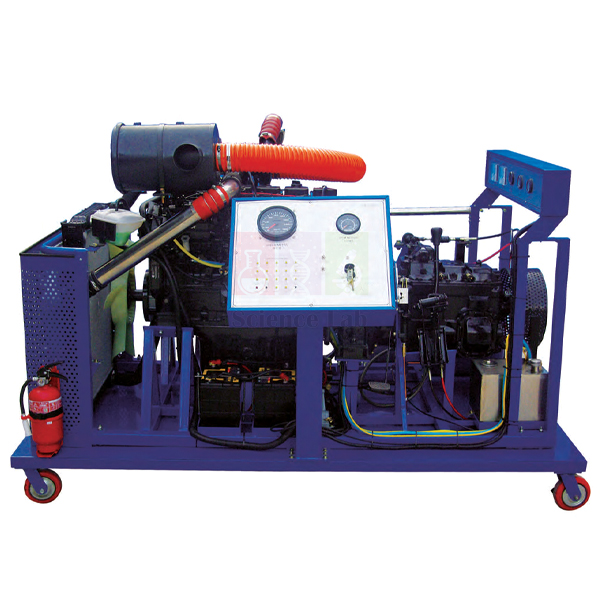
Large Yard Tractor Engine Fault Diagnosis System
The Large Yard Tractor Engine Fault Diagnosis System puts a Cummins diesel engine assembly of 400HP or more on a guarded, wheeled frame for heavy-engine fault finding. Trainees start it from a key switch, read oil pressure, voltage and current on the control panel, and test sensors and circuits at a 20-port diagnosis terminal while the instructor sets faults with the Auto Fault function.
Yard tractor engine fault system specifications
| Parameter | Detail |
|---|---|
| Engine | Cummins diesel engine assembly, 400HP or more |
| Fuel and electrical | Fuel filter, removable fuel tank, fuel pump, battery, generator |
| Cooling | Radiator on its own stand, electric fan cooling system, overflow tanks, antifreeze |
| Exhaust | Exhaust components such as an exhaust silencer |
| Controls | Ignition key switch, control box, accelerator lever |
| Control panel | Meter, oil pressure gauge, voltmeter, ampere meter, power switch, power lamp, 20-port diagnosis terminal |
| Diagnosis | Auto Fault function; connector-checking socket for inspecting sensors and actuators |
| Frame and protection | Stainless steel moulded guards, laser-processed protection panel, anti-vibration dampers, urethane wheels |
| Weight and size | Approx. 650 kg; approx. 2,400 × 1,500 × 1,500 mm |
| Product code | SLE/ATE/24 |
| Minimum order | 10 units |
| Dispatch | Usually within 7 to 10 working days |
| Manufacturer | ScienceLab (Jain Scientific Equipments Pvt Ltd), Ambala, India |
Heavy diesel service tasks on the yard tractor engine
Walk-round and first start. Check the oil, the coolant in the overflow tanks and the fuel, and look over the belts and guards. Start from the key switch and watch the oil pressure gauge rise, then log the warm idle readings of oil pressure, voltage and current as the baseline for later faults.
Charging and maneuver circuits. Trainees compare the panel voltmeter and ampere meter with their own readings at the battery and generator, taken with a digital multimeter. They then measure voltage and current in the maneuver circuit and explain any difference between panel and meter.
Sensor and actuator checks. Using the connector-checking socket and the 20-port diagnosis terminal, students measure each sensor and actuator circuit with an advanced digital multimeter. The instructor then sets a fault with the Auto Fault function, and each trainee records the symptom, the circuit tested and the reading that located it.
Stepping up to a heavy engine. Trainees who began on the smaller diesel engine fault diagnosis trainer repeat the fuel pump operation test and oil pressure inspection here on a far larger engine. The drive beyond the engine is then followed on the heavy duty vehicles differential gear model.
Frequently Asked Questions About the Large Yard Tractor Engine Fault Diagnosis System
What should trainees check when the oil pressure gauge reads low?
Check the oil level first, and look or smell for fuel or coolant in the oil, because diluted oil loses pressure. Then check the oil filter, the pickup screen and the pump, and finally bearing wear. Confirm a low reading with a separate test gauge before condemning the engine, and stop it if pressure stays low.
Why is the radiator cap pressure-tested?
The cap keeps the cooling system under pressure, which raises the boiling point of the coolant. A weak seal or spring lets the coolant boil early and push out to the overflow tanks. Test the cap and the radiator only on a cold engine, using a cooling system pressure tester and the figures in the service manual.
How is belt tension measured, and what goes wrong if it is off?
Press the belt at the middle of its longest run and measure the deflection, or use a belt tension gauge, and compare the result with the service manual. A loose belt slips, so the generator undercharges and any belt-driven pump slows down. An overtight belt wears the pulley bearings.
What should the voltmeter and ampere meter show during a charging check?
With the engine off, the voltmeter shows battery voltage at rest, and the reading dips during cranking. Once the engine runs, the generator should lift the voltage and the ampere meter should show charge, falling back as the battery recovers. No charge at all points to the belt, the wiring or the generator.
How is a compression test done on a large diesel?
Warm the engine, stop it and disable the fuel supply so that it cannot start. Fit a diesel compression gauge in place of an injector, crank the engine for a few turns and record the highest reading. Repeat on each cylinder and compare the results with each other and with the service manual figure.
What is the 20-port diagnosis terminal for?
It brings the sensor, actuator and circuit connections of the engine to one panel, so trainees can measure them with a meter instead of back-probing connectors on a hot engine. With the connector-checking socket, the class can test each circuit in turn while the instructor sets faults through the Auto Fault function.
Heavy vehicle and diesel trainers, with a test meter
- Diesel Engine Fault Diagnosis Training Equipment Auto Fault
- Heavy Duty Vehicles Differential Gear Model
- Trailer Air Brake Training Equipment
- Trailer Type Air Brake System Training Equipment
- 4 Stroke Diesel Engine
- Advanced Digital Multimeter
To request a quotation, send the product name, code and quantity through our contact page or add the item to your enquiry cart.
Last updated: 20 November 2026
