- Physics Lab Equipment
- Chemistry Lab Equipment
- Biology Lab Equipment
- Anatomical Lab Equipment
- Learning
- Educational Lab Equipment
- Magnets
- Agriculture
- Astronomy
- Earth Science
- Geography Lab Equipment
- Safety Lab Coat
- Laboratory
- Meteorological
- Electricity & Magnetism
- Heat
- School Lab Equipment
- Lab Glassware
- Science Lab Equipment
- Tvet Lab Equipment
- Robotics Kits Supplier and Manufacturer for Schools India
- Math Lab Equipment Manufacturers and Exporters in Ambala
- STEM Kits Manufacturers and Supplier India
- Engineering Lab Equipment
- Hospital Lab Equipment
- Water, Sanitation & Hygiene Supplies
- Cold Chain, Solar & Communication Equipment
- Nutrition
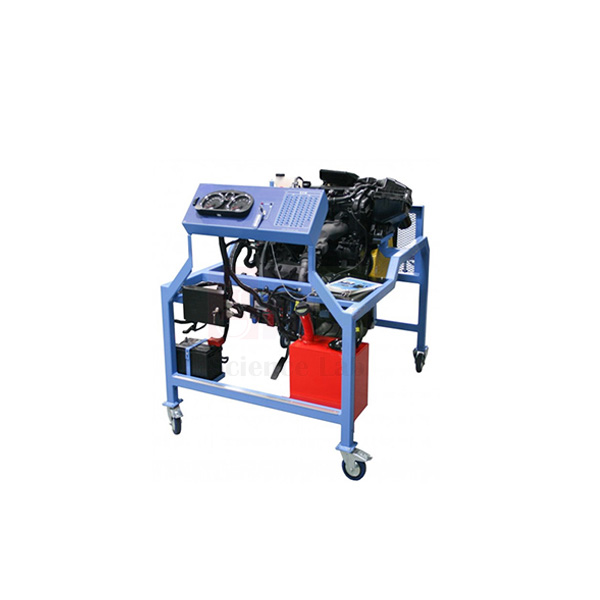
Four Stroke Four Cylinder Petrol Engine Test Bench
The Four Stroke Four Cylinder Petrol Engine Test Bench couples a 1054 cc, water-cooled MPFI petrol engine to a brake load unit for performance testing. Students measure torque, power, fuel consumption and overall efficiency on an engine rated 63 BHP at 5500 rpm and 89 Nm at 3000 rpm. The rig stands on a welded frame on rollers, with perforated guards over hot and rotating parts.
Petrol engine test bench specifications
| Parameter | Detail |
|---|---|
| Engine | Branded four-cylinder petrol engine, MPFI version; four-stroke, spark ignition |
| Capacity and bore × stroke | 1054 cc; 66 mm × 77 mm |
| Maximum power | 63 BHP at 5500 rpm |
| Maximum torque | 89 Nm at 3000 rpm |
| Cooling and starting | Water-cooled, closed cooling water circuit; self-start |
| Fuel and engine oil | Petrol; SAE 5W-30 engine oil |
| Electrical | Battery 12 V, 45 Ah; alternator 12 V, 45 A; mains supply 230 V, 50 Hz, single phase |
| Load connection | Engine fastened to the load unit; brake driven through a rotationally elastic coupling with jointed shaft |
| Frame and guarding | Solid welded frame on rollers with the engine flexibly mounted; perforated plates over hot surfaces and rotating parts |
| Product code | SLE/MCE/53 |
| Minimum order | 10 units |
| Dispatch | Usually within 7 to 10 working days |
| Manufacturer | ScienceLab (Jain Scientific Equipments Pvt Ltd), Ambala, India |
Performance tests on the petrol engine bench
Full-throttle torque curve. Warm the engine, open the throttle fully and raise the brake load in steps so that the speed falls from the top of the range. At each steady speed, record torque and rpm, work out brake power and plot both against speed. Students then compare their peaks with the rated 89 Nm and 63 BHP.
Fuel consumption at part load. Hold one speed and add load in steps. At each step, time the engine as it draws a marked volume from the manual volumetric fuel gauge, using a digital stopwatch. Convert the volume to mass with the fuel density, then plot specific fuel consumption and brake thermal efficiency against brake power.
Heat balance. For this extension the bench is paired with an exhaust gas calorimeter, which passes the hot exhaust through a measured flow of water. Students divide the fuel energy into brake power, heat carried off by the exhaust and the remainder lost to cooling, friction and radiation, and set the figures out as a heat balance sheet.
Before the running tests. The cut section model of a four stroke petrol engine shows the pistons, valves and crank that stay hidden on the bench. The engine management system (MPI) trainer then explains how an MPFI engine meters and times the fuel at each injector.
Frequently Asked Questions About the Four Stroke Four Cylinder Petrol Engine Test Bench
How is brake power worked out from the torque reading?
Brake power is torque multiplied by angular speed. Change the speed from rpm to radians per second by multiplying by two pi and dividing by sixty, then multiply by the torque in newton metres to get watts. Take readings only after speed and load have settled.
Why does the engine reach peak torque well below its peak power speed?
Torque follows how well the cylinders fill with air and fuel, which peaks in the middle of the speed range, here 3000 rpm. Power is torque times speed, so it keeps rising past the torque peak until falling torque outweighs the extra speed. This engine is rated to reach peak power at 5500 rpm.
How is specific fuel consumption found on this bench?
Time how long the engine takes to use a known volume of petrol, convert it to a mass flow with the fuel density, and divide by brake power. Results are usually given in grams per kilowatt hour. Repeat each timing and average the readings, because one short run is easily misread.
What should be checked before a performance run?
Check the oil level with SAE 5W-30 engine oil, top up the closed cooling circuit and confirm that the battery is charged. Make sure the perforated guards cover the coupling and hot parts and that the exhaust is led to extraction. Warm the engine up before any reading is taken.
Can the bench be used to draw up a heat balance?
Yes, with added instruments. Brake power comes from the bench readings, and fuel input from timing a known volume of fuel, for example on a manual volumetric fuel gauge. Heat in the exhaust needs an exhaust gas calorimeter, which can be added to the bench for heat-balance work. The rest, mostly heat to the cooling water, friction and radiation, is then found by difference.
Why must the engine run in a ventilated bay?
Petrol exhaust contains carbon monoxide, which has no smell and builds up quickly indoors. Roll the bench to a well-ventilated bay or connect the exhaust to an extraction point before starting. Keep the extraction running through full-load runs, when exhaust flow and heat are at their highest.
Engine test bench companions and engine trainers
- Exhaust Gas Calorimeter
- Manual Volumetric Fuel Gauge
- Engine management system (MPI)
- Cut Section Model Of Four Stroke Petrol Engine
- 4 Stroke Petrol Engine
- Motor Cycle Dynamometer Test Bench
To request a quotation, send the product name, code and quantity through our contact page or add the item to your enquiry cart.
Last updated: 15 November 2026
