- Physics Lab Equipment
- Chemistry Lab Equipment
- Biology Lab Equipment
- Anatomical Lab Equipment
- Learning
- Educational Lab Equipment
- Magnets
- Agriculture
- Astronomy
- Earth Science
- Geography Lab Equipment
- Safety Lab Coat
- Laboratory
- Meteorological
- Electricity & Magnetism
- Heat
- School Lab Equipment
- Lab Glassware
- Science Lab Equipment
- Tvet Lab Equipment
- Robotics Kits Supplier and Manufacturer for Schools India
- Math Lab Equipment Manufacturers and Exporters in Ambala
- STEM Kits Manufacturers and Supplier India
- Engineering Lab Equipment
- Hospital Lab Equipment
- Water, Sanitation & Hygiene Supplies
- Cold Chain, Solar & Communication Equipment
- Nutrition
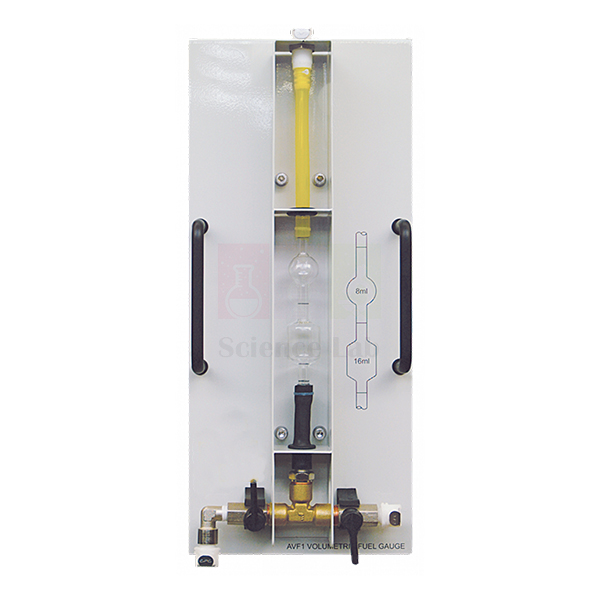
Manual Volumetric Fuel Gauge
The Manual Volumetric Fuel Gauge measures how much fuel a petrol or diesel engine uses during bench tests. A valve shuts off the tank so that the engine draws only from a precision-calibrated two-bulb pipette, and students time how long it takes to use a set volume. The gauge mounts on the instrumentation frame, with self-sealing couplings between tank and engine.
Volumetric fuel gauge specifications
| Parameter | Detail |
|---|---|
| Measuring element | Precision-calibrated two-bulb pipette |
| Flow control | Control valves, including a valve that cuts off the tank supply so the engine draws fuel from the pipette only |
| Filling | Fuel enters the pipette from the fuel tank |
| Installation | Mounts on the instrumentation frame of the engine test set, between the fuel tank and the engine under test |
| Couplings | Self-sealing, for quick connection and disconnection with minimum loss or spillage of fuel |
| Suitable fuels | Petrol or diesel |
| Measurement method | Time taken to consume a set volume of fuel, from which the fuel flow rate is calculated |
| Product code | SLE/EE/01 |
| Minimum order | 10 units |
| Dispatch | Usually within 7 to 10 working days |
| Manufacturer | ScienceLab (Jain Scientific Equipments Pvt Ltd), Ambala, India |
Fuel consumption practicals with the pipette gauge
Taking one reading. With the engine steady, close the tank supply valve so that the engine draws from the pipette alone. Start a digital stopwatch as the meniscus passes the upper mark and stop it at the lower mark. Reopen the valve so the pipette refills before the next reading.
Load test on a petrol engine. Fit the gauge to the test set of the 4 stroke petrol engine and take three timings at each load step. Average them, convert to mass flow and plot specific fuel consumption and brake thermal efficiency against brake power.
Diesel against petrol. Move the gauge to the 4 stroke diesel engine through its self-sealing couplings, draining the pipette when the fuel changes. Repeat the load steps and compare the fuel each engine burns for the same brake power.
Energy balance. Use the fuel mass flow and the calorific value of the fuel to find the energy supplied. With the heat leaving in the exhaust measured on an exhaust gas calorimeter, students account for where that energy goes.
Frequently Asked Questions About the Manual Volumetric Fuel Gauge
How is the fuel flow rate worked out from a pipette reading?
Divide the marked volume by the time taken to use it to get the volumetric flow. Multiply by the fuel density to get mass flow, which is what the efficiency and specific fuel consumption formulas need. Keep the units consistent, for example millilitres, seconds and grams per millilitre, and convert at the end.
Why do air bubbles spoil the reading?
A bubble takes up space in the pipette, so the level falls faster than the fuel actually used and the meniscus can jump past a mark. Refill slowly, let any bubbles rise and clear before timing, and bleed air from the line if they keep appearing. Take several timings and discard any that stand apart.
Where should the return fuel from a diesel engine go during a test?
Leak-off and pump return fuel has already passed through the gauge. If it flows back to the tank, the pipette counts it as fuel burnt and the consumption reads too high. Lead the return into the line after the gauge, so that only the fuel the engine actually burns leaves the pipette.
How long should each timing be?
Long enough that a small error in starting or stopping the watch hardly matters. A timing of only a few seconds can be out by a large share through reaction time alone. Wait until speed and load are steady, and at high fuel rates time a larger marked volume if the pipette allows it.
What are the usual sources of error with this gauge?
Reading the meniscus from above or below the mark, starting or stopping the watch late, speed or load drifting during the timing, air bubbles, and a pipette not refilled to the top mark. Fuel temperature also changes the density, so note it when converting volume to mass.
How should the gauge be looked after between practicals?
Close the valves at the end of a session and disconnect at the self-sealing couplings to keep spills small. Drain the pipette when changing between petrol and diesel. Wipe up spilt fuel at once, keep flames and sparks away, and store the gauge where the pipette cannot be knocked.
Engines and instruments for fuel consumption and heat balance tests
- 4 Stroke Petrol Engine
- 4 Stroke Diesel Engine
- Exhaust Gas Calori meter
- Stopwatch, Digital
- Four Stroke Four Cylinder Petrol Engine Test Bench
To request a quotation, send the product name, code and quantity through our contact page or add the item to your enquiry cart.
Last updated: 14 November 2026
