- Physics Lab Equipment
- Chemistry Lab Equipment
- Biology Lab Equipment
- Anatomical Lab Equipment
- Learning
- Educational Lab Equipment
- Magnets
- Agriculture
- Astronomy
- Earth Science
- Geography Lab Equipment
- Safety Lab Coat
- Laboratory
- Meteorological
- Electricity & Magnetism
- Heat
- School Lab Equipment
- Lab Glassware
- Science Lab Equipment
- Tvet Lab Equipment
- Robotics Kits Supplier and Manufacturer for Schools India
- Math Lab Equipment Manufacturers and Exporters in Ambala
- STEM Kits Manufacturers and Supplier India
- Engineering Lab Equipment
- Hospital Lab Equipment
- Water, Sanitation & Hygiene Supplies
- Cold Chain, Solar & Communication Equipment
- Nutrition
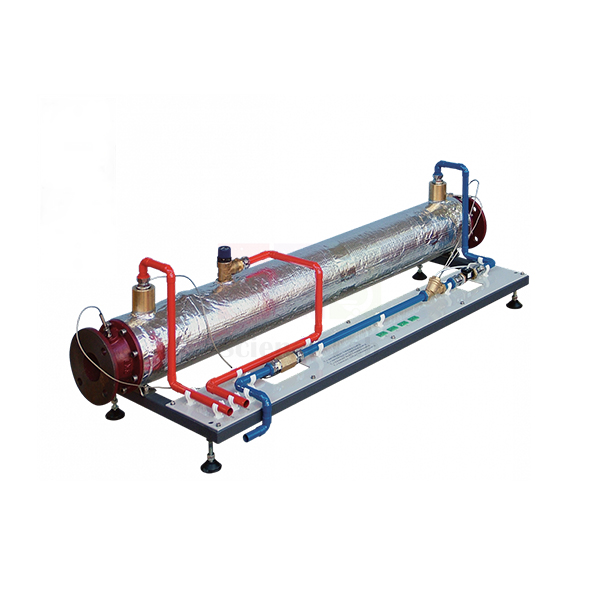
Exhaust Gas Calorimeter for IC Engine Tests
Exhaust Gas Calorimeter for IC Engine Tests is a gas-to-water shell and multi-tube heat exchanger that measures the heat carried away in the exhaust of a test engine. Exhaust runs through the tubes inside a jacket of flowing cooling water, and thermocouples feed a four-channel digital display that also shows the water flow for the heat balance.
Shell and multi-tube exhaust calorimeter specifications
| Parameter | Detail |
|---|---|
| Heat exchanger | Gas-to-water shell and multi-tube heat exchanger on a sturdy base plate |
| Gas path | Exhaust gases from the test engine on the test set flow through the tubes |
| Cooling water | Jacket of constantly flowing cooling water around the tubes |
| Flow measurement | Turbine flow meter for the cooling-water flow rate |
| Water flow control | Hand-operated control valve mounted on the control console of the test set |
| Temperature sensing | Thermocouples for gas and water temperatures at inlet and outlet |
| Display | Digital four-channel temperature and flow display unit on the instrumentation rail of the test set console frame |
| Pressure-relief valve | Fitted for the case of insufficient cooling water flow |
| Product code | SLE/EE/03 |
| Minimum order | 10 units |
| Dispatch | Usually within 7 to 10 working days |
| Manufacturer | ScienceLab (Jain Scientific Equipments Pvt Ltd), Ambala, India |
Heat balance practicals with the shell and tube calorimeter
Full heat balance at one load. Run the test engine at a steady load and set the cooling water with the console valve. Measure fuel use with a manual volumetric fuel gauge, then log brake power, the engine jacket water heat and the calorimeter's four channels and flow. These figures fill one column of the heat balance sheet.
Load sweep. Repeat the readings at several loads on the 4 stroke diesel engine or the 4 stroke petrol engine. Plot exhaust heat and brake power against load, and compare how the exhaust share of the fuel energy changes from light load to full load.
Water flow trial. Hold the engine at one load and change the water flow in steps with the hand valve. Watch the water temperature rise and the gas outlet temperature, and discuss why a very low flow risks boiling while a very high flow gives a rise too small to read well.
Exchanger principle first. Before the engine test, students meet the shell and tube idea with hot and cold water on the shell and tube heat exchanger trainer, where the flows are easier to vary.
Frequently Asked Questions About the Exhaust Gas Calorimeter for IC Engine Tests
How is exhaust heat worked out from the calorimeter readings?
The heat taken up by the water equals its mass flow times its specific heat times its temperature rise. In steady running this matches the heat given up by the gas, its mass flow times its specific heat times its temperature fall. Students use this balance to check the exhaust gas flow or its specific heat, then work out the exhaust share of the heat balance.
Why wait until all four channels are steady before recording?
The tubes, shell and water jacket store heat. Until they settle, part of the exhaust heat goes into warming metal rather than the water, so the calculated value comes out low. Keep the engine load and water flow fixed and log the four channels until they stop drifting.
Does it matter which way the water flows relative to the gas?
Yes. When the two streams run in opposite directions, a temperature difference stays along the whole tube length, so more heat passes for the same exchanger size and the water can leave hotter than the gas outlet. Connect the water inlet and outlet as the supplied operating instructions describe.
What should be checked if a thermocouple reads lower than expected?
Check that the thermocouple and any extension leads are the correct type, that the junctions are clean and tight, and that the probe tip sits in the gas stream rather than against a wall. Swapping two sensors between channels shows whether the error follows the sensor or the display channel.
What does the pressure-relief valve on this calorimeter deal with?
If too little cooling water flows, water in the jacket can boil and pressure builds up. The relief valve lets that pressure out. It is a backstop, not a control: open the water flow with the console valve before exhaust reaches the exchanger, and keep it flowing until the gas has cooled.
How does engine load change the heat carried away by the exhaust?
At higher load the engine burns more fuel, and exhaust temperature and mass flow both rise, so the exhaust carries more heat. Its share of the fuel energy changes less than its absolute value. Readings at several loads let students plot both and explain the trend.
Engine heat balance and heat exchanger equipment
- 4 Stroke Petrol Engine
- 4 Stroke Diesel Engine
- Manual Volumetric Fuel Gauge
- Four Stroke Four Cylinder Petrol Engine Test Bench
- Shell and Tube Heat Exchanger
- Exhaust Gas Calorimeter
To request a quotation, send the product name, code and quantity through our contact page or add the item to your enquiry cart.
Last updated: 15 November 2026
