- Physics Lab Equipment
- Chemistry Lab Equipment
- Biology Lab Equipment
- Anatomical Lab Equipment
- Learning
- Educational Lab Equipment
- Magnets
- Agriculture
- Astronomy
- Earth Science
- Geography Lab Equipment
- Safety Lab Coat
- Laboratory
- Meteorological
- Electricity & Magnetism
- Heat
- School Lab Equipment
- Lab Glassware
- Science Lab Equipment
- Tvet Lab Equipment
- Robotics Kits Supplier and Manufacturer for Schools India
- Math Lab Equipment Manufacturers and Exporters in Ambala
- STEM Kits Manufacturers and Supplier India
- Engineering Lab Equipment
- Hospital Lab Equipment
- Water, Sanitation & Hygiene Supplies
- Cold Chain, Solar & Communication Equipment
- Nutrition
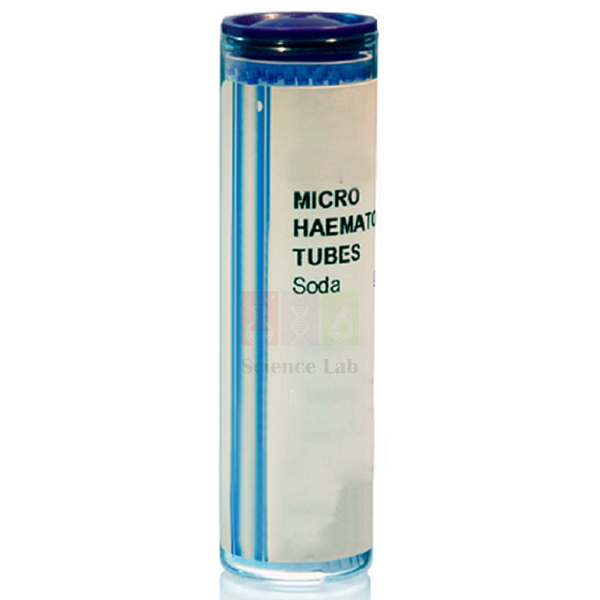
EDTA Capillary Tube
EDTA Capillary Tube (Product Code: SLE/CL/43) is a 75 mm capillary tube with an internal EDTA coating, designed for the collection, transportation and processing of capillary blood from a finger or heel prick. The EDTA stops the small sample from clotting, so it can be carried to the bench and centrifuged or dispensed for testing. Tubes are packed in vials of 100 and are used by haematology benches, point-of-care testing sites and training laboratories. They are supplied by Jain Scientific Equipments Pvt Ltd (ScienceLab), Ambala, a lab consumables supplier in India for clinical sampling items.
Specifications
| Parameter | Detail |
|---|---|
| Type | Capillary tube, EDTA coated |
| EDTA coating | 1.65 mg/ml (listed as 1,65 mg/ml) |
| Diameter | 1.15 mm (listed as 1,15 mm) |
| Length | 75 mm |
| Packing | Vials of 100 tubes |
| Application | Collection, transportation and processing of capillary blood |
Typical Use
After the skin is punctured with a lancet and the first drop wiped away, the tip of the tube is touched to the next drop and blood rises by capillary action. Hold the tube level or angled slightly downward and stop before the end to avoid air gaps. For packed cell volume work, one end is closed with sealant, the tube is placed in a haematocrit centrifuge, and the ratio of packed cells to total column is read afterwards; tubes can also be used to move a measured drop onto slides or test devices.
Roll the filled tube gently between the fingers to spread the EDTA through the blood, and process the sample promptly. Nursing and medical laboratory technology programmes buying lab equipment for college teaching in India often use EDTA capillary tubes to show students how small-volume sampling differs from venous collection. Keep vials closed when not in use so the tubes stay clean.
Supplier
These capillary tubes are supplied by Jain Scientific Equipments Private Limited, a company in Ambala, Haryana, that trades as ScienceLab and keeps a range of capillary sampling consumables for laboratories and health programmes. For vendor registration, its GSTIN is 06AAECJ8618A1ZT and its Legal Entity Identifier (LEI) is 3358004HRD1JIVXKYX49. The company profile has further information.
Related Clinical Laboratory Items
Items needed for the rest of the capillary sampling routine:
- Safety Lancet Disposable 2.4 mm — makes the finger or heel puncture
- Capillary Tube Sealant — closes one end of the tube before spinning
- Haematocrit Centrifuge — spins sealed capillary tubes for packed cell volume readings
- Capillary Heparin Tube — the heparin-coated alternative when your method calls for heparin
- Sharp Container Leak Proof Plastic — for used lancets and any broken tubes
Explore the Clinical Laboratory category for more capillary and venous sampling supplies.
Frequently Asked Questions
How many tubes are in a vial?
Each vial holds 100 tubes, as listed. For carton sizes, please contact us.
What are the tube dimensions?
The tubes are 75 mm long with a diameter of 1.15 mm. The original listing writes these values with a decimal comma (1,15 mm).
How much EDTA is in the coating?
The listing states EDTA coated 1.65 mg/ml (written 1,65 mg/ml). Ask us if your method requires a specific EDTA salt.
Are the tubes glass or plastic?
The material is not stated in our listing. Please confirm with us before ordering if your protocol depends on it.
When should I choose EDTA rather than heparin capillary tubes?
EDTA is usual for haematology tests on capillary blood, while heparin is often used where the method specifies it. Follow the requirements of your test method.
Do you supply capillary tubes for screening programmes?
Yes. Send the number of vials and delivery location, and we will quote for supply in India or international markets.
Request a Quote
Request pricing for EDTA Capillary Tube through the contact form, or add the vials to your enquiry cart with lancets and sealant for one combined quotation.
Last updated: 24 September 2026
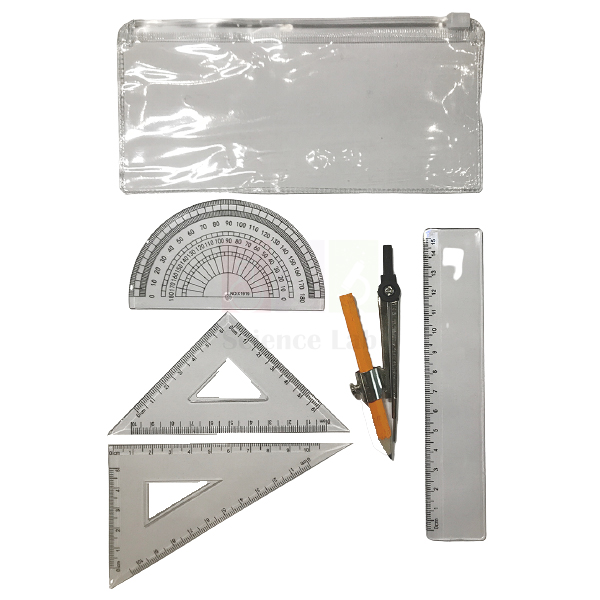
Student's Geometry Set/BOX-20
Student’s Geometry Set/BOX-20 (Product Code: SLE/CS/07) is a 7-item student geometry set — protractor, metal compass with pencil, HB pencil, two set squares and a ruler — packed in a closable, tear-resistant plastic wallet. It gives each pupil the instruments needed to measure angles, draw circles and construct triangles and parallel lines in maths lessons and exams. The set is supplied by Jain Scientific Equipments Pvt Ltd (ScienceLab), Ambala, India, to schools and education programmes that combine student supplies with school lab equipment bulk supply.
Specifications
| Parameter | Detail |
|---|---|
| Items per set | 7 (6 instruments plus the wallet) |
| Protractor | Robust, hard-wearing clear plastic; 10 cm base length; 2 mm thick |
| Compass | Metal, with sturdy and durable screw ring and pencil (pencil length approx. 85 mm); total length approx. 13 cm end to end |
| Pencil | Black lead, HB grade, core min. 2 mm and max. 3 mm, quality wood casing |
| Set square 1 | Robust, hard-wearing clear plastic; angles 45, 45 and 90 degrees |
| Set square 2 | Robust, hard-wearing clear plastic; angles 30, 60 and 90 degrees |
| Ruler | Robust, hard-wearing clear plastic; approx. 16 cm long with 15 cm calibrated length; 2 mm thick |
| Wallet | Sturdy plastic, resistant to tearing, can be closed |
| Estimated weight | 1.417 kg (as listed for this item) |
| Estimated volume | 6.017 cdm (as listed for this item) |
Typical Use
From the middle primary years onwards, pupils use the protractor to measure and draw angles, the compass to draw circles and arcs for bisectors and triangle constructions, and the two set squares to draw perpendicular and parallel lines or standard angles such as 30, 45 and 60 degrees. The clear plastic lets them see the line beneath the instrument, and the 15 cm calibrated ruler handles most exercise-book diagrams. Keeping everything in the closable wallet means nothing goes missing between lessons.
Schools that buy mathematics lab kits in India for demonstration often issue these sets so each pupil can repeat the teacher’s board construction at their desk. Remind students to keep the compass point capped or inside the wallet, sharpen the pencil to a fine point for accurate constructions, and check that the compass screw ring is firm before drawing so the radius does not slip.
Supplier
Jain Scientific Equipments Private Limited supplies this geometry set under its ScienceLab trading name from Ambala, Haryana, alongside the larger blackboard instruments teachers use for the same lessons. The company profile has more about ScienceLab.
Related Classroom Student Products
Teacher-size instruments and kits used in the same geometry lessons:
- Set Square, Blackboard,45-45-90 degrees — the board-size version of the 45-degree set square.
- Set Square, Blackboard, 30-60-90 degrees — the board-size 30-60-90 set square.
- Protractor, Plastic, for Blackboard, 44cm — lets the teacher demonstrate angle measurement to the class.
- Compass, Plastic, for Blackboard, 45cm — for drawing circles and arcs on the board.
- Student Kit Grade 5-8 — a complete student kit that includes this geometry set.
See the full Classroom Student category.
Frequently Asked Questions
What is in each geometry set?
A protractor, a metal compass with pencil, an HB pencil, a 45-45-90 set square, a 30-60-90 set square and a ruler, packed in a closable plastic wallet — 7 items in all.
How big are the protractor and ruler?
The protractor has a 10 cm base; the ruler is approx. 16 cm long with a 15 cm calibrated scale. Both are 2 mm thick clear plastic.
What pencil does the compass take?
The compass comes with a pencil of approx. 85 mm and holds it with a screw ring, so a standard wooden pencil can be fitted as a replacement.
What does BOX-20 in the name mean?
It is the box pack unit used for this item. Please confirm the number of sets per box when you request a quotation.
Is the set suitable for exams?
It contains the standard instruments used in school geometry. Check your examination board’s rules on permitted equipment.
Can you quote for large school or export orders?
Yes. Send the number of sets and delivery location through the contact page; ScienceLab supplies India and international markets.
Request a Quote
To order Student’s Geometry Set/BOX-20, use the contact page or add it to the enquiry cart together with blackboard instruments.
Last updated: 24 September 2026
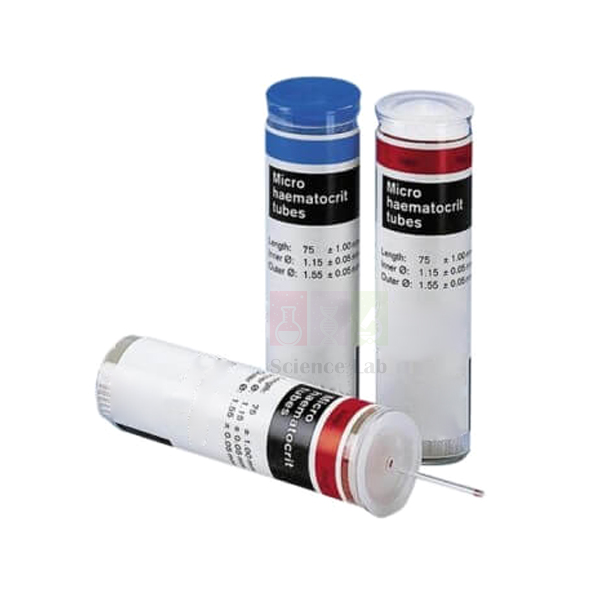
Capillary Heparin Tube
Capillary Heparin Tube (Product Code: SLE/CL/44) is a heparin-coated glass capillary tube, 75mm long with an inner diameter of 1.15mm, used to draw small volumes of blood for several laboratory tests. The heparin lining keeps the sample fluid after a skin puncture, and the glass bore gives a clear view of the blood column, which is useful for packed cell volume readings. The tubes come packed in glass boxes of 100 each and are supplied by Jain Scientific Equipments Pvt Ltd (ScienceLab), Ambala, a lab glassware supplier in India for hospital, clinic and teaching laboratories.
Specifications
| Parameter | Detail |
|---|---|
| Type | Capillary tube, heparin coated |
| Material | Glass |
| Inner diameter | 1.15mm (listed as 1,15mm) |
| Length | 75mm |
| Packing | Glass boxes of 100 tubes each |
| Application | Multiple tests on capillary blood |
Typical Use
The classic application is the micro-haematocrit test. Blood from a finger prick is allowed to run into the tube until it is roughly three-quarters full, the dry end is pushed into sealant, and the tube is placed in a haematocrit centrifuge with the sealed end facing outward. After spinning, the height of the red cell column is compared with the total column on a reading chart. Heparinised capillaries are also used to collect small samples for other methods that specify heparin.
Because the tubes are glass, wear gloves, press them into sealant with a gentle twisting motion rather than force, and discard any cracked tube. Put used or broken tubes straight into a sharps container. Any laboratory centrifuge in India intended for this test should have a capillary rotor, as standard tube buckets cannot hold these tubes.
Supplier
ScienceLab, the trading name of Jain Scientific Equipments Private Limited in Ambala, Haryana, supplies these heparin capillary tubes together with the sealants, lancets and centrifuges that go with them. To learn more about the company, visit the ScienceLab profile.
Related Clinical Laboratory Items
What you will typically need for a complete micro-haematocrit setup:
- Lancet 2.4 mm Disposable — for the skin puncture that supplies the blood drop
- Capillary Tube Sealant — seals the tube end so blood stays in during spinning
- Hematocrit Centrifuge — a centrifuge with a rotor made for capillary tubes
- EDTA Capillary Tube — an EDTA-coated option when your method specifies EDTA
- Gloves Exam Latex Without Powder — hand protection when handling blood and glass
The full Clinical Laboratory listing includes further capillary sampling products.
Frequently Asked Questions
What material are the tubes made from?
Glass, with a heparin coating on the inside.
What size are they?
Length 75mm and inner diameter 1.15mm. The source listing uses a decimal comma, so the diameter appears there as 1,15mm.
How are the tubes packed?
In glass boxes containing 100 tubes each. Ask us about carton quantities for larger orders.
Which heparin and what amount is used?
The heparin type and quantity are not stated in our listing. Please contact us if your test method specifies them.
Can these tubes be reused?
No. Once filled with blood and sealed or spun, they should be discarded as sharps waste.
What details help you prepare a quotation?
The number of boxes, the delivery address and whether you also need sealant, lancets or a centrifuge. We quote for India and international markets.
Request a Quote
For a price on Capillary Heparin Tube, reach us via the contact page or add it to the enquiry cart and submit your full list.
Last updated: 24 September 2026
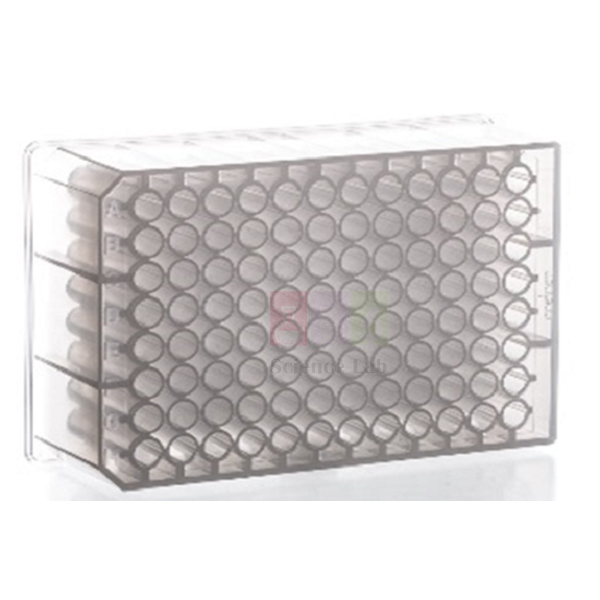
PCR Microplate
PCR Microplate (Product Code: SLE/CL/45) is a 96-well polypropylene plate for running PCR cycles, with slightly opaque white U-bottom wells that are alphanumerically identified. Its thin walls support efficient heat transfer between the thermal block and the reaction, and slightly raised well edges help the plate seal properly. Each plate is individually wrapped, sterile and RNase and DNase free, and is used in regional hospital laboratories, reference centres and molecular biology teaching labs. It forms part of the PCR equipment in India supplied by Jain Scientific Equipments Pvt Ltd (ScienceLab), Ambala.
Specifications
| Parameter | Detail |
|---|---|
| Type | Micro well plate for PCR cycles |
| Material | Polypropylene, autoclavable |
| Number of wells | 96, alphanumerically identified |
| Well colour | Slightly opaque white |
| Well shape | U-bottom |
| Well volume | Accommodates the content of 0.2ml PCR tubes |
| Wall design | Thin walls for optimal thermal transfer |
| Sealing | Slightly raised well edges facilitate plate sealing |
| Condition | Individually wrapped, sterile, RNase and DNase free |
| Compatibility | Stated to fit standard thermo-cyclers, real-time PCR systems and DNA sequencers |
Typical Use
The plate lets a laboratory run up to 96 reactions in one thermal cycler run, for example screening many patient samples, running controls and standards alongside unknowns, or comparing primer conditions. Reactions are usually set up with a multichannel pipette drawing master mix from a reservoir, filling one column at a time; the letter-and-number well labels (rows A to H, columns 1 to 12) make it easy to keep to a plate map. White wells are commonly chosen for real-time PCR because they reflect fluorescence back toward the detector.
Open the wrapper only at the clean bench, wear gloves and use filter tips to keep the plate free of contaminating nucleic acids. Seal the plate evenly across the raised rims before cycling so no well evaporates. Research groups and colleges building lab equipment for research in India often pair this plate with a multichannel pipette to cut set-up time for class practicals and diagnostic runs.
Supplier
This microplate is supplied by Jain Scientific Equipments Private Limited, which trades as ScienceLab from Ambala, Haryana, and supports molecular and clinical laboratories with plasticware as well as its own apparatus. Company background is available on the ScienceLab profile.
Related Laboratory Equipment
Instruments and consumables that complete a plate-based PCR workflow:
- Polymerase Chain Reaction (PCR) Machine — the thermal cycler that runs the plate
- Digital Pipette 8 Channels — fills a full column of wells in one stroke
- Reagent Reservoir 60ml — holds master mix for multichannel pipetting
- Filter Pipette Tips — barrier tips that help prevent carry-over contamination
- Punch DBS 3.0mm — for cutting dried blood spot discs to place into wells
More molecular and clinical items are in the Clinical Laboratory category.
Frequently Asked Questions
Will the plate fit my thermal cycler?
The listing states it fits standard thermo-cyclers, real-time PCR systems and DNA sequencers. To be sure, send us your instrument model and block type through our contact page.
What volume does each well take?
Each well accommodates the content of a 0.2ml PCR tube.
Is the plate sterile and free of nucleases?
Yes. Plates are individually wrapped, sterile, and RNase and DNase free, as listed.
Can the plate be autoclaved?
The polypropylene is autoclavable. Because the plate arrives sterile, autoclaving is normally only needed to decontaminate used plates before disposal.
Is the plate skirted or non-skirted?
The skirt style is not stated in our listing. Ask us to confirm it if your cycler or plate handler needs a particular format.
Can you supply plates in quantity for a testing programme?
Yes. Tell us the number of plates, delivery site and schedule, and we will quote for India or international markets.
Request a Quote
Send an enquiry for PCR Microplate through the contact page, or add it to the enquiry cart with pipettes and tips for a complete PCR set-up quotation.
Last updated: 24 September 2026
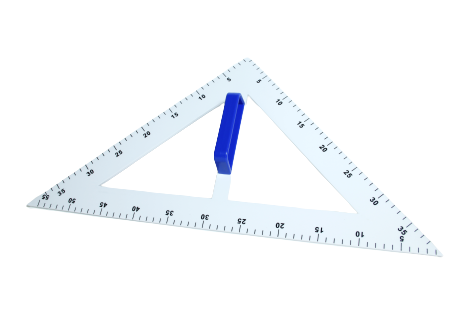
Set Square, Blackboard, 45-45-90 degrees
Set Square, Blackboard, 45-45-90 degrees (Product Code: SLE/CS/08) is a board-size set square used to draw right angles, 45-degree lines and parallel or perpendicular lines on the classroom blackboard in maths and technical drawing lessons. Teachers use it as the large counterpart to the small set square in student geometry sets and mathematics lab kits in India, so the whole class can follow each construction. It is made by Jain Scientific Equipments Pvt Ltd (ScienceLab), an OEM manufacturer, at its own factory in Ambala, India.
Key Details
| Parameter | Detail |
|---|---|
| Type | Blackboard (chalkboard) set square |
| Angles | 45, 45 and 90 degrees (right-angled isosceles triangle) |
| Purpose | Drawing right angles, 45-degree lines and perpendicular or parallel lines on the board |
| Size, material and graduations | To be confirmed at the time of quotation |
| Product code | SLE/CS/08 |
| Manufacturer | Jain Scientific Equipments Pvt Ltd (ScienceLab) — OEM |
| Country of origin | India (made in Ambala, Haryana) |
What Is the 45-45-90 Blackboard Set Square Used For?
The teacher holds the set square flat against the board and runs chalk along its edges to draw a clean right angle or a line at 45 degrees to a base line. Placed against a long board ruler and slid along it, the set square produces parallel lines; turned on its other edge, it gives perpendiculars for constructing squares, rectangles and the altitudes of triangles. Because both short sides are equal, it is also a simple way to show the properties of an isosceles right triangle before pupils repeat the construction in their exercise books.
Wipe off chalk dust with a dry cloth after each lesson, keep the edges free of nicks so lines stay straight, and store the set square flat or hanging on a hook next to the board.
What to Specify When Ordering
- Which angle set you need: this 45-45-90 version, the 30-60-90 blackboard set square, or both
- The number of classrooms to be equipped
- The size, material and graduations you require, which we confirm in the quotation
- Matching board instruments, such as a blackboard ruler, protractor or compass
OEM Manufacturer
ScienceLab is the trading name of Jain Scientific Equipments Private Limited (CIN U29309HR2020PTC087597), the OEM (original equipment manufacturer) of this blackboard set square. It is produced at the company's own licensed factory at 449, HSIIDC Industrial Area, Saha, Ambala, Haryana (Factory Licence AMB-ONLINE-CHD-J-414), and supplied factory-direct to schools, education departments, dealers and importers. Repeat orders and replacement pieces are handled by the manufacturer itself, so just ask us. Read more on the company profile.
Related Classroom Student Products
Other board instruments and student tools used in the same geometry lessons:
- Set Square, Blackboard, 30-60-90 degrees — the companion set square for 30- and 60-degree lines
- Ruler, Plastic, Blackboard, 100cm — a straight edge to slide the set square along for parallel lines
- Protractor, Plastic, for Blackboard, 44cm — for measuring and marking other angles on the board
- Compass, Plastic, for Blackboard, 45cm — completes the set for circle and arc constructions
- Student’s Geometry Set/BOX-20 — the pupils’ set, which includes a small 45-45-90 set square
More items are listed in the Classroom Student category.
Frequently Asked Questions
What angles does this set square have?
The Set Square, Blackboard, 45-45-90 degrees has one right angle and two 45-degree angles, so its two shorter sides are equal in length, making it a right-angled isosceles triangle for board constructions.
What are its size, material and markings?
The size, material and graduations of the 45-45-90 blackboard set square are not listed on this page. Please state what you need when you enquire through our contact page, and we will confirm them in the quotation.
How is it different from the 30-60-90 version?
The 45-45-90 blackboard set square gives right angles and 45-degree lines, while the 30-60-90 blackboard set square gives 30- and 60-degree lines. Most classrooms use the two set squares together for complete constructions.
Can it be used on a whiteboard?
Yes. The 45-45-90 blackboard set square works on any flat teaching board; use chalk on a blackboard or a marker on a whiteboard, and keep the drawing edges clean so the lines stay sharp.
Who manufactures the Set Square, Blackboard, 45-45-90 degrees?
Jain Scientific Equipments Private Limited (ScienceLab) is the OEM that manufactures the Set Square, Blackboard, 45-45-90 degrees at its own factory in Saha, Ambala, Haryana, India, supplying schools, dealers and importers in India and international markets directly.
How should it be cleaned and stored?
Wipe the 45-45-90 blackboard set square with a dry or slightly damp cloth after each lesson and store it flat or hanging on a hook beside the board, so the edges are not nicked and the lines stay straight.
Can you supply sets for many classrooms?
Yes. The 45-45-90 blackboard set square can be quoted for single classrooms or whole schools in India and international markets; include the number of classrooms, any matching board instruments and the delivery location in your request.
Request a Quote
Quotations for the 45-45-90 degree blackboard set square come straight from the manufacturer. Write to us via the contact page or add it to the enquiry cart with other board instruments.
Last updated: 24 September 2026
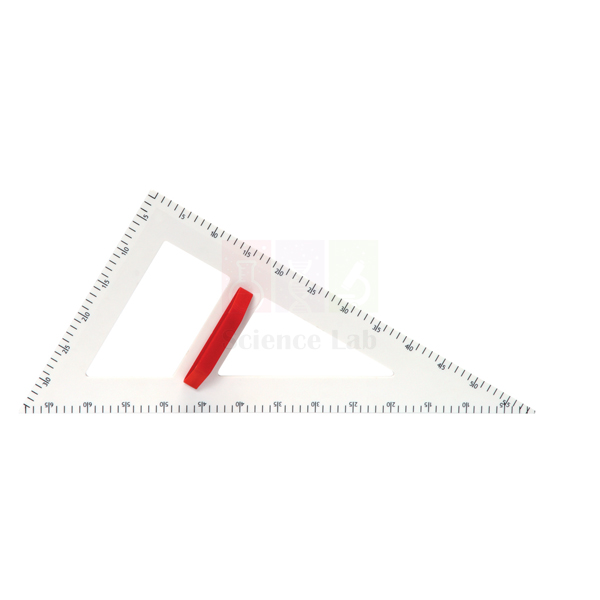
Set Square, Blackboard, 30-60-90 degrees
Set Square, Blackboard, 30-60-90 degrees (Product Code: SLE/CS/09) is a chalkboard triangle with a 60 cm longest side, made of 5 mm thick plastic, graduated in centimetres on all sides and fitted with a detachable handle. Teachers use it to draw 30- and 60-degree lines, right angles and equilateral-triangle constructions large enough for a whole class to follow, and its scales let it double as a board ruler. It is made by Jain Scientific Equipments Pvt Ltd (ScienceLab), Ambala, India, for schools equipping maths rooms alongside their mathematics lab kits in India and abroad.
Specifications
| Parameter | Detail |
|---|---|
| Type | Blackboard triangle / set square (chalkboard triangle) |
| Angles | 30, 60 and 90 degrees |
| Longest side | 60 cm |
| Material | Plastic, 5 mm thick |
| Graduation | Graduated in cm on all sides |
| Handle | Detachable |
| Estimated weight | 0.264 kg |
| Estimated volume | 0.869 cdm |
Typical Use
With the handle fitted, the teacher can press the triangle firmly against the board and draw along an edge without fingers getting in the way of the chalk. The 30-degree and 60-degree corners give those angles directly, two 60-degree lines from the ends of a base produce an equilateral triangle, and repeating the step around a point builds a regular hexagon. Because every side carries a centimetre scale, the same instrument measures the lengths it draws, so pupils see both the angle and the measurement at once.
Remove the handle when the lesson is over so the set square can be stored flat in a cupboard or drawer, which protects the graduated edges. Wipe away chalk dust with a dry cloth rather than a wet one to keep the scale easy to read. As a school lab equipment manufacturer in India, ScienceLab offers it together with the other board instruments so a maths classroom can be equipped in one order.
Manufacturer
The 30-60-90 blackboard set square is produced under the ScienceLab brand of Jain Scientific Equipments Private Limited, whose workshop and offices are in Ambala, Haryana. The company builds classroom teaching aids as well as science laboratory apparatus; see the ScienceLab profile for details.
Related Classroom Student Products
Pair it with these items for board geometry lessons:
- Set Square, Blackboard,45-45-90 degrees — the companion triangle for right-isosceles constructions.
- Protractor, Plastic, for Blackboard, 44cm — measures angles the set squares cannot give directly.
- Compass, Plastic, for Blackboard, 45cm — draws the arcs used in triangle and hexagon constructions.
- Chalk, White — for clear lines along the set square edge.
- Duster/Wiper for Blackboard — cleans the board and the instrument after the lesson.
Explore the Classroom Student category for more classroom items.
Frequently Asked Questions
How long is the longest side?
The longest side is 60 cm, which gives lines long enough to be seen from the back of a classroom.
What is it made of?
It is made of 5 mm thick plastic.
Does it have measuring scales?
Yes. It is graduated in centimetres on all sides, so it can be used as a ruler as well as a set square.
Why is the handle detachable?
The handle gives a firm grip while drawing; taking it off lets the set square lie flat for storage or transport.
What are the weight and packed volume?
The estimated weight is 0.264 kg and the estimated volume is 0.869 cdm, useful when planning shipments.
Can I order it with the right-isosceles blackboard set square?
Yes. Both are listed in the same category and can be quoted together through the contact page. ScienceLab supplies schools in India and international markets.
Request a Quote
For a quotation on the 30-60-90 degree blackboard set square, contact us through the contact page or add it to the enquiry cart.
Last updated: 24 September 2026
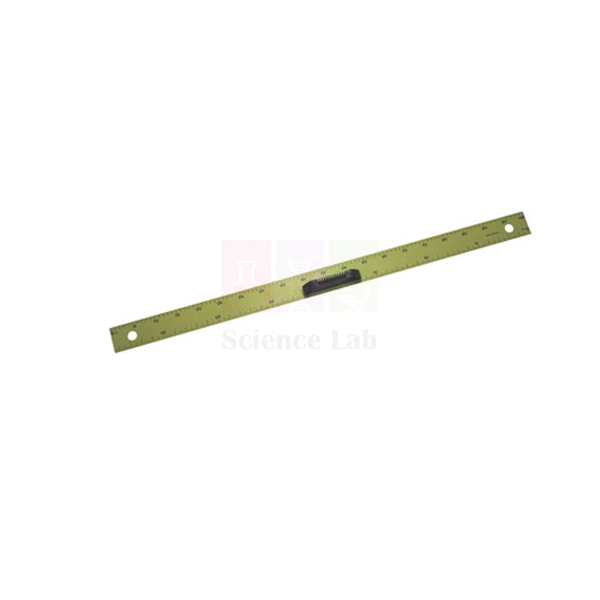
Ruler, Plastic, Blackboard, 100cm
Ruler, Plastic, Blackboard, 100cm (Product Code: SLE/CS/010) is a metre-long demonstration ruler that lets a teacher rule straight lines and mark measured lengths on a chalkboard at a size the whole class can follow from the back row. It carries both a centimetre scale and an inch scale, which makes it equally handy for measurement lessons, geometry constructions and drawing graph axes. It is made by Jain Scientific Equipments Pvt Ltd (ScienceLab), Ambala, and is a practical addition to the mathematics lab kits India's primary and secondary schools put together for board-based teaching.
Specifications
| Parameter | Detail |
|---|---|
| Length | 100cm |
| Graduations | 100 x 1cm and 39 x 1inch |
| Material | Strong plastic |
| Width | 55mm |
| Thickness | 5mm |
| Supplied as | 2 x 50cm halves, assembled and held firmly together by a detachable handle |
| Intended use | Classroom teaching aid for the chalkboard |
| Estimated weight | 0.307kg |
| Estimated volume | 0.766cdm |
Typical Use
Teachers use this ruler to draw number lines, x and y axes, tables and bar-chart frameworks on the board, and to show pupils how to read a scale by lining up zero and counting whole centimetres. Having both metric and inch markings on one ruler makes it easy to compare the two systems during a units lesson. When ruling lines, hold the ruler by its handle and press it flat against the board so the chalk runs cleanly along the edge without smudging the markings.
Because it arrives as two 50cm halves, the ruler stores in a cupboard or storage box and moves between classrooms without difficulty; join the halves with the handle before the lesson and check the joint is firm so the edge stays straight. Schools planning a school lab equipment bulk supply for several classrooms often order it together with the matching blackboard protractor, compass and set squares so every room has the same set of board instruments.
Manufacturer
This ruler is produced by Jain Scientific Equipments Private Limited, the Ambala, Haryana company that trades under the ScienceLab name and makes classroom and laboratory teaching aids for schools in India and international markets. Background on the company is available on our company profile page.
Related Classroom Student Products
These blackboard instruments and board supplies are commonly used alongside the 100cm ruler in the same geometry and measurement lessons:
- Protractor, Plastic, for Blackboard, 44cm — for measuring and drawing the angles between lines ruled on the board.
- Compass, Plastic, for Blackboard, 45cm — completes the construction set for circles and arcs.
- Set Square, Blackboard, 45-45-90 degrees — for right angles and parallel lines together with the ruler.
- Set Square, Blackboard, 30-60-90 degrees — adds the 30 and 60 degree angles used in construction exercises.
- Blackboard, Double-sided, 1160 x 760 mm — a portable board surface to use the ruler on.
See the full range in our Classroom Student category.
Frequently Asked Questions
Is the 100cm ruler supplied in one piece?
No. It comes as two 50cm halves that are assembled and held firmly together by a detachable handle, which keeps it compact for storage and transport.
Which scales are marked on it?
It is graduated 100 x 1cm and 39 x 1inch, so both metric and imperial lengths can be demonstrated with one instrument.
How rigid is it on the board?
The ruler is made of strong plastic, 55mm wide and 5mm thick, giving a firm straight edge to draw against with chalk.
How should it be cleaned?
Wipe off chalk dust with a dry or slightly damp cloth and let it dry before storing; avoid solvents that could dull the printed scale.
Can a calibration certificate be provided?
This is a teaching ruler for board demonstrations. If your order needs any measurement documentation, please discuss it with us through the contact page before ordering.
What should an institutional quotation request include?
Send the product code SLE/CS/010, the number of rulers, the delivery address and any tender specification you must match, and we will reply with a formal quotation.
Do you supply larger quantities for schools and export?
Yes. We supply schools and distributors in India and international markets; the estimated weight of 0.307kg and volume of 0.766cdm per ruler help with planning freight for larger orders.
Request a Quote
To order the 100cm blackboard ruler, add it to your enquiry cart or send your quantities and delivery details through our contact page.
Last updated: 24 September 2026
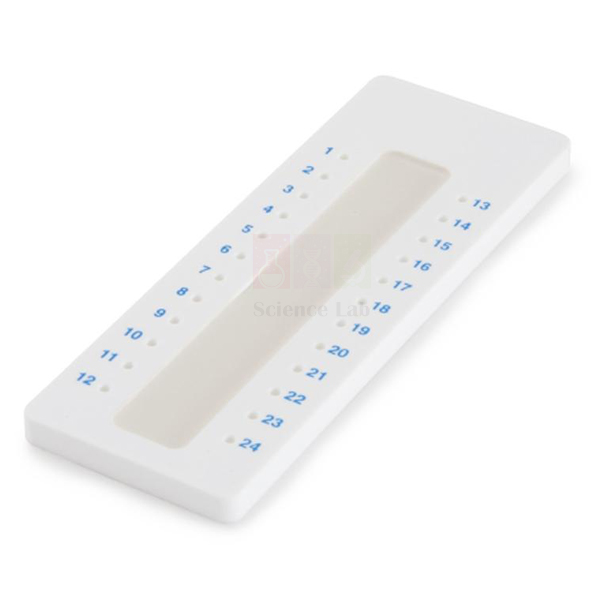
Capillary Tube Sealant
Capillary Tube Sealant (Product Code: SLE/CL/46) is a sealing compound for closing one end of blood-filled capillary tubes before they are centrifuged, supplied with a 24 slot tray that holds the tubes upright and in order. Sealing stops the blood from being thrown out of the tube during spinning, so it is a basic requirement for micro-haematocrit and similar capillary methods. It is used across laboratory services from district laboratories to reference centres, and is one of the lab equipment accessories in India supplied by Jain Scientific Equipments Pvt Ltd (ScienceLab), Ambala.
Specifications
| Parameter | Detail |
|---|---|
| Type | Sealant for capillary tubes |
| Supplied with | 24 slot tray for holding capillary tubes |
| Purpose | Sealing capillary tubes prior to centrifugation |
| Service level | District laboratory to reference centre |
Typical Use
Once a capillary tube has been filled, keep a finger over the clean end, hold the tube upright and press the dry end straight down into the sealant; a small twist as you lift it out leaves a neat plug in the bore. Stand the sealed tube in one of the tray slots so it stays upright and its position can be matched to the patient or student record. Working through the slots in order is a simple way to keep track of several samples before they are loaded into the centrifuge together.
Check each plug before spinning: it should fill the bore completely with no air gap between the plug and the blood. Use a fresh area of sealant for each tube, keep the tray covered between sessions so the surface stays clean, and wear gloves throughout. Teaching labs that run haematocrit practicals on a laboratory centrifuge in India usually keep a spare sealant tray on each bench so students do not have to share.
Supplier
Jain Scientific Equipments Private Limited, known to customers as ScienceLab, supplies this sealant from its base in Ambala, Haryana, as part of a capillary sampling range that also covers tubes, lancets and centrifuges. You can read about the company on its profile page.
Related Clinical Laboratory Items
Items that are used together with capillary tube sealant:
- Capillary Heparin Tube — heparinised glass tubes that are sealed before spinning
- EDTA Capillary Tube — EDTA-coated capillaries for haematology samples
- Haematocrit Centrifuge — spins the sealed tubes for packed cell volume
- Safety Lancet Disposable 2.4 mm — for the finger prick that provides the sample
- Gloves W/o Powder Nitrile Disposable — protection while handling blood-filled tubes
See the Clinical Laboratory range for more haematology consumables.
Frequently Asked Questions
What comes with the sealant?
It is supplied with a 24 slot tray for holding capillary tubes.
How many tubes can stand in the tray at once?
The tray has 24 slots, so up to 24 sealed tubes can be held and kept in sequence.
What is the sealant made of?
The sealant material is not stated in our listing. Please contact us if you need this for your records.
Will it suit the capillary tubes I already use?
It is made for sealing capillary tubes in general. If your tubes are an unusual diameter, tell us the size and we will confirm.
How many tubes can be sealed before the sealant runs out?
This is not stated in the listing and depends on how the sealant is used. Ask us about refill or replacement options when ordering.
Do you supply district and regional laboratories in quantity?
Yes. Send the number of units and delivery locations, and we will quote for India or international markets.
Request a Quote
Price and availability of Capillary Tube Sealant are available through our contact page; you can also add it to the enquiry cart along with capillary tubes.
Last updated: 24 September 2026