- Physics Lab Equipment
- Chemistry Lab Equipment
- Biology Lab Equipment
- Anatomical Lab Equipment
- Learning
- Educational Lab Equipment
- Magnets
- Agriculture
- Astronomy
- Earth Science
- Geography Lab Equipment
- Safety Lab Coat
- Laboratory
- Meteorological
- Electricity & Magnetism
- Heat
- School Lab Equipment
- Lab Glassware
- Science Lab Equipment
- Tvet Lab Equipment
- Robotics Kits Supplier and Manufacturer for Schools India
- Math Lab Equipment Manufacturers and Exporters in Ambala
- STEM Kits Manufacturers and Supplier India
- Engineering Lab Equipment
- Hospital Lab Equipment
- Water, Sanitation & Hygiene Supplies
- Cold Chain, Solar & Communication Equipment
- Nutrition
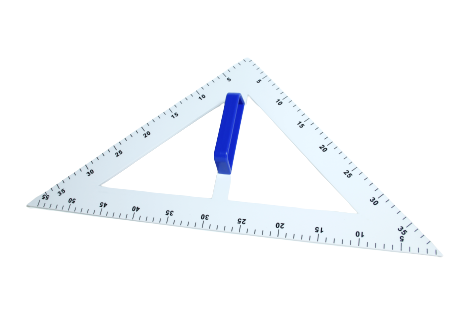
Set Square, Blackboard, Magnetic, 50 cm, 45-45-90 degrees
This 50 cm board set square has angles of 45, 45 and 90 degrees and magnets on the back, so it holds itself against a steel-faced board while the teacher draws. It is made of recycled plastic. Teachers use it to draw right angles, 45 degree lines and parallels large enough for a whole class to follow.
Magnetic board set square specifications
| Parameter | Detail |
|---|---|
| Type | Board set square, magnetic version |
| Size | 50 cm |
| Angles | 45, 45 and 90 degrees |
| Material | Recycled plastic |
| Board fixing | Magnets on the back |
| Other version | Non-magnetic version available as a separate item |
| Product code | SLE/CS/08 |
| Minimum order | 10 units |
| Dispatch | Usually within 7 to 10 working days |
| Manufacturer | ScienceLab (Jain Scientific Equipments Pvt Ltd), Ambala, India |
Board constructions with the magnetic set square
Squares and rectangles. Lay a board ruler along the base line, set one short edge of the set square against it and draw each upright side at a right angle. On a steel-faced board the magnets keep the set square in place, so one hand stays free for the chalk or marker. Check the finished corners with the board protractor.
Parallel and diagonal lines. Hold the ruler still and slide the set square along it, drawing a line at each stop: every line comes out parallel to the first. Turn the set square so its long edge rests on the ruler and its short edges give lines at 45 degrees, which is how the diagonals of a square are drawn.
A square inside a circle. Draw a circle with the board compass, then use the set square to draw two diameters that cross at right angles. Joining the four points where they meet the circle gives an inscribed square. Clear the board with a board duster before the class repeats the construction in exercise books.
Frequently Asked Questions About the Set Square, Blackboard, Magnetic, 50 cm, 45-45-90 degrees
Which boards will the magnetic set square hold on?
The magnets grip a board with a steel face or a steel sheet behind it, such as most magnetic whiteboards and steel chalkboards. They will not hold on wood, painted plywood or plain glass. Test the board with an ordinary magnet first; on a non-magnetic board, hold the set square flat by hand.
Is there a non-magnetic version of this set square?
Yes. A non-magnetic version is a separate item. This listing is the magnetic version, with magnets fixed to the back. The non-magnetic one is the better match for wooden, painted plywood or plain glass boards, where magnets have nothing to grip.
Why does the set square move while I draw, and how do I stop it?
The magnets hold it against the board, but heavy sideways pressure from chalk or a marker can still push it out of line. Keep one hand spread flat on the set square, draw along the edge with light, even strokes, and check that it still sits against the ruler before each line.
How do I draw a perpendicular line on the board?
Place the ruler along the given line. Stand one short edge of the set square on the ruler and slide it until the other short edge passes through the point. Draw along that edge. The two short edges meet at 90 degrees, so the new line is perpendicular to the first.
How do I keep parallel lines evenly spaced?
You need the set square and a straight ruler. Put one edge of the set square on the first line, press the ruler against another edge and slide the set square along the ruler. Mark equal steps along the ruler and move the set square to each mark in turn, so every line sits the same distance from the one before.
How should the set square be cleaned and stored?
Wipe chalk dust off with a dry cloth or duster, and remove marker ink with a whiteboard cleaner or a damp cloth. Keep the edges free of nicks so that lines stay straight. Store it flat or on the board itself, away from heaters, so the plastic does not warp.
Board instruments for geometry lessons
- Set Square, Blackboard, 30-60-90 degrees
- Ruler, Plastic, Blackboard, 100cm
- Protractor, Plastic, for Blackboard, 44cm
- Compass, Plastic, for Blackboard, 45cm
- Duster/Wiper for Blackboard
- Blackboard, Double-sided, 1160 x 760 mm
Manufacturer
Jain Scientific Equipments Pvt Ltd, based in Ambala, Haryana, trades as ScienceLab and manufactures this magnetic board set square for schools, colleges and dealers. Teachers who need a full set of board instruments can add the matching board set square with the other angle set and the board compass from the same source. ScienceLab sends school equipment to buyers in 110 countries. See the ScienceLab company profile.
To request a quotation, send the product name, code and quantity through our contact page or add the item to your enquiry cart.
Last updated: 20 November 2026