- Physics Lab Equipment
- Chemistry Lab Equipment
- Biology Lab Equipment
- Anatomical Lab Equipment
- Learning
- Educational Lab Equipment
- Magnets
- Agriculture
- Astronomy
- Earth Science
- Geography Lab Equipment
- Safety Lab Coat
- Laboratory
- Meteorological
- Electricity & Magnetism
- Heat
- School Lab Equipment
- Lab Glassware
- Science Lab Equipment
- Tvet Lab Equipment
- Robotics Kits Supplier and Manufacturer for Schools India
- Math Lab Equipment Manufacturers and Exporters in Ambala
- STEM Kits Manufacturers and Supplier India
- Engineering Lab Equipment
- Hospital Lab Equipment
- Water, Sanitation & Hygiene Supplies
- Cold Chain, Solar & Communication Equipment
- Nutrition
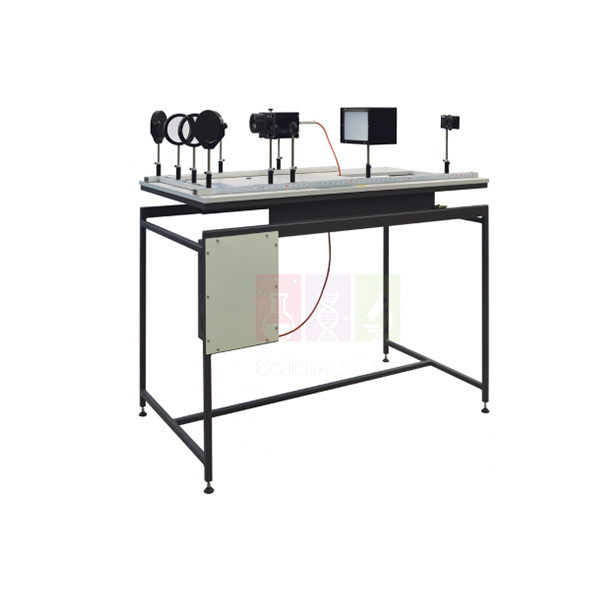
Schlieren Apparatus
Schlieren Apparatus is an optical system that makes density gradients in air visible as changes in illumination. Students use it to see supersonic flow patterns, shockwaves and expansions around models in the supersonic flow rig it is used with. Its mirrors and lenses are made to a high optical standard to limit distortion, and the included digital imaging equipment records each run.
Schlieren Apparatus optical details
| Parameter | Detail |
|---|---|
| Principle | Density gradients shown as variations in intensity of illumination |
| Flow features shown | Supersonic air-flow patterns around models; shockwaves and expansions |
| Optics | Mirrors and lenses of high optical standard to reduce image distortion |
| Image recording | Digital imaging equipment included |
| Typical pairing | Supersonic flow rig (not part of this item) |
| Learning outcome | Shock and expansion positions and angles compared with theory |
| Product code | SLE/EA/02 |
| Minimum order | 10 units |
| Dispatch | Usually within 7 to 10 working days |
| Manufacturer | ScienceLab (Jain Scientific Equipments Pvt Ltd), Ambala, India |
Schlieren work in the gas dynamics lab
Checking the optics before a run. Darken the room and pass a candle flame or warm air from a hand through the test-section beam. The rising plume should appear as clear light and dark bands. Adjust the cut-off until the background is evenly grey, then remove the test source.
Shock angle on a model. Start the image recording so that frames cover the short steady part of the supersonic run. On a saved frame, measure the shock angle against the flow direction with a protractor or image software. Compare it with oblique-shock theory for the model angle and flow Mach number.
Pressure data alongside images. Pressure traverses through the convergent-divergent nozzle of the Laval Nozzle Pressure Apparatus show where a shock raises pressure inside a passage. The schlieren frames show the shape of shocks in external flow, and students can discuss both in one report.
Low-speed contrast. In low-speed air flow at an even room temperature the density hardly changes, so schlieren images show little. Smoke streamlines on the Flow Visualisation Wind Tunnel are the better tool there, and comparing the two methods explains why each exists.
Frequently Asked Questions About the Schlieren Apparatus
Why does the screen show no density effects when the system is first set up?
Usually the cut-off is not at the focus of the light-source image, or the beam is not parallel through the test section. Move the knife edge along the beam until the whole field darkens evenly as it cuts in. Then test with a candle flame before the supersonic run.
Can the Schlieren Apparatus show low-speed air flows?
It shows any density gradient, such as the hot plume above a candle or air warmed by a hand. In low-speed flow at room temperature the density barely changes, so little is seen. Supersonic flow gives strong gradients at shocks and expansions, which is why the apparatus is used with supersonic flow.
How do students find the Mach number from a shock image?
Measure the oblique shock angle on the saved image relative to the oncoming flow, and note the model's deflection angle. The oblique-shock relation between deflection angle, shock angle and Mach number then gives the upstream Mach number. Students can also compare the measured angle with the value predicted for the rig setting.
How is a schlieren image different from a shadowgraph?
A schlieren system uses a knife edge to block part of the deflected light, so the image responds to the density gradient itself. A shadowgraph needs no knife edge and responds to changes in that gradient. Shadowgraphs are simpler and show sharp shocks well, but schlieren picks up weaker density changes.
Why do measured shock angles differ from theory?
The boundary layer on the model and walls makes the body act slightly thicker, which moves the shock. Errors in model alignment, in the flow Mach number and in reading the angle add further differences. For shock positions, a known reference length in the frame lets students scale the image correctly.
Units for compressible, visual and low-speed flow studies
- Laval Nozzle Pressure Apparatus
- Flow Visualisation Wind Tunnel
- Flow Visualisation
- Subsonic Wind Tunnel
- Flight Demonstration Wind Tunnel
To request a quotation, send the product name, code and quantity through our contact page or add the item to your enquiry cart.
Last updated: 16 November 2026
