- Physics Lab Equipment
- Chemistry Lab Equipment
- Biology Lab Equipment
- Anatomical Lab Equipment
- Learning
- Educational Lab Equipment
- Magnets
- Agriculture
- Astronomy
- Earth Science
- Geography Lab Equipment
- Safety Lab Coat
- Laboratory
- Meteorological
- Electricity & Magnetism
- Heat
- School Lab Equipment
- Lab Glassware
- Science Lab Equipment
- Tvet Lab Equipment
- Robotics Kits Supplier and Manufacturer for Schools India
- Math Lab Equipment Manufacturers and Exporters in Ambala
- STEM Kits Manufacturers and Supplier India
- Engineering Lab Equipment
- Hospital Lab Equipment
- Water, Sanitation & Hygiene Supplies
- Cold Chain, Solar & Communication Equipment
- Nutrition
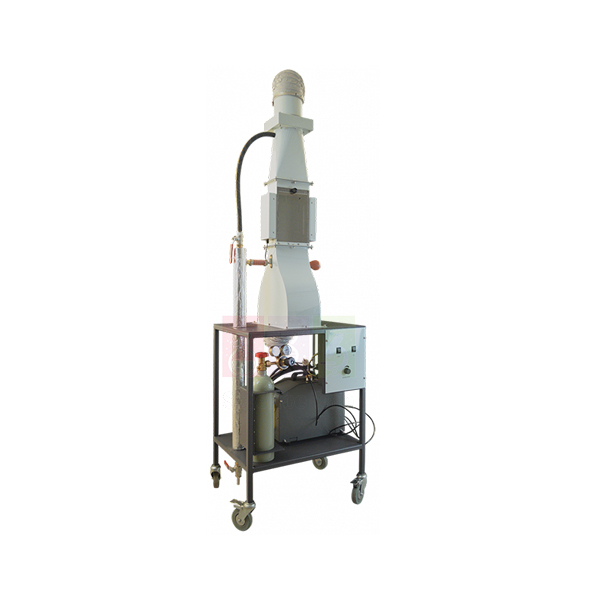
Flow Visualisation Wind Tunnel
Flow Visualisation Wind Tunnel is a vertical, suction-type smoke tunnel for watching air flow around models. A variable-speed fan on top draws air upwards through a filter and a transparent working section lit from both sides. A movable smoke comb below the section releases smoke from vaporised food-grade oil, and the tunnel stands on a castored metal frame.
Flow Visualisation Wind Tunnel construction
| Parameter | Detail |
|---|---|
| Tunnel type | Vertical, suction type; air flows vertically upwards |
| Fan | Variable speed, mounted on top of the tunnel |
| Controls | Fan-speed control unit on the frame |
| Smoke source | Generator vaporising food-grade oil; smoke listed as non-toxic |
| Smoke comb | Below the working section; moves from side to side |
| Working section | Transparent, with removable front wall; optional models attach to the back |
| Lighting | Lamps on both sides of the working section |
| Flow conditioning | Filter for a uniform air flow |
| Frame | Metal frame on castors |
| Product code | SLE/EA/03 |
| Minimum order | 10 units |
| Dispatch | Usually within 7 to 10 working days |
| Manufacturer | ScienceLab (Jain Scientific Equipments Pvt Ltd), Ambala, India |
Watching streamlines, wakes and separation
Bluff against streamlined. Fit a bluff model, run the fan slowly and sketch the smoke pattern. Then fit a streamlined model at the same fan setting. Students compare where the filaments leave the surface and how wide the wake is. They can then measure the drag difference on similar shapes in the Subsonic Wind Tunnel.
Mapping one model. Slide the smoke comb a little at a time so the filaments pass over the edge, the middle and the far side of the model. A photograph at each comb position builds a full picture of where the flow stays attached and where it breaks away.
Effect of speed. Hold the comb still and raise the fan speed in steps. Note how the wake grows unsteady and the smoke lines thin out. Link this to the stall tufts on the Flight Demonstration Wind Tunnel, which show the same separation on a wing in motion.
Frequently Asked Questions About the Flow Visualisation Wind Tunnel
Why are the smoke lines sharp at low fan speed but blurred at higher speed?
At low speed the air moves smoothly and each filament stays thin and distinct. As speed rises, the same smoke is spread through more air and the wake becomes turbulent, so the lines thin out and mix. Smoke patterns are usually clearest at low to moderate fan settings.
How do the side lamps make the smoke easier to see?
Smoke scatters light that strikes it from the side, so lit filaments glow against a darker background. Dim the room lights and stand the class in front of the working section rather than facing a lamp. A dark card behind the section adds further contrast for photographs.
What does the smoke show behind a flat plate compared with a streamlined shape?
Behind a flat plate set square to the flow, the filaments break away at the edges and leave a wide, swirling wake. That low-pressure wake causes most of the plate's drag. Around a streamlined shape the lines close up behind it, the wake stays narrow and the drag is far lower.
Does the oil smoke leave a film inside the tunnel?
Over many sessions, oil smoke can leave a light film on the transparent walls and on models. Remove the front wall after use and wipe the inside and the models with a soft, dry cloth. Regular cleaning keeps the walls clear, so the class can see sharp filaments.
Why can the smoke comb move from side to side?
Moving the comb places the filaments over different parts of the model, such as its edge or its centre line. This lets students trace the flow over the whole shape without changing the model, which is useful for finding where separation begins.
From seeing the flow to measuring it
- Flow Visualisation
- Subsonic Wind Tunnel
- Flight Demonstration Wind Tunnel
- Modular Air Flow Bench
- Schlieren Apparatus
To request a quotation, send the product name, code and quantity through our contact page or add the item to your enquiry cart.
Last updated: 14 November 2026