- Physics Lab Equipment
- Chemistry Lab Equipment
- Biology Lab Equipment
- Anatomical Lab Equipment
- Learning
- Educational Lab Equipment
- Magnets
- Agriculture
- Astronomy
- Earth Science
- Geography Lab Equipment
- Safety Lab Coat
- Laboratory
- Meteorological
- Electricity & Magnetism
- Heat
- School Lab Equipment
- Lab Glassware
- Science Lab Equipment
- Tvet Lab Equipment
- Robotics Kits Supplier and Manufacturer for Schools India
- Math Lab Equipment Manufacturers and Exporters in Ambala
- STEM Kits Manufacturers and Supplier India
- Engineering Lab Equipment
- Hospital Lab Equipment
- Water, Sanitation & Hygiene Supplies
- Cold Chain, Solar & Communication Equipment
- Nutrition
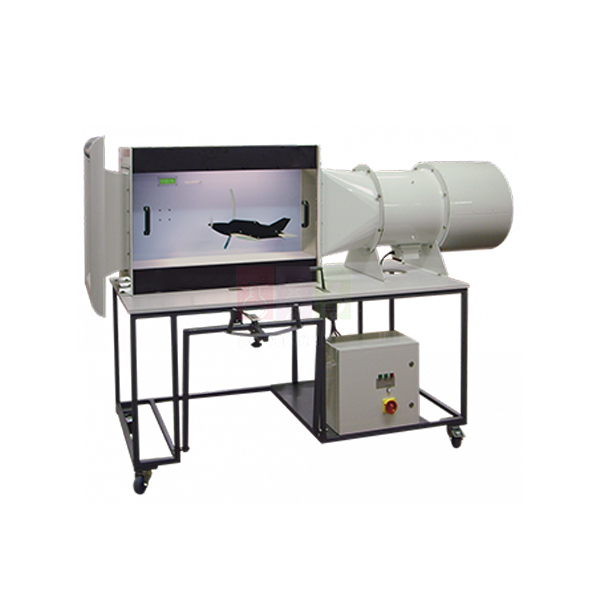
Flight Demonstration Wind Tunnel
Flight Demonstration Wind Tunnel holds a model aircraft that is free to rise and to pitch about its quarter-chord point, each motion independent of the other. As air speed changes, the model takes off, flies level, cruises and lands. An electronic display shows air speed, attitude, altitude, pressure and lift, while tufts on the wing reveal stall.
Flight Demonstration Wind Tunnel details
| Parameter | Detail |
|---|---|
| Model motion | Vertical movement and pitch about the quarter-chord point, independent of each other |
| Flight phases simulated | Take-off, level flight, cruise and landing |
| Demonstrations | Aerofoil lift, stall, longitudinal stability and transient motion |
| Electronic display | Air speed, attitude, altitude, pressure and lift |
| Stall indication | Tufts on the wing show flow separation |
| Working section | Brightly illuminated |
| Model balance | Adjustable centre of gravity |
| Compatible recorder | Two Channel Recorder (SLE/EA/04) |
| Product code | SLE/EA/05 |
| Minimum order | 10 units |
| Dispatch | Usually within 7 to 10 working days |
| Manufacturer | ScienceLab (Jain Scientific Equipments Pvt Ltd), Ambala, India |
Demonstrations on the free-flying model
Lift and take-off. Raise the air speed slowly with the model resting in the working section. Note the speed and the displayed lift as the model lifts off, then again in level flight and cruise. Lower the speed to bring it in to land and compare the readings on the way down.
Stall and separation. Watch the wing tufts as the wing works at steeper angles of attack. They lie flat while the flow stays attached, then flutter and point forward as it separates. Record the attitude at that moment and the drop in lift. For a fixed-model comparison, plot lift against angle on the Subsonic Wind Tunnel.
Stability and the centre of gravity. Move the centre of gravity forward, nudge the model and see how quickly it settles back. Repeat with the centre of gravity further aft. The response changes from a damped return to a lasting oscillation or a steady divergence. The Two Channel Recorder puts the trace on paper for a transient-motion report.
Separation in smoke. Follow the tuft work with smoke lines on the Flow Visualisation Wind Tunnel. There, students watch the flow break away from a model and form a wake.
Frequently Asked Questions About the Flight Demonstration Wind Tunnel
Why does the wing stall when its angle becomes too steep?
Lift grows with angle of attack only while the air can follow the upper surface of the wing. Beyond a certain angle the flow breaks away, lift falls and drag rises. On this tunnel the tufts flutter and reverse at that point, and the displayed lift drops at the same moment.
How does moving the centre of gravity change the way the model flies?
With the centre of gravity well forward, the model returns quickly to its trim attitude after a disturbance. As it moves aft the restoring effect weakens, and past a certain point a small nudge grows instead of dying out. This is why real aircraft must be loaded within a set balance range.
What is the difference between static and dynamic stability on this model?
Static stability is the first tendency after a disturbance: does the model start to swing back towards trim or away from it? Dynamic stability is what happens over time: whether the swings die away or keep growing. A model can be statically stable yet still oscillate for a long time if damping is poor.
Why does the model pitch about its quarter-chord point?
On a wing at low speed, the aerodynamic centre lies close to the quarter-chord. About that point the wing's pitching moment stays nearly constant as the angle of attack changes. Pivoting there lets students see clearly how the centre-of-gravity setting decides the trim angle.
Can the model's motion be recorded for a report?
Yes. The Two Channel Recorder is listed to work with this tunnel and gives a paper trace of the transient motion. Students can then read the time for oscillations to die away at each centre-of-gravity setting.
Aerodynamics units to use alongside the flight tunnel
- Two Channel Recorder
- Subsonic Wind Tunnel
- Flow Visualisation Wind Tunnel
- Modular Air Flow Bench
- Schlieren Apparatus
To request a quotation, send the product name, code and quantity through our contact page or add the item to your enquiry cart.
Last updated: 14 November 2026