- Physics Lab Equipment
- Chemistry Lab Equipment
- Biology Lab Equipment
- Anatomical Lab Equipment
- Learning
- Educational Lab Equipment
- Magnets
- Agriculture
- Astronomy
- Earth Science
- Geography Lab Equipment
- Safety Lab Coat
- Laboratory
- Meteorological
- Electricity & Magnetism
- Heat
- School Lab Equipment
- Lab Glassware
- Science Lab Equipment
- Tvet Lab Equipment
- Robotics Kits Supplier and Manufacturer for Schools India
- Math Lab Equipment Manufacturers and Exporters in Ambala
- STEM Kits Manufacturers and Supplier India
- Engineering Lab Equipment
- Hospital Lab Equipment
- Water, Sanitation & Hygiene Supplies
- Cold Chain, Solar & Communication Equipment
- Nutrition
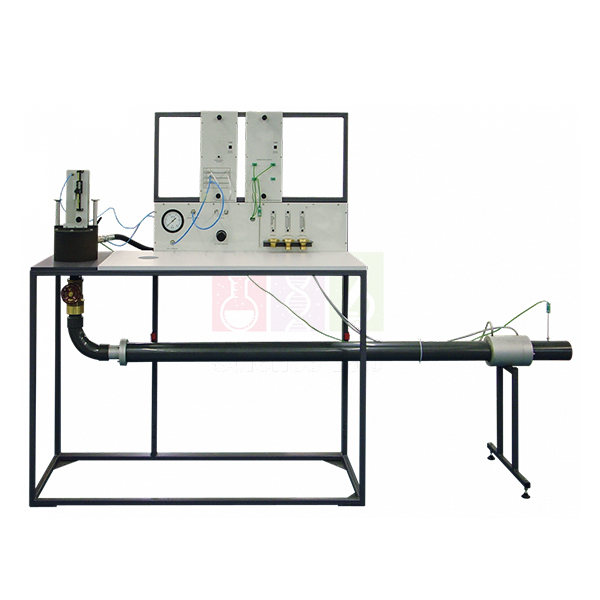
Laval Nozzle Pressure Apparatus
Laval Nozzle Pressure Apparatus is a floor-standing compressed-air rig for studying the adiabatic expansion of air through subsonic and supersonic nozzles. It has three interchangeable polished brass nozzles: convergent, convergent-divergent (Laval) and convergent-parallel. A stainless-steel probe on a vertical traverse maps pressure along the nozzle axis, and digital displays give pressures and temperatures at key points.
Laval Nozzle Pressure Apparatus specifications
| Parameter | Detail |
|---|---|
| Nozzles | Three interchangeable, profiled and polished brass nozzles with mimics: convergent, convergent-divergent (Laval) and convergent-parallel |
| Air circuit | Compressed air through a pressure regulator and isolating valve; after the nozzle, flow settles in a horizontal pipe, passes an orifice and exits to atmosphere |
| Mass flow | Found by students from the pressures around the orifice |
| Instrumentation | Digital temperature and pressure displays at key points; chest pressure also on an analogue gauge |
| Inlet pressure | Held by the pressure regulator, with an analogue reference gauge |
| Axial probe | Stainless steel, on a manually adjustable vertical traverse; digital indicator shows probe position |
| Frame | Floor-standing; pressure chest with removable lid and nozzle traverse, worktop and instrument frame |
| Dimensions | 2900 x 600 x 1730 mm (length x depth x height) |
| Weight | 123 kg |
| Product code | SLE/EA/06 |
| Minimum order | 10 units |
| Dispatch | Usually within 7 to 10 working days |
| Manufacturer | ScienceLab (Jain Scientific Equipments Pvt Ltd), Ambala, India |
Nozzle experiments on the rig
Choking in the convergent nozzle. With the isolating valve closed, fit the convergent nozzle through the chest lid and refit the lid. Raise the inlet pressure on the regulator in steps, recording chest pressure, temperatures and the orifice pressures each time. Work out the mass flow, multiply it by the square root of the absolute chest temperature and divide by the chest pressure. Plot this mass flow parameter against pressure ratio and look for the point where the curve flattens. The Orifice and Venturi meter demonstrator introduces orifice metering in incompressible flow first.
Pressure profile of the Laval nozzle. Fit the convergent-divergent nozzle and move the probe along the axis step by step, reading its position on the digital indicator. Use the nozzle mimic to mark the throat on the graph. Compare the measured profile with isentropic predictions and look for a sudden rise that signals a shock.
Three shapes compared. Repeat the traverse with the convergent and convergent-parallel nozzles at the same inlet pressure and overlay all three profiles. Students who have watched shocks and expansions with the Schlieren Apparatus can relate the pressure jumps to those images. The Bernoulli's Theorem Demonstration module shows the low-speed form of the same area and pressure link.
Frequently Asked Questions About the Laval Nozzle Pressure Apparatus
Why does the mass flow stop rising once the throat chokes?
When air at the throat reaches sonic speed, pressure changes downstream can no longer travel back upstream past it. Lowering the downstream pressure further then has no effect on the throat, so mass flow stays fixed for a given inlet pressure and temperature. Raising the inlet pressure still increases it.
What happens to the pressure after the throat of the Laval nozzle?
It depends on the downstream pressure. If that is low enough, the air keeps accelerating to supersonic speed in the widening section and pressure keeps falling. Over a middle range, a shock forms there, pressure jumps and the flow turns subsonic. Higher still, the throat never reaches sonic speed and pressure recovers after it, as in a venturi. The probe traverse shows which case occurs.
What do over-expanded and under-expanded flow mean?
An over-expanded nozzle drops the jet pressure below the surrounding pressure at the exit, so shocks form at or beyond the exit to raise it again. An under-expanded nozzle releases the jet above the surrounding pressure, and it keeps expanding after leaving. A correctly expanded nozzle exits at the surrounding pressure.
Why can only the Laval nozzle make the flow supersonic?
Below sonic speed, air speeds up as the passage narrows. Above sonic speed, it speeds up only as the passage widens. A convergent nozzle or a parallel section after the throat cannot take the air past sonic speed, so the diverging part of the Laval nozzle is what makes supersonic flow possible.
How do students work out the mass flow on this rig?
Air leaving the nozzle settles in a horizontal pipe and passes an orifice to atmosphere. Students read the pressures around the orifice and the temperature, work out the air density, and apply the orifice equation with its discharge coefficient. Multiplying the result by the square root of absolute chest temperature and dividing by chest pressure gives a mass flow parameter that levels off once the nozzle chokes.
Compressible, internal and external flow teaching units
- Schlieren Apparatus
- Orifice and Venturi meter demonstrator
- Bernoulli's Theorem Demonstration module
- Pipe Flow And Nozzle Kit
- Subsonic Wind Tunnel
To request a quotation, send the product name, code and quantity through our contact page or add the item to your enquiry cart.
Last updated: 14 November 2026