- Physics Lab Equipment
- Chemistry Lab Equipment
- Biology Lab Equipment
- Anatomical Lab Equipment
- Learning
- Educational Lab Equipment
- Magnets
- Agriculture
- Astronomy
- Earth Science
- Geography Lab Equipment
- Safety Lab Coat
- Laboratory
- Meteorological
- Electricity & Magnetism
- Heat
- School Lab Equipment
- Lab Glassware
- Science Lab Equipment
- Tvet Lab Equipment
- Robotics Kits Supplier and Manufacturer for Schools India
- Math Lab Equipment Manufacturers and Exporters in Ambala
- STEM Kits Manufacturers and Supplier India
- Engineering Lab Equipment
- Hospital Lab Equipment
- Water, Sanitation & Hygiene Supplies
- Cold Chain, Solar & Communication Equipment
- Nutrition
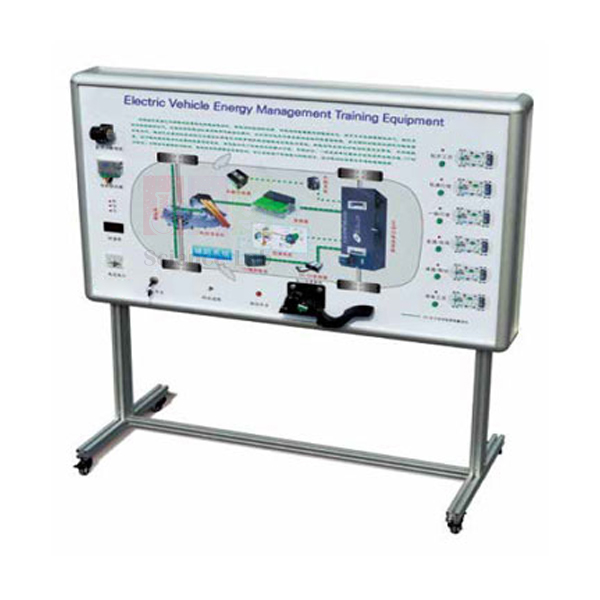
Electric Vehicle Energy Management Training Equipment
The Electric Vehicle Energy Management Training Equipment is a panel trainer that shows how energy moves through an electric vehicle drive in six conditions, from start to stop. LED paths show the direction of energy flow and an analog motor shows the motor's working state. The panel runs from 220V AC through an internal 12V DC supply, so it needs no battery.
EV energy management trainer specifications
| Parameter | Detail |
|---|---|
| Simulated conditions | Six: start, low speed, general driving, full speed, slow down and stop |
| Panel controls and indicators | Ignition switch, operating condition switch, throttle pedal, gear switch, brake switch, digital tachometer, current indicator and other parts |
| Energy-flow display | Light-emitting diode system showing the dynamic direction of energy flow |
| Motor demonstration | Analog motor showing the working status of the motor |
| Power supply | 220V AC input; internal transformer-rectifier circuit gives 12V DC; no battery required |
| Protection | Anti-short-circuit function on the 12V DC supply |
| Operating temperature | -40 °C to +50 °C |
| Size | 1,600 × 700 × 1,700 mm |
| Training content | Components of an electric vehicle energy management system and how they work |
| Product code | SLE/ATE/30 |
| Minimum order | 10 units |
| Dispatch | Usually within 7 to 10 working days |
| Manufacturer | ScienceLab (Jain Scientific Equipments Pvt Ltd), Ambala, India |
Classroom exercises on the EV energy-flow panel
Six-condition energy log. Switch on the ignition, then step through start, low speed, general driving, full speed, slow down and stop with the operating condition switch. For each condition, students sketch the LED energy-flow path and note the tachometer and current readings in one table. The finished table shows how motor speed and current change over a journey.
Motor principle first. Before the panel lesson, run a demonstration electric motor to recall how current in a coil produces a turning force. Then return to the trainer and press the throttle pedal slowly while watching the current indicator and the analog motor. Students link a higher current to more motor effort.
Driver controls and their effects. One student works the throttle pedal, gear switch and brake switch like a driver while a partner calls out what the LED paths and indicators do. The pair then swap roles and list which control changes which reading.
Electric drives in other machines. Close the topic on the electric forklift circuit simulator, where battery, motor and current draw appear in an industrial truck. Then contrast both with petrol engine control on the automotive engine fault diagnosis simulator.
Frequently Asked Questions About the Electric Vehicle Energy Management Training Equipment
Why does an electric car use more energy at full speed than in general driving?
Mostly because of air drag. Drag grows roughly with the square of speed, and the power needed to push through it rises even faster. At town speeds drag stays small. On the trainer, compare the current readings for general driving and full speed to show the extra demand.
How does regenerative braking return energy when an electric vehicle slows down?
When the driver lifts off or brakes, the wheels turn the motor and it works as a generator. The controller sends the current it produces back into the battery, and the generator's drag slows the car. Friction brakes still handle hard stops. On the panel, compare the LED path for slow down with the path for general driving.
Why does stop-start traffic hurt an electric car's range less than a petrol car's?
A stationary electric car draws only a little power for lights, controls and cabin comfort, while a petrol engine keeps burning fuel at idle. Each slowdown also gives back part of the energy through regeneration. The start and stop conditions on the trainer give a starting point for this discussion.
What does the inverter do between the battery and the traction motor?
The battery stores direct current, but most traction motors run on alternating current. The inverter switches the battery's DC into AC of variable frequency and amplitude, which sets motor speed and torque. During regeneration it works the other way and feeds DC back to the battery. The trainer shows the motor's state with an analog motor and a current indicator.
Why do most electric cars manage with a single-speed gearbox?
An electric motor gives strong torque from standstill and runs efficiently across a broad speed band, so one fixed reduction gear covers both town driving and high speed. Reverse comes from turning the motor the other way. On the panel, the gear switch takes the place of the driver's selector.
Why does this trainer run from mains power instead of a traction battery?
An internal transformer-rectifier circuit turns the 220V AC supply into 12V DC, and that supply has an anti-short-circuit function. There is no battery to charge between classes. Students also work at low voltage, away from the high-voltage pack of a real EV, which needs isolation and trained handling.
Other items for an EV and vehicle electrics module
- Electric Forklift Electric Circuit Training Simulator
- Excavator Electric Circuit Training Simulator
- Demonstration, Electric Motor
- Digital Multimeter
- Engine management system (MPI)
To request a quotation, send the product name, code and quantity through our contact page or add the item to your enquiry cart.
Last updated: 14 November 2026
