- Physics Lab Equipment
- Chemistry Lab Equipment
- Biology Lab Equipment
- Anatomical Lab Equipment
- Learning
- Educational Lab Equipment
- Magnets
- Agriculture
- Astronomy
- Earth Science
- Geography Lab Equipment
- Safety Lab Coat
- Laboratory
- Meteorological
- Electricity & Magnetism
- Heat
- School Lab Equipment
- Lab Glassware
- Science Lab Equipment
- Tvet Lab Equipment
- Robotics Kits Supplier and Manufacturer for Schools India
- Math Lab Equipment Manufacturers and Exporters in Ambala
- STEM Kits Manufacturers and Supplier India
- Engineering Lab Equipment
- Hospital Lab Equipment
- Water, Sanitation & Hygiene Supplies
- Cold Chain, Solar & Communication Equipment
- Nutrition
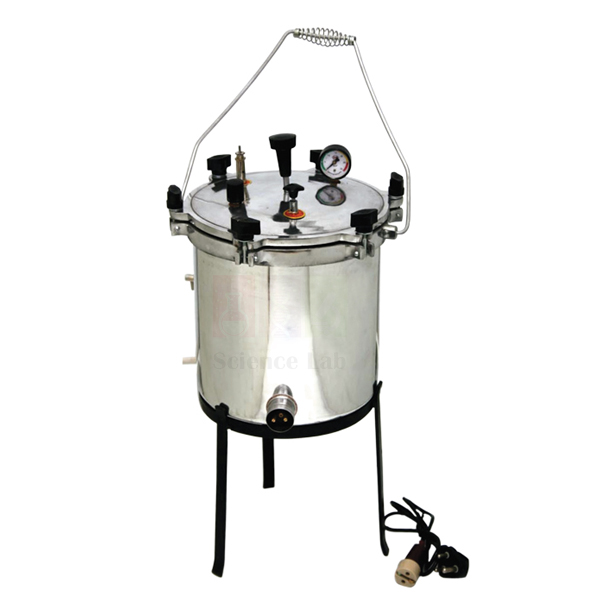
Electric Autoclave
This electrically heated steam autoclave follows the pressure-cooker pattern and handles media, glassware and instruments in teaching laboratories. The aluminium body and lid are each formed without seams, and a 2 kW heater raises steam to a working pressure of 15 psi. The lid carries a pressure gauge, for following each stage of the run, and a double safety valve.
Electric autoclave specifications
| Parameter | Detail |
|---|---|
| Type | Electrically heated steam autoclave |
| Heater | 2 kW |
| Working pressure | 15 psi |
| Body and lid | Aluminium, formed without seams |
| Lid fittings | Pressure gauge and double safety valve |
| Product code | SLE/LA/01 |
| Minimum order | 10 units |
| Dispatch | Usually within 7 to 10 working days |
| Manufacturer | ScienceLab (Jain Scientific Equipments Pvt Ltd), Ambala, India |
Teaching practicals with the electric autoclave
Boiling versus autoclaving. Seed three tubes of nutrient broth with the same hay infusion, using an inoculation loop. Keep one as a control, boil the second in a water bath for ten minutes and hold the third at 15 psi in the autoclave. After incubation, the control turns cloudy, and cloudiness in the boiled tube shows that heat-resistant spores survived boiling.
Plotting a pressure curve. With a load of water-filled flasks in an autoclave basket, one student reads the gauge every minute from switch-on, through venting and the hold at 15 psi, to the return to zero. The plotted curve shows how long heating up and cooling down take compared with the hold itself.
Clearing culture waste. At the end of the session, used plates go into an autoclave bag with its neck left open. The bag runs through a full cycle at 15 psi before it is sealed and sent for disposal.
Frequently Asked Questions About the Electric Autoclave
When should the sterilising time start?
Only once the air has been vented and the gauge has climbed to 15 psi. The heating-up time does not count towards it. Watch the needle during the hold: if it falls below 15 psi, bring the pressure back up and start the timing again from zero.
Why is 15 psi used for steam sterilising?
At about 15 psi above atmospheric pressure, pure steam is roughly twenty degrees hotter than boiling water, which is the long-standing figure for moist-heat sterilising. The gauge only stands in for temperature if all the air was driven out first, since trapped air lowers the steam temperature at the same pressure.
What does the double safety valve do?
It gives the steam two routes out if the pressure climbs past the working level. Before every run, check that the valve moves freely and is clear of scale or dried media. Never block, weight or tie it down to make pressure build faster.
Why is steam escaping and the gauge not rising?
Usually the lid is not closed evenly, the rim is dirty, or the vent was left open after the air was purged. Switch off, let the vessel cool and lose its pressure, then clean the rim and close the lid again. Also check that enough water is left in the base.
How should the aluminium vessel be cleaned?
Empty it after each day's use, wash it with mild detergent and dry it fully. Avoid washing soda and strong alkaline cleaners, which attack aluminium and leave it pitted. Wipe the gauge face and valve with a damp cloth, never by dunking the lid in water.
How should students be trained before using the autoclave?
Start with a cold, empty unit. Show how the lid closes, where the vent and valve are, and how to read the gauge. Let each student run one supervised cycle with water-filled flasks, and keep a logbook of who ran each load and for how long.
Sterilizers and items for the sterilising bench
- Gas Autoclave
- Autoclave Stainless Steel
- Autoclave, Stainless Steel, 15 Litre
- Autoclave Basket
- Autoclave Tape
- Autoclave Bag Disposable
To request a quotation, send the product name, code and quantity through our contact page or add the item to your enquiry cart.
Last updated: 14 November 2026