- Physics Lab Equipment
- Chemistry Lab Equipment
- Biology Lab Equipment
- Anatomical Lab Equipment
- Learning
- Educational Lab Equipment
- Magnets
- Agriculture
- Astronomy
- Earth Science
- Geography Lab Equipment
- Safety Lab Coat
- Laboratory
- Meteorological
- Electricity & Magnetism
- Heat
- School Lab Equipment
- Lab Glassware
- Science Lab Equipment
- Tvet Lab Equipment
- Robotics Kits Supplier and Manufacturer for Schools India
- Math Lab Equipment Manufacturers and Exporters in Ambala
- STEM Kits Manufacturers and Supplier India
- Engineering Lab Equipment
- Hospital Lab Equipment
- Water, Sanitation & Hygiene Supplies
- Cold Chain, Solar & Communication Equipment
- Nutrition
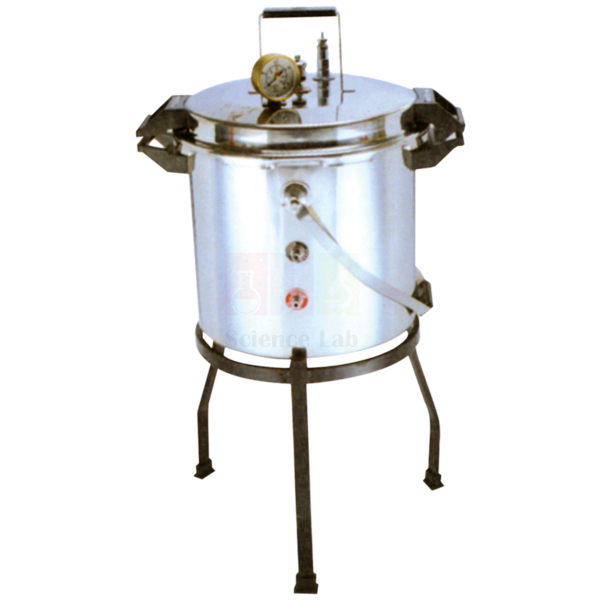
Autoclave Stainless Steel
This pressure sterilizer is built for laboratories that have no fixed heat source. Its stainless steel body is formed in one piece, with no welded joints inside, and it runs on charcoal, kerosene, gas or electricity. The vessel measures 350 mm across and 300–325 mm high, and the lid seals on a thermally insulated, vulcanized polychloroprene gasket.
Stainless steel any-fuel autoclave specifications
| Parameter | Detail |
|---|---|
| Construction | Stainless steel sterilizer, body formed without seams |
| Gasket | Thermally insulated, vulcanized polychloroprene (synthetic rubber) |
| Heat source | Any fuel: charcoal, kerosene, gas or electricity |
| Size | 350 mm (diameter) × 300–325 mm (height) |
| Capacity | 30 litres |
| Fittings | Pressure gauge, safety valve and vent |
| Handling | Designed for easy handling |
| Product code | SLE/LA/02 |
| Minimum order | 10 units |
| Dispatch | Usually within 7 to 10 working days |
| Manufacturer | ScienceLab (Jain Scientific Equipments Pvt Ltd), Ambala, India |
Sterilising tasks for school and field biology labs
Preparing dissection instruments. Wrap scalpels and forceps in paper, seal each pack with autoclave tape and stand the packs in an autoclave basket above the water. After the run, the stripes on the tape show which packs went through the cycle, so used and processed packs are not mixed up.
Nutrient broth for a field microbiology class. Fill test tubes or conical flasks with broth and plug them with cotton wool. Heat the vessel on whatever the site has, from a kerosene stove to a gas ring, and let it cool fully before the tubes are lifted out for inoculation.
Decontaminating used cultures. Collect used plates in an autoclave bag and leave the neck loose so steam can reach the contents. Run a full cycle, let the vessel cool, and only then send the bag for disposal.
Frequently Asked Questions About the Autoclave Stainless Steel
Can the autoclave be used on a charcoal or kerosene stove?
Yes. It works on charcoal, kerosene, gas or electricity. Stand it level on a stove that is steady under the full, water-filled vessel. Raise the heat gradually, and on charcoal keep the fire even, because surges and drops in heat make the pressure rise and fall.
Why must there always be water in the vessel?
The steam that does the sterilising comes from that water. Heated dry, the base overheats and the gasket can be damaged. Check the level before every run, top it up with clean water, and never leave the vessel on the heat after the water has boiled away.
Why does an autoclave work better than boiling?
Boiling at normal pressure stops at the boiling point of water, which some bacterial spores survive. Sealed under pressure, the steam gets hotter. When it condenses on cooler items it gives up its heat quickly, and moist heat at that temperature, held long enough, kills spores as well as active cells.
When can the lid be opened after a run?
Only after the heat is off and all pressure has gone. Let the vessel cool on its own and never force or prise the lid. Wait until the pressure gauge reads zero, open the vent to let out any remaining steam, then lift the lid with the far edge first, so steam rises away from your face.
How should the polychloroprene gasket be looked after?
Wipe the gasket after each run, let it dry and keep it free of grit and grease. Before closing, check that it sits evenly all round. Replace a gasket that is cracked, flattened or hard, since steam will leak past it and pressure will not build.
What are the main steps of a sterilising run?
Add water, load items loosely in a basket above it and close the lid evenly. Heat with the vent open until a steady flow of steam has driven the air out, then close the vent and watch the pressure gauge. Hold the run for the time your protocol sets, then remove the heat and let it cool fully before opening.
Sterilizers and sterilising consumables
- Electric Autoclave
- Gas Autoclave
- Autoclave, Stainless Steel, 15 Litre
- Autoclave Basket
- Autoclave Tape
- Autoclave Bag
To request a quotation, send the product name, code and quantity through our contact page or add the item to your enquiry cart.
Last updated: 15 November 2026
