- Physics Lab Equipment
- Chemistry Lab Equipment
- Biology Lab Equipment
- Anatomical Lab Equipment
- Learning
- Educational Lab Equipment
- Magnets
- Agriculture
- Astronomy
- Earth Science
- Geography Lab Equipment
- Safety Lab Coat
- Laboratory
- Meteorological
- Electricity & Magnetism
- Heat
- School Lab Equipment
- Lab Glassware
- Science Lab Equipment
- Tvet Lab Equipment
- Robotics Kits Supplier and Manufacturer for Schools India
- Math Lab Equipment Manufacturers and Exporters in Ambala
- STEM Kits Manufacturers and Supplier India
- Engineering Lab Equipment
- Hospital Lab Equipment
- Water, Sanitation & Hygiene Supplies
- Cold Chain, Solar & Communication Equipment
- Nutrition
Theory of Machines apparatus demonstrates the kinematics and dynamics of mechanisms, including governors, cams, gears, bearings, vibration and rotating-frame effects, for mechanical engineering degree and diploma laboratories. Jain Scientific Equipments Pvt Ltd (ScienceLab), Ambala, manufactures the range as an OEM at its own licensed factory in Ambala. Each of the 29 listed units lets students compare measured behaviour with the equations met in dynamics of machinery lectures, making it core lab equipment for technical institutes teaching mechanical engineering.
What Does the Theory of Machines Range Include?
| Topic | What it covers | Example products |
|---|---|---|
| Free vibration systems | One-degree-of-freedom beam-spring and cantilever systems built on a bench-top test frame | Free Vibrations Test Frame, Free Vibration Of Beam Spring, Free Vibrations Of A Cantilever |
| Damping | Piston-and-cylinder dashpot dampers using user-chosen fluids for different damping levels | Damper Kit, Damper Kit For Mass/Spring |
| Bearings and lubrication | Pressure around an air-lubricated bearing and contact between two loaded surfaces | Air Bearing Apparatus, Hertzian Contact Apparatus |
| Mechanisms, gears and rotating systems | Linkages, gear trains, balancing, gyroscopic effect and whirling of shafts | Four Bar Chain Apparatus, Gear Train Model, Static and Dynamic Balancing Apparatus, Gyroscope Experiment Manual, Whirling of Shaft Apparatus |
| Flywheels and drives | Angular acceleration and static efficiency using weights on a flywheel shaft | Acceleration & Static Test Stand |
Featured Theory of Machines Apparatus
| Product | Product Code | Typical Use |
|---|---|---|
| Governor | SLE/ETM/02 | Comparing Porter, Proell and Hartnell governors with sleeve-lift sensing on a variable-speed base |
| Cam Analysis Machine | SLE/ETM/10 | Studying follower motion with interchangeable followers on a direct-drive variable-speed motor |
| Free And Forced Vibrations | SLE/ETM/13 | Free and servomotor-driven forced vibration with non-contact displacement sensing |
| Journal Bearing Demonstration | SLE/ETM/03 | Journal bearing performance under different loads, speeds and directions |
| Michell Pad Apparatus | SLE/ETM/14 | Oil-film pressure distribution under a tilting pad, read on graduated tubes |
| Geared Systems | SLE/ETM/12 | Measuring input and output power of drive units to find transmission efficiency |
| Coriolis Force | SLE/ETM/15 | Watching a water jet deflect on a rotating arm at set speeds and directions |
OEM Manufacturing & Supply
ScienceLab (Jain Scientific Equipments Private Limited) is the OEM for the Theory of Machines range and produces it at its own licensed factory at 449, HSIIDC Industrial Area, Saha, Ambala, Haryana. The apparatus is supplied factory-direct to engineering colleges, polytechnics, technical institutes, dealers, tender buyers and importers in India and international markets, and each quotation comes straight from the manufacturer. Buyers completing vendor-registration forms can use CIN U29309HR2020PTC087597, GSTIN 06AAECJ8618A1ZT and LEI 3358004HRD1JIVXKYX49.
Related Ranges
- Engineering Lab Equipment — the parent hub for every engineering teaching lab range.
- Automotive Training Equipment — power trains, transmissions and engines where these mechanism principles are applied to vehicles.
- Materials Testing and Properties — strength of materials apparatus for the same mechanical engineering departments.
- Control & Process Engineering Trainers — servo, speed-control and process trainers that extend machine dynamics into control.
- General Products — structures and statics apparatus for beams, frames and trusses.
Frequently Asked Questions
What does the Theory of Machines range include?
The Theory of Machines range lists 29 units: a governor unit with Porter, Proell and Hartnell governors, cam analysis and cam mechanism apparatus, gear trains and geared systems, a four-bar chain, balancing, gyroscope and whirling-of-shaft apparatus, free and forced vibration rigs with dampers and test frame, journal, air and Michell pad bearing rigs, Hertzian contact and Coriolis demonstrators.
Which courses need Theory of Machines apparatus?
Theory of Machines apparatus serves kinematics of machines, dynamics of machinery, mechanical vibrations and tribology practicals in mechanical and production engineering degrees and diplomas, where students verify governor, cam, vibration and bearing theory by measurement.
Can the vibration apparatus be bought as a set?
Yes. The Theory of Machines vibration items are designed to work together: the beam-spring, cantilever and Damper Kit experiments fit the Free Vibrations Test Frame, so a department can order the frame with the experiments it needs and add the Free And Forced Vibrations unit.
Who manufactures the Theory of Machines range?
The Theory of Machines range is manufactured by Jain Scientific Equipments Private Limited, trading as ScienceLab, at its licensed factory in Saha, Ambala, Haryana, and supplied directly to institutions, dealers, tender buyers and importers.
What should a Theory of Machines quotation request include?
A Theory of Machines quotation request should list the SLE/ETM product codes, quantities, which vibration and bearing experiments are required, the delivery destination and whether the order is for a tender, a new laboratory or an export shipment.
Request a Quote or Catalogue
Send your dynamics lab list via our contact page or add items to the shopping cart, and ScienceLab will send a quotation or the Theory of Machines catalogue from Ambala.
Last updated: 24 September 2026
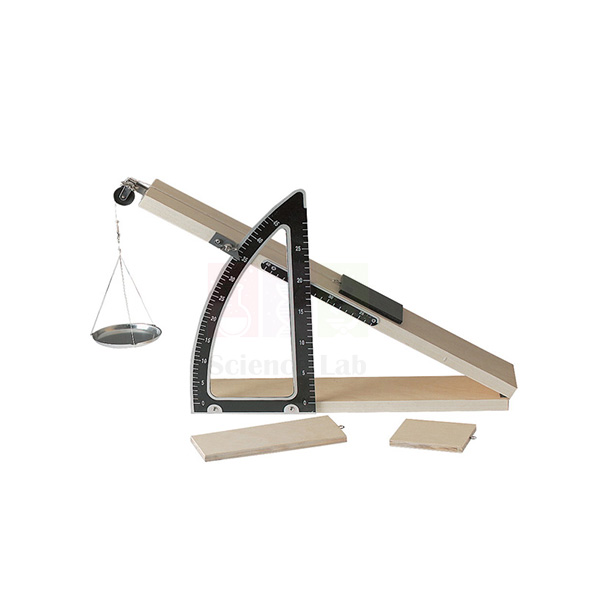
Friction Slide Apparatus
Friction Slide Apparatus (Product Code: SLE/MCE/24) is a bench-top inclined-plane apparatus used to measure the coefficient of friction between pairs of materials in mechanics and theory of machines laboratories. Its ground steel plane locks at any angle within ±45° on a protractor scale, and two composite slider trays let students compare aluminium, steel, nylon and brass surfaces. It is made by Jain Scientific Equipments Pvt Ltd (ScienceLab), an OEM manufacturer, at its own factory in Ambala, India.
Specifications
| Parameter | Detail |
|---|---|
| Construction | Compact bench-top unit with sturdy aluminium base plate, non-slip feet and central vertical pillar |
| Plane | Ground steel plane pivoting on the base |
| Angle range | Lockable at any angle between ±45° |
| Angle indication | Semi-circular protractor scale |
| Slider trays | Two composite trays: one with aluminium and steel faces, one with nylon and brass faces |
| Loading | Weight hanger with added weights; trays also accept additional weight |
| Cord guidance | Hanger cord passes over a pulley and bearing that reduce friction for accurate results |
| Product code | SLE/MCE/24 |
| Manufacturer | Jain Scientific Equipments Pvt Ltd (ScienceLab) — OEM |
| Country of origin | India (made in Ambala, Haryana) |
What Is the Friction Slide Apparatus Used For?
Each slider tray is tied to a weight hanger by a cord that runs over the pulley, and weights are added until the tray just begins to slide up the steel plane. The hanging load at that moment, compared with the tray's weight and the plane angle, gives the coefficient of static friction for that material pair. Loading extra weight into the tray shows students that friction force rises in proportion to the normal force.
Because the plane locks anywhere within ±45°, the same set-up doubles as an exercise in equilibrium of forces on an inclined plane apparatus, resolving weight into components along and normal to the surface. Keep the steel plane and tray faces clean and dry, start each trial from the same position and repeat readings to average out scatter. It is compact mechanics lab equipment in India that suits both engineering and senior physics classes.
What to Specify When Ordering
- Number of units for your student groups
- Weights for the hanger and trays — confirm with us what is included and what you need added
- Delivery destination in India or abroad
OEM Manufacturer
The Friction Slide Apparatus is made by Jain Scientific Equipments Private Limited, the company that trades as ScienceLab and acts as OEM (original equipment manufacturer) for its theory of machines range. Production takes place at its own licensed factory at Saha, Ambala, Haryana, India, and units go factory-direct to engineering colleges, polytechnics, schools, dealers and importers.
For institutional buyers completing vendor registration, the company's GSTIN is 06AAECJ8618A1ZT and its LEI is 3358004HRD1JIVXKYX49. Spare slider trays, cords or repeat sets can be requested from the manufacturer directly — ask us. More on the ScienceLab company profile.
Related Theory of Machines Equipment
These items widen a friction practical or continue the mechanics sequence:
- Static and Kinetic Friction Tester — a motor-driven tester that displays static and kinetic friction values.
- Inclined Plane Tester — another inclined-plane approach to friction measurement.
- Friction Demonstration Device (Tribometer) — a simple classroom demonstration of sliding friction.
- Hangers with Slotted Weights — for adding load to the hanger in steps.
See more in Theory of Machines.
Frequently Asked Questions
What does the Friction Slide Apparatus measure?
The Friction Slide Apparatus measures the coefficient of friction between a slider tray and a ground steel plane by finding the hanging load that just starts the tray moving. It also works as an exercise in equilibrium of forces on an incline.
Which materials can be compared on the Friction Slide Apparatus?
The Friction Slide Apparatus comes with two composite slider trays, one with aluminium and steel faces and one with nylon and brass faces. Each slides on the ground steel plane, so four material pairings can be compared in one practical.
What angles can the Friction Slide Apparatus plane be set to?
The steel plane of the Friction Slide Apparatus pivots on its base and can be locked at any angle between ±45°. The angle is read on a semi-circular protractor scale mounted on the unit.
How does the Friction Slide Apparatus keep results accurate?
The Friction Slide Apparatus runs the hanger cord over a pulley and bearing that reduce friction in the pulling system, so the hanging load reflects friction at the tray. Its aluminium base with non-slip feet keeps the unit steady on the bench.
Who manufactures the Friction Slide Apparatus?
The Friction Slide Apparatus is manufactured by Jain Scientific Equipments Pvt Ltd (ScienceLab), the OEM, at its own licensed factory in Saha, Ambala, Haryana, India. Quotations and after-sales questions go straight to the manufacturer.
Are weights included with the Friction Slide Apparatus?
The listing for the Friction Slide Apparatus confirms a weight hanger system but does not detail the weight set. Ask through the contact page and the quotation will state exactly which weights are supplied.
Request a Quote
Ask the manufacturer directly for a Friction Slide Apparatus quotation through the ScienceLab contact page, or add it to the enquiry cart. Mention quantity, any weights required and the delivery location.
Last updated: 24 September 2026
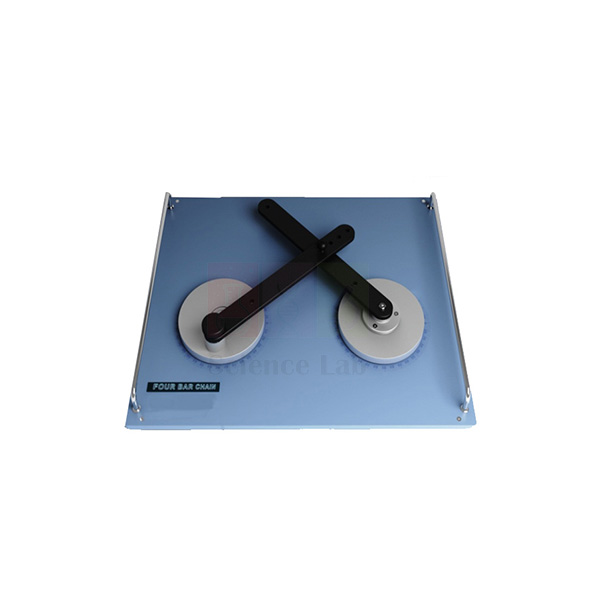
Four Bar Chain Apparatus
Four Bar Chain Apparatus (Product Code: SLE/MCE/25) is a kinematics teaching unit used to show how a four-bar linkage converts uniform continuous rotation into non-uniform rotation or oscillation, in theory of machines laboratories. Students reposition its pivot joints to change crank radius, oscillation radius and coupling length, then read input and output angles on built-in scales to compare crank-rocker, double rocker and double crank mechanisms. It is made by Jain Scientific Equipments Pvt Ltd (ScienceLab), an OEM manufacturer, at its own factory in Ambala, India.
Key Details
| Parameter | Detail |
|---|---|
| Mechanism | Four-bar linkage (four-joint link) with elements connected by pivot joints |
| Motion conversion | Uniform rotation into non-uniform rotation or oscillation; rotary into oscillating motion |
| Input side | Drive disk with crank and coupling; disc with angular scale for the exact input angle |
| Output side | Output disk with rocker; output angle read on its angle scale |
| Adjustments | Pivot positions vary crank radius, oscillation radius and coupling length; crank pin locates at different radii |
| Mechanisms studied | Crank-rocker, double rocker and double crank |
| Mounting | Elements on a base plate with an integrated angle scale |
| Handling | Two handles for easy carrying and stacking |
| Product code | SLE/MCE/25 |
| Manufacturer | Jain Scientific Equipments Pvt Ltd (ScienceLab) — OEM |
| Country of origin | India (made in Ambala, Haryana) |
What Is the Four Bar Chain Apparatus Used For?
Four-bar linkages sit inside windscreen wipers, rocking conveyors, pump jacks and countless machine mechanisms, and this unit lets students see exactly how one works. The class turns the drive disk in equal steps, notes the input angle on its scale and reads the matching output angle on the output disk. Plotting output against input reveals the non-uniform motion, the limits of oscillation and the dead-centre positions of the linkage.
Changing the pivot positions then shows how link proportions decide whether the linkage behaves as a crank-rocker, double rocker or double crank — the Grashof condition taught in lectures. Work gently near the extreme positions, tighten the pivots after each change and keep a sketch of every configuration with its readings. For departments sourcing mechanics lab equipment in India, it is a stackable, portable unit that serves several groups in turn.
OEM Manufacturer
Jain Scientific Equipments Private Limited, trading as ScienceLab, is the OEM (original equipment manufacturer) of the Four Bar Chain Apparatus. It is produced and assembled at the company's own licensed factory at Saha, Ambala, Haryana, India, and supplied factory-direct to engineering colleges, polytechnics, technical training institutes, dealers and importers.
Because you deal with the maker, questions about link parts, pivots or matching units for additional benches get answered at source — just ask us. See the ScienceLab profile for company details.
Related Theory of Machines Equipment
These units continue the kinematics topics that start with the four-bar chain:
- Cam Mechanism — another way to turn rotation into follower motion.
- Cam Analysis Machine — deeper study of cam and follower behaviour.
- Corollis Component of Acceleration Apparatus — takes link kinematics on to acceleration analysis.
- Gear Trainer Demonstrator — compares linkage motion with transmission through gears.
Browse the full Theory of Machines category.
Frequently Asked Questions
What does the Four Bar Chain Apparatus demonstrate?
The Four Bar Chain Apparatus demonstrates how a four-bar linkage converts uniform continuous rotation into non-uniform rotation or oscillation. Students measure input and output angles to see the motion relationship for different link arrangements.
Which mechanisms can be set up on the Four Bar Chain Apparatus?
The Four Bar Chain Apparatus can be arranged as a crank-rocker mechanism, a double rocker mechanism or a double crank. Moving the pivot joints changes crank radius, oscillation radius and coupling length to switch between them.
How are angles measured on the Four Bar Chain Apparatus?
On the Four Bar Chain Apparatus, the input angle is set with the drive disk and read on an angular scale, while the output angle is read on the scale of the output disk. Both scales are built into the unit.
Is the Four Bar Chain Apparatus easy to store and move?
Yes. The Four Bar Chain Apparatus has all elements mounted on a base plate with two handles, which make the unit easy to carry between benches and to stack when the practical is finished.
Who manufactures the Four Bar Chain Apparatus?
The Four Bar Chain Apparatus is manufactured by Jain Scientific Equipments Pvt Ltd (ScienceLab), the OEM, at its own licensed factory in Saha, Ambala, Haryana, India. Quotations and follow-up support come directly from the manufacturer.
What should a quotation request for the Four Bar Chain Apparatus include?
A quotation request for the Four Bar Chain Apparatus should state how many units you need, any other theory of machines items you are equipping at the same time, and the delivery location. Send it via the contact page.
Request a Quote
Quotations for the Four Bar Chain Apparatus come direct from the manufacturer. Use the ScienceLab contact page or the enquiry cart, and include quantity and delivery details.
Last updated: 24 September 2026
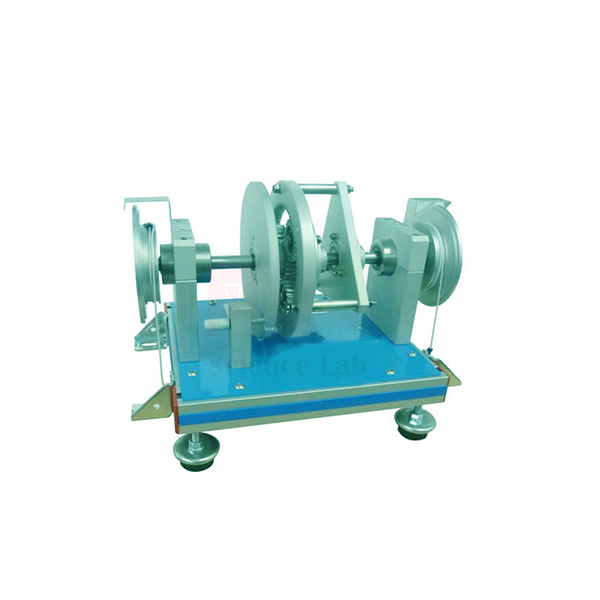
Gear Trainer Demonstrator
Gear Trainer Demonstrator (Product Code: SLE/MCE/27) is a sliding mesh gearbox demonstrator used to teach how gear ratios change speed and torque through a transmission, in automotive and theory of machines laboratories. It represents a typical three forward ratio and reverse sliding mesh box, with protractor pulleys on the input and output shafts so students can determine and verify velocity and torque ratios. It is made by Jain Scientific Equipments Pvt Ltd (ScienceLab), an OEM manufacturer, at its own factory in Ambala, India.
Key Details
| Parameter | Detail |
|---|---|
| Gearbox type | Sliding mesh |
| Ratios | Three forward ratios and reverse |
| Gears | Gear wheels of different sizes |
| Measurement | Pulleys fitted with protractors on the input and output shafts |
| Experiments | Determination and verification of velocity ratio and torque ratio |
| Use | Classroom demonstrations and student laboratory work |
| System expansion | Can be coupled to an Overdrive and Differential to represent a simple transmission system (these units are not listed as included) |
| Product code | SLE/MCE/27 |
| Manufacturer | Jain Scientific Equipments Pvt Ltd (ScienceLab) — OEM |
| Country of origin | India (made in Ambala, Haryana) |
What Is the Gear Trainer Demonstrator Used For?
The sliding mesh box is seldom found on modern cars and survives mainly on heavy commercial vehicles, yet its layout is the one from which most modern gearboxes were developed. That makes it the clearest starting point for students of automobile engineering and machine design. With each ratio engaged in turn, the class turns the input pulley through a measured angle, reads the output rotation on the second protractor and works out the velocity ratio.
Applying known loads at the pulleys then lets students compare torque ratio with velocity ratio and discuss losses between them. Counting teeth to predict each ratio before measuring it is a good check, and the reverse gear shows how an extra gear changes the direction of output rotation. The demonstrator works equally well at the front of a lecture room or on a practical bench, which makes it versatile engineering lab equipment for technical institutes.
What to Specify When Ordering
- Number of demonstrators for lecture and practical use
- Whether you also need an Overdrive and Differential to build a simple transmission — confirm availability with us
- Delivery destination in India or abroad
OEM Manufacturer
Jain Scientific Equipments Private Limited, which trades as ScienceLab, is the OEM (original equipment manufacturer) of the Gear Trainer Demonstrator. The gearbox, pulleys and frame are made and assembled at the company's own licensed factory at Saha, Ambala, Haryana, India, and the unit is supplied factory-direct to engineering colleges, ITIs, polytechnics, dealers and importers.
Buying from the manufacturer means that questions about gear wheels, protractor pulleys or matching units reach the people who build them — ask us whenever needed. Read about the company on the ScienceLab profile.
Related Theory of Machines Equipment
These items extend gear and transmission teaching:
- Gear Train Model — a spur-gear differential train built from two planetary trains.
- Vehicle Transmission 5 Speed Manual Gearbox — a full vehicle gearbox to compare with the sliding mesh layout.
- Differential Gear — the final-drive stage of a vehicle transmission.
- Gear Trains Kit — spur, bevel and worm gears for simple and compound train experiments.
See all items in Theory of Machines.
Frequently Asked Questions
What type of gearbox is the Gear Trainer Demonstrator?
The Gear Trainer Demonstrator represents a typical sliding mesh gearbox with three forward ratios and reverse. It uses gear wheels of different sizes, showing the basic layout from which most modern gearboxes have been developed.
How do students measure ratios on the Gear Trainer Demonstrator?
The Gear Trainer Demonstrator has pulleys fitted with protractors on its input and output shafts. Students rotate the input, read the output rotation on the second protractor and use these readings to determine and verify velocity and torque ratios.
Can the Gear Trainer Demonstrator be used in lectures?
Yes, the Gear Trainer Demonstrator is suited both to classroom demonstrations by the teacher and to hands-on use by students in the laboratory, so one unit can support theory lectures and practical sessions.
Can the Gear Trainer Demonstrator connect to other transmission units?
The Gear Trainer Demonstrator can be coupled to an Overdrive and Differential to represent a simple transmission system. These units are not listed as part of the demonstrator, so ask us about them when you request a quotation.
Who manufactures the Gear Trainer Demonstrator?
The Gear Trainer Demonstrator is manufactured by Jain Scientific Equipments Pvt Ltd (ScienceLab), the OEM, at its own licensed factory in Saha, Ambala, Haryana, India. Buyers receive quotations and after-sales answers directly from the manufacturer.
Does ScienceLab supply the Gear Trainer Demonstrator for export?
Yes, ScienceLab supplies the Gear Trainer Demonstrator to institutions and dealers in India and international markets. Share quantity and destination through the contact page and the manufacturer will prepare a quotation.
Request a Quote
Request a Gear Trainer Demonstrator quotation direct from the manufacturer through the ScienceLab contact page, or add it to the enquiry cart. Mention whether you also need the Overdrive and Differential.
Last updated: 24 September 2026
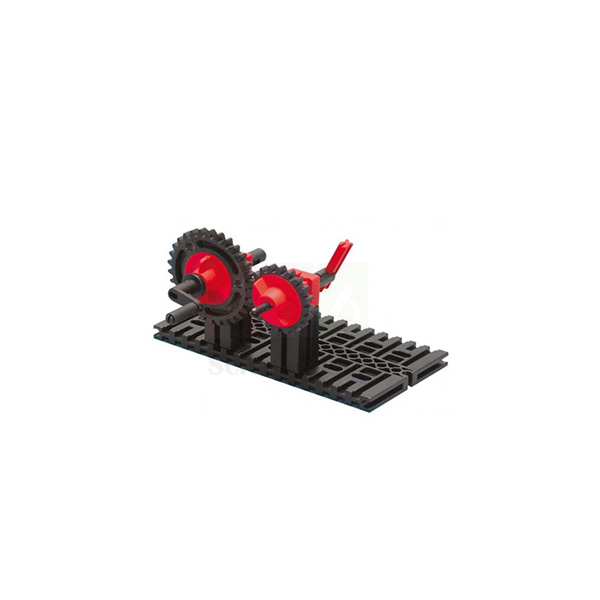
Gear Train Model
Gear Train Model (Product Code: SLE/MCE/28) is a mechanism model used to demonstrate a differential gear train built entirely from spur gears, in theory of machines and automobile engineering laboratories. It combines two planetary gear trains whose sun gears are coaxial, so students can hold either wheel and watch how the remaining gears keep turning. It is made by Jain Scientific Equipments Pvt Ltd (ScienceLab), an OEM manufacturer, at its own factory in Ambala, India.
Key Details
| Parameter | Detail |
|---|---|
| Mechanism | Differential gear train |
| Gear type | All spur gears |
| Arrangement | Combination of two planetary gear trains with coaxial sun gears |
| Both wheels free | With the mechanism driven, all spur gears run |
| Right wheel held | Right sun gear becomes fixed; the other gears still rotate |
| Left wheel held | Left sun gear becomes fixed; the other gears still rotate |
| Application shown | Situations that require two controllable inputs |
| Product code | SLE/MCE/28 |
| Manufacturer | Jain Scientific Equipments Pvt Ltd (ScienceLab) — OEM |
| Country of origin | India (made in Ambala, Haryana) |
What Is the Gear Train Model Used For?
A differential lets two outputs turn at different speeds from one input, which is why a vehicle's wheels can take a corner without scrubbing. Textbook diagrams can make this hard to picture; this model shows the same function with spur gears only, arranged as two planetary trains sharing a common axis. Holding one wheel fixes its sun gear, and students can watch the other gears keep turning and relate what they see to the kinematic equations of planetary trains.
A good exercise is to drive the model slowly, count output turns with one wheel held and then the other, and compare the results with calculated values. The model also illustrates mechanisms that need two controllable inputs, a topic that links theory of machines with robotics and control. Handle it at low speed and keep fingers clear of meshing gears. It is well suited as engineering lab equipment for demonstration tables and student practicals alike.
OEM Manufacturer
The Gear Train Model is manufactured by Jain Scientific Equipments Private Limited (CIN U29309HR2020PTC087597), which trades as ScienceLab and is the OEM (original equipment manufacturer) of this model. Production takes place at the company's licensed factory at 449, HSIIDC Industrial Area, Saha, Ambala, Haryana (Factory Licence AMB-ONLINE-CHD-J-414).
Colleges, training institutes, dealers and importers buy it factory-direct, so quotations, repeat orders and questions about replacement gears are handled by the manufacturer — ask us. More background is on the ScienceLab company profile.
Related Theory of Machines Equipment
Pair the model with these items when teaching gear trains and transmissions:
- Gear Trainer Demonstrator — a sliding mesh gearbox for velocity and torque ratio work.
- Cut Model Of Planetary Gear System — a sectioned planetary set for comparing gear layouts.
- Differential Gear — relates the model to a real vehicle differential.
- Internal Gear Pinion Drive — shows internal gearing of the kind used in ring gears.
Explore more in Theory of Machines.
Frequently Asked Questions
What mechanism does the Gear Train Model show?
The Gear Train Model shows a differential gear train in which all the gears are spur gears. It is built as a combination of two planetary gear trains whose two sun gears are coaxial, demonstrating differential action without bevel-gear complexity.
What happens when one wheel of the Gear Train Model is held?
When the right wheel of the Gear Train Model is held, the right sun gear becomes fixed while the other gears can still rotate; holding the left wheel fixes the left sun gear in the same way. With both wheels free, all spur gears run.
Where is the principle of the Gear Train Model applied?
The Gear Train Model illustrates mechanisms for situations that require two controllable inputs, as well as the familiar vehicle differential. Students can link its behaviour to planetary gear train theory covered in theory of machines courses.
Who manufactures the Gear Train Model?
The Gear Train Model is manufactured by Jain Scientific Equipments Pvt Ltd (ScienceLab), the OEM, at its own licensed factory in Saha, Ambala, Haryana, India. Quotations and after-sales support come directly from the manufacturer.
Is the Gear Train Model suitable for classroom demonstration?
Yes, the Gear Train Model is a demonstration mechanism that a teacher can operate in front of a class or students can study at a practical bench. Run it at low speed so everyone can follow the motion of each gear.
What should a quotation request for the Gear Train Model include?
A quotation request for the Gear Train Model should state the quantity, any related theory of machines items you are ordering and the delivery location. Send it through the contact page and the manufacturer will respond.
Request a Quote
Quotations for the Gear Train Model come direct from the manufacturer. Contact us through the ScienceLab contact page or add the model to the enquiry cart with your quantity and delivery details.
Last updated: 24 September 2026
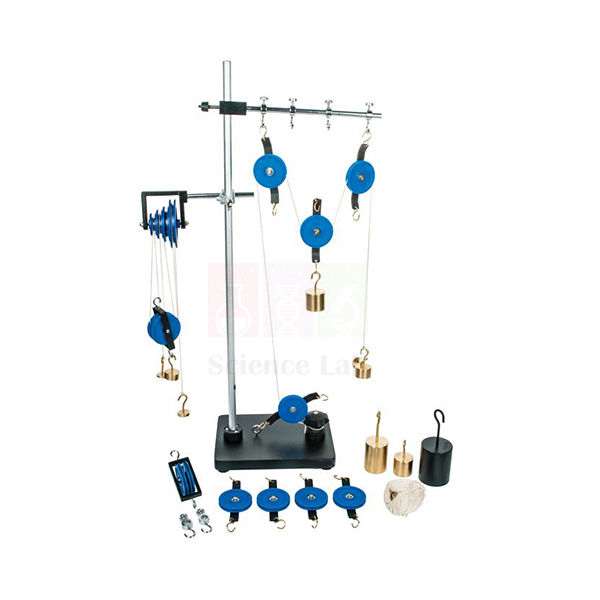
Pulley Demonstration Set
Pulley Demonstration Set (Product Code: SLE/MCE/29) is a free-standing pulley rig used to demonstrate mechanical advantage, velocity ratio and efficiency with fixed and movable pulleys in school and college mechanics laboratories. Physics teachers and engineering instructors use it to build anything from a single pulley to quadruple-sheave systems on three 81 cm steel rods, loaded with brass slotted masses. It is made by Jain Scientific Equipments Pvt Ltd (ScienceLab), an OEM manufacturer, at its own factory in Ambala, India, as a complete pulley system lab set in one order.
Specifications
| Parameter | Detail |
|---|---|
| Overall height | 32 inches (approx. 81 cm) |
| Base | Wooden base 81 x 20 cm (7.8 inches wide), fitted with 2 sockets, a capstan and an eye hook |
| Rods | 3 steel rods, 12.5 mm diameter, 81 cm long |
| Pulleys | 8 single, 2 triple tandem, 2 quadruple |
| Rod fittings | 8 collars with hook; 3 right-angled clamps |
| Wheel and axle | 1 |
| Tool | 1 tommy bar for tightening the vertical rods |
| Cord | 4 rolls |
| Slotted brass mass set | 2 x 10 g, 2 x 20 g, 2 x 50 g, 4 x 100 g, 4 x 200 g, 1 x 500 g |
| Brass weight hangers | 5 x 50 g, 1 x 20 g, 1 x 10 g |
| Product code | SLE/MCE/29 |
| Manufacturer | Jain Scientific Equipments Pvt Ltd (ScienceLab) — OEM |
| Country of origin | India (made in Ambala, Haryana) |
What Is the Pulley Demonstration Set Used For?
Collars with hooks slide onto the horizontal rod to carry the pulleys, and the right-angled clamps hold that rod across the vertical rods. A brass weight hanger carries the load, and slotted masses are added on the effort side until the load just rises. Comparing load with effort gives the mechanical advantage; measuring how far the effort and the load travel gives the velocity ratio, and the two together give the efficiency of the arrangement.
Because the kit contains single, triple tandem and quadruple pulleys plus a wheel and axle, one set covers the whole progression from a simple fixed pulley to block-and-tackle systems and other simple machines, making it practical mechanics lab equipment in India for beginner and advanced classes alike. The base also carries a capstan and an eye hook for cord arrangements. Before loading, tighten the vertical rods with the tommy bar, keep the cord running squarely in each groove and add masses gently so that swinging does not upset the readings.
What to Specify When Ordering
- Number of complete sets needed for your student groups
- Extra cord rolls, if classes re-string the pulleys often (4 rolls come with each set)
- Additional slotted brass masses or weight hangers beyond the standard assortment
- Spare single, triple tandem or quadruple pulleys for replacement
- Delivery location in India or abroad
OEM Manufacturer
ScienceLab is the OEM behind this Pulley Demonstration Set. Jain Scientific Equipments Private Limited, which trades as ScienceLab, makes it at its own licensed factory at Saha, Ambala, Haryana, India, instead of buying it in from a trader. Schools, colleges, laboratory dealers and importers therefore order factory-direct from the team that assembles the rods, pulleys and base.
For replacement pulleys, cord or masses on sets already in service, ask us and the manufacturer will advise on what can be supplied. More about the company is on the ScienceLab company profile.
Related Theory of Machines Equipment
These items are used alongside the pulley set when a class works through simple machines, forces and power transmission:
- Force Meter/Spring Balance — reads the effort directly instead of balancing it with slotted masses.
- Slotted Mass Hanger, 1kg — carries heavier loads on multi-pulley arrangements.
- Balance Demonstration Fulcrum/Lever — lets students compare lever advantage with pulley systems.
- Gear Train Model — the next step: velocity ratio in gear drives.
- Friction Slide Apparatus — explains the friction losses that keep real pulley efficiency below the ideal.
Browse the full Theory of Machines range for more mechanisms and demonstration apparatus.
Frequently Asked Questions
What is included in the Pulley Demonstration Set?
The Pulley Demonstration Set includes 8 single, 2 triple tandem and 2 quadruple pulleys, a wooden base 81 x 20 cm, three steel rods, 8 collars with hook, 3 right-angled clamps, a wheel and axle, a tommy bar, 4 rolls of cord, a slotted brass mass set and brass weight hangers.
How big is the Pulley Demonstration Set?
The Pulley Demonstration Set stands 32 inches (about 81 cm) high on a wooden base 81 cm long and 7.8 inches (about 20 cm) wide. Its three steel rods are 12.5 mm in diameter and 81 cm long, giving a compact frame for a teacher's demonstration bench.
Which masses come with the Pulley Demonstration Set?
The Pulley Demonstration Set comes with slotted brass masses of 2 x 10 g, 2 x 20 g, 2 x 50 g, 4 x 100 g, 4 x 200 g and 1 x 500 g, plus brass weight hangers of 5 x 50 g, 1 x 20 g and 1 x 10 g for building up loads and efforts.
Which topics can students study with the Pulley Demonstration Set?
With the Pulley Demonstration Set, students study fixed and movable pulleys, block-and-tackle systems, mechanical advantage, velocity ratio, efficiency and the wheel and axle. The mix of single, triple tandem and quadruple pulleys lets one kit serve both beginner and advanced mechanics classes.
Who manufactures the Pulley Demonstration Set?
The Pulley Demonstration Set is manufactured by Jain Scientific Equipments Pvt Ltd (ScienceLab), the OEM, at its own licensed factory at Saha, Ambala, Haryana, India. Orders, quotations and spare-part requests are handled directly by the manufacturer rather than through a reseller.
Can I get replacement pulleys or cord for the Pulley Demonstration Set later?
You can ask for replacement pulleys, cord rolls or slotted masses for an existing Pulley Demonstration Set through our contact page. Tell us which parts and how many you need, and the manufacturer will confirm what can be supplied.
What should a quotation request for the Pulley Demonstration Set include?
For a Pulley Demonstration Set quotation, state the number of sets, any extra masses, cord or spare pulleys, and the delivery location in India or abroad. Institutions equipping several laboratories can ask for one consolidated quotation for bulk supply.
Request a Quote
To get a price for the Pulley Demonstration Set (SLE/MCE/29), send your requirement through our contact form or add the item to the enquiry cart. The quotation comes straight from the manufacturer, whether you need one set for a school or several for a college mechanics laboratory.
Last updated: 24 September 2026
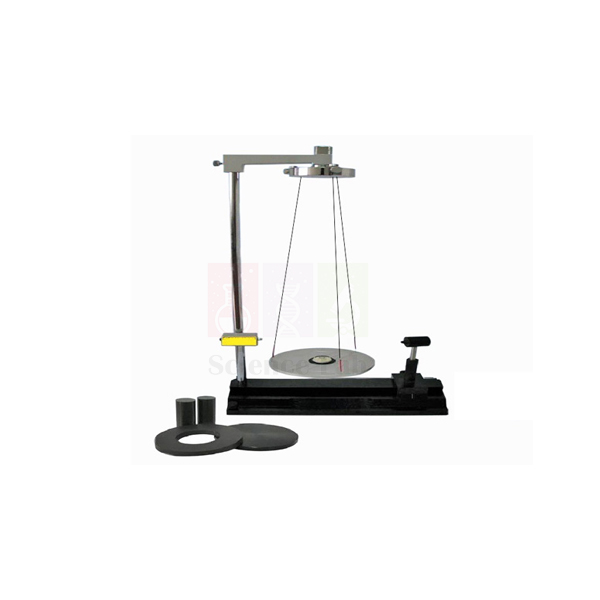
Rotational Moment of Inertia Apparatus
Rotational Moment of Inertia Apparatus (Product Code: SLE/MCE/30) is a three-string pendulum set-up used to determine the moment of inertia of a rigid body in engineering and physics laboratories. A hanging plate is twisted into torsional oscillation, and a photoelectric sensor with a time counting device measures the oscillation period, so students obtain the period electronically rather than by eye. It is made by Jain Scientific Equipments Pvt Ltd (ScienceLab), an OEM manufacturer, at its own factory in Ambala, India.
Key Details
| Parameter | Detail |
|---|---|
| Measurement method | Three-string pendulum (trifilar suspension) |
| Oscillating element | Hanging plate in torsional oscillation |
| Timing system | Photoelectric sensor combined with a time counting device |
| Quantity measured | Torsional oscillation period of the plate |
| Result | Moment of inertia of a rigid body |
| Variables studied | Mass distribution and axis (shaft) position of the rigid body |
| Product code | SLE/MCE/30 |
| Manufacturer | Jain Scientific Equipments Pvt Ltd (ScienceLab) — OEM |
| Country of origin | India (made in Ambala, Haryana) |
What Is the Rotational Moment of Inertia Apparatus Used For?
Moment of inertia is the rotational counterpart of mass: it describes how strongly a body resists a change in its rotation, and it depends on how that mass is distributed about the axis. Here the plate hangs from three strings, a small twist sets it oscillating about its vertical axis, and the period of that torsional oscillation is linked to the moment of inertia of whatever the plate carries. Timing the empty plate first and then the plate with a test body lets students separate the body's own moment of inertia.
Moving the same body away from the centre of the plate shows how the axis position changes the result, a direct check of the parallel axis theorem in engineering mechanics classes. For consistent readings, keep the twist small, start the plate without sideways swing, and repeat each timing a few times before averaging. As a moment of inertia kit for Indian colleges and polytechnics, it pairs well with a balance and a vernier caliper, because the calculation needs the masses and dimensions involved.
OEM Manufacturer
The Rotational Moment of Inertia Apparatus comes from ScienceLab as the original equipment manufacturer. Jain Scientific Equipments Private Limited, trading as ScienceLab, builds it at its own licensed factory in Saha, Ambala, Haryana, so engineering colleges, universities, distributors and importers buy direct from the maker rather than from a stockist.
The company is a registered MSME with manufacturing as its major activity (Udyam UDYAM-HR-01-0003714), and export consignments are shipped under Importer-Exporter Code AAECJ8618A issued by DGFT. See the ScienceLab company profile for more background.
Related Theory of Machines Equipment
Working out a moment of inertia also needs masses and dimensions, and the topic links to other rotational and torsional experiments:
- Physical Balance (Digital) — weighs the plate and test bodies used in the calculation.
- Caliper Vernier (Metal) — measures plate radius and body dimensions for the theoretical value.
- Stopwatch, Digital — a manual cross-check of the electronic period reading.
- Vibration Of Spiral Spring Apparatus — another torsional oscillation experiment, using a spiral spring instead of strings.
More rotating-mass and mechanism apparatus is listed in the Theory of Machines category.
Frequently Asked Questions
What method does the Rotational Moment of Inertia Apparatus use?
The Rotational Moment of Inertia Apparatus uses the three-string pendulum method. A plate hung on three strings oscillates about its vertical axis, and the moment of inertia of a rigid body placed on it is calculated from the measured torsional oscillation period.
How does the Rotational Moment of Inertia Apparatus measure the period?
The Rotational Moment of Inertia Apparatus measures the torsional oscillation period with a photoelectric sensor combined with a time counting device. Electronic timing avoids relying on a student's reaction speed with a hand stopwatch, which makes repeated readings more consistent.
Which test bodies come with the Rotational Moment of Inertia Apparatus?
The product listing for the Rotational Moment of Inertia Apparatus does not specify the test bodies or accessories supplied. Please ask through our contact page so that the quotation states exactly which bodies and parts are included.
What can students learn from the Rotational Moment of Inertia Apparatus?
With the Rotational Moment of Inertia Apparatus, students learn the physical meaning of moment of inertia, the three-string pendulum measurement method, and how the mass distribution and axis position of a rigid body change its moment of inertia.
Who manufactures the Rotational Moment of Inertia Apparatus?
Jain Scientific Equipments Pvt Ltd (ScienceLab) manufactures the Rotational Moment of Inertia Apparatus as the OEM at its own licensed factory in Saha, Ambala, Haryana, India. Quotations and spares queries are answered directly by the company that makes it.
Is a calibration certificate available for the Rotational Moment of Inertia Apparatus?
Calibration documents for the Rotational Moment of Inertia Apparatus timing system are not stated in the product listing. If your institution needs a calibration certificate, mention it when you request a quote so that availability can be discussed with us before ordering.
Can the Rotational Moment of Inertia Apparatus be ordered in bulk or for export?
Yes, the Rotational Moment of Inertia Apparatus can be quoted for a single laboratory or for multiple units, for buyers in India and international markets. State the quantity and destination in your enquiry so the quotation matches your order.
Request a Quote
Send your requirement for the Rotational Moment of Inertia Apparatus (SLE/MCE/30) through the contact page, or place it in the enquiry cart together with any other laboratory items. Quotes are issued directly by the manufacturer in Ambala.
Last updated: 24 September 2026
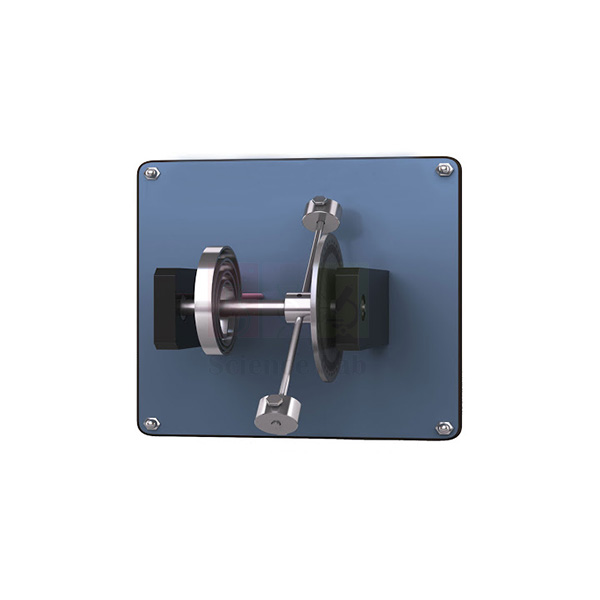
Vibration Of Spiral Spring Apparatus
Vibration Of Spiral Spring Apparatus (Product Code: SLE/MCE/32) is a wall-mounted torsional oscillator used to study the stiffness and free vibration of a flat spiral spring in theory of machines and mechanical engineering laboratories. Its spring has a listed stiffness of 238 Nmm and a 10 x 1 mm cross-section, and two levers with sliding weights let students change the rotating mass while an integrated 360° scale reads the deflection. It is made by Jain Scientific Equipments Pvt Ltd (ScienceLab), an OEM manufacturer, at its own factory in Ambala, India.
Specifications
| Parameter | Detail |
|---|---|
| Spring stiffness | c = 238 Nmm |
| Spring cross-section | 10 x 1 mm |
| Effective spring length | Approx. 800 mm |
| Inside radius | 10 mm |
| Outside radius | 50 mm |
| Mass | 0.5 kg |
| Diameter | 50 mm |
| Axis | Mounted on ball bearings |
| Levers | 2 levers with sliding weights |
| Deflecting element | Metallic rod carrying masses at its ends |
| Angle measuring scale | Integrated on the axis, 360°, resolution 1° |
| Mounting | Wall mounting plate of anodised aluminium |
| Base plate (w x h) | 200 x 250 mm |
| Product code | SLE/MCE/32 |
| Manufacturer | Jain Scientific Equipments Pvt Ltd (ScienceLab) — OEM |
| Country of origin | India (made in Ambala, Haryana) |
What Is the Spiral Spring Vibration Apparatus Used For?
The practical runs in two stages. In the static stage, the metallic rod with its end masses applies a moment that turns the shaft against the spiral spring, and the angle scale shows the resulting deflection, so students can calculate the spring stiffness and read how far the spring was deflected initially. In the dynamic stage the rod is released, the spring-mass system oscillates freely, and the timed period is compared with the value predicted from stiffness and moment of inertia.
Sliding the weights along the two levers changes the moment of inertia without changing the spring, so one unit produces a full series of frequency readings for a graph. The ball-bearing axis keeps friction low, helping the oscillations last long enough to time several cycles. Fix the anodised aluminium plate firmly to a solid wall at a comfortable reading height; it is compact engineering lab equipment for vibration and SHM practicals in India and abroad.
What to Specify When Ordering
- Number of units, for example one per bench or student group
- Wall space for each 200 x 250 mm base plate
- A stopwatch or timer for the oscillation readings, if your laboratory does not already have one
OEM Manufacturer
ScienceLab is the OEM for this apparatus. Jain Scientific Equipments Private Limited, the company behind the ScienceLab name, manufactures it at its own licensed factory at Saha, Ambala, Haryana, India, so it reaches buyers factory-direct rather than through a trading chain.
Technical colleges, TVET institutes, dealers and importers get quotations and technical answers from the source, and requests for replacement levers or weights on existing units go straight to the maker — just ask us. Read about the company on the ScienceLab profile page.
Related Theory of Machines Equipment
Other apparatus and accessories used in the same vibration and rotational dynamics course:
- Rotational Moment of Inertia Apparatus — torsional oscillation of a plate on three strings.
- Free and Forced Vibration Apparatus — extends the topic to damped and forced vibration.
- Free Vibration Of Beam Spring — free vibration of a beam and spring system for comparison.
- Stopwatch, Digital — times the oscillation period.
See the complete Theory of Machines category for further vibration and mechanism trainers.
Frequently Asked Questions
What is the spring stiffness of the Vibration Of Spiral Spring Apparatus?
The spiral spring of the Vibration Of Spiral Spring Apparatus has a listed stiffness of c = 238 Nmm, a 10 x 1 mm cross-section and an effective length of approximately 800 mm, with an inside radius of 10 mm and an outside radius of 50 mm.
How is deflection read on the Vibration Of Spiral Spring Apparatus?
Deflection on the Vibration Of Spiral Spring Apparatus is read on an integrated angle measuring scale mounted on the axis. The scale covers 360° with a resolution of 1°, and it also shows how far the spring was deflected initially.
How is the Vibration Of Spiral Spring Apparatus installed?
The Vibration Of Spiral Spring Apparatus is built on a wall mounting plate made of anodised aluminium, with a base plate of 200 x 250 mm (width x height). Fix it to a solid wall at eye level so students can read the angle scale comfortably.
Can students change the oscillating mass on the Vibration Of Spiral Spring Apparatus?
Yes. The Vibration Of Spiral Spring Apparatus has two levers with sliding weights, so students can move the weights to change the moment of inertia and record how the natural frequency of the spring system changes with each setting.
Who manufactures the Vibration Of Spiral Spring Apparatus?
The Vibration Of Spiral Spring Apparatus is manufactured by Jain Scientific Equipments Pvt Ltd (ScienceLab), the OEM, at its own licensed factory at Saha, Ambala, Haryana, India. It is supplied factory-direct to institutions, dealers and importers.
What should a quotation request for the Vibration Of Spiral Spring Apparatus include?
For a Vibration Of Spiral Spring Apparatus quotation, give the number of units, the delivery location in India or abroad, and any extra items, such as stopwatches, that you want on the same quotation. Use the contact page to send it.
Request a Quote
Ask for a price on the Vibration Of Spiral Spring Apparatus (SLE/MCE/32) through our contact page, or add it to the enquiry cart with the rest of your laboratory list. Your quotation is prepared by the manufacturer itself.
Last updated: 24 September 2026
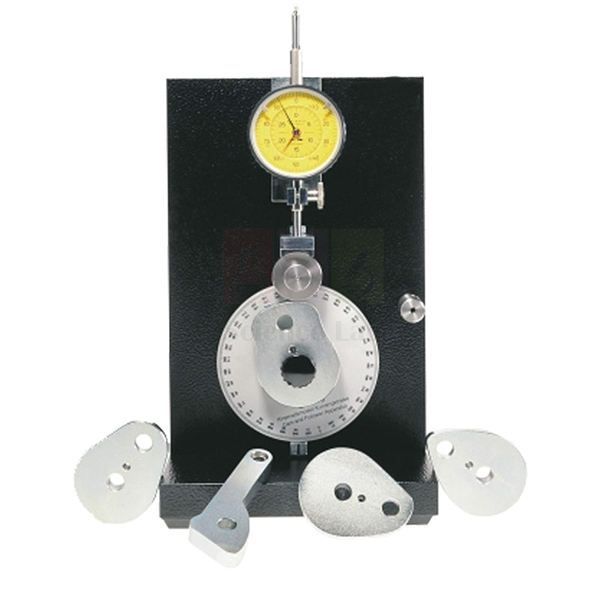
Cam Mechanism
Cam Mechanism (Product Code: SLE/MCE/75) is a bench-top demonstration unit used to show how a rotating cam converts uniform rotation into non-uniform follower motion, with or without dwell, in theory of machines laboratories. Students fit one of four cam shapes and one of three engaging members, then read the follower stroke on a 0–30 mm dial gauge against the cam angle on a 360° scale. It is made by Jain Scientific Equipments Pvt Ltd (ScienceLab), an OEM manufacturer, at its own factory in Ambala, India.
Specifications
| Parameter | Detail |
|---|---|
| Cam shapes | 4: circular arc, tangent, hollow, asymmetric |
| Engaging members | 3: roller plunger, flat plunger, cam follower |
| Angular scale | 0–360°, graduation 1°, for the angle of rotation |
| Dial gauge for the stroke | 0–30 mm, graduation 0.01 mm |
| Changeover | Cam and engaging member exchanged without tools |
| Dimensions | 300 x 300 x 400 mm |
| Weight | 8 kg |
| Product code | SLE/MCE/75 |
| Manufacturer | Jain Scientific Equipments Pvt Ltd (ScienceLab) — OEM |
| Country of origin | India (made in Ambala, Haryana) |
What Is the Cam Mechanism Used For?
A cam is a shaped disc that pushes a follower through a planned motion as it turns, as in engine valve gear and automatic machinery. On this unit, students set the cam to successive positions on the angular scale and record the stroke on the dial gauge, building a displacement diagram of follower lift against cam angle. Repeating the test with the circular arc, tangent, hollow and asymmetric cams shows how the profile shapes the rise, dwell and return of the follower.
Swapping between the roller plunger, flat plunger and cam follower needs no tools, so the class can compare how each engaging member traces the same profile within one session. From the displacement readings, advanced students can estimate follower velocity and acceleration by differentiating the curve, a standard exercise in a kinematics of machines course. Keep the dial gauge plunger clean and square to the follower to make full use of its 0.01 mm graduation.
OEM Manufacturer
The Cam Mechanism is an OEM product of ScienceLab. Jain Scientific Equipments Private Limited, trading under the ScienceLab name, manufactures it at its own licensed factory at Saha, Ambala, Haryana, India, and sells it factory-direct to engineering colleges, polytechnics, ITIs, dealers and importers.
Because the maker handles each order, questions about extra cams, spare engaging members or repeat orders for more benches can be raised with us directly. The ScienceLab company profile explains more about the company as an engineering lab equipment manufacturer.
Related Theory of Machines Equipment
Mechanisms that are usually taught alongside cams in a kinematics laboratory:
- Cam Analysis Machine — a further machine for studying cam and follower behaviour.
- Four Bar Chain Apparatus — the basic linkage studied next to cams in motion conversion.
- Gear Trainer Demonstrator — gear drives for comparison with cam-driven motion.
- Internal Gear Pinion Drive — another hands-on power transmission demonstration.
Explore the wider Theory of Machines category for more mechanism trainers.
Frequently Asked Questions
Which cam shapes come with the Cam Mechanism?
The Cam Mechanism has four cam shapes: circular arc, tangent, hollow and asymmetric. Using all four on the same unit lets students compare the follower displacement that each profile produces and relate the curve to the shape of the cam.
What followers can be used on the Cam Mechanism?
The Cam Mechanism accepts three engaging members: a roller plunger, a flat plunger and a cam follower. Both the cam and the engaging member can be exchanged without tools, so changeovers between tests take very little class time.
How are readings taken on the Cam Mechanism?
On the Cam Mechanism, the follower stroke is read on a dial gauge with a 0–30 mm range and 0.01 mm graduation, while the cam rotation is read on an angular scale from 0 to 360° with 1° graduation.
How large is the Cam Mechanism?
The Cam Mechanism measures 300 x 300 x 400 mm and weighs 8 kg. It is a bench-top unit, so it can be set up on an ordinary laboratory bench without a dedicated frame or floor space.
Who manufactures the Cam Mechanism?
The Cam Mechanism is manufactured by Jain Scientific Equipments Pvt Ltd (ScienceLab), the OEM, at its own licensed factory at Saha, Ambala, Haryana, India. Quotations come directly from the manufacturer, not from an intermediary.
Is a calibration certificate available for the Cam Mechanism dial gauge?
Calibration paperwork for the Cam Mechanism dial gauge is not stated in the product listing. If your department needs a calibration certificate, mention it in your enquiry so that availability can be discussed with us before you order.
Can the Cam Mechanism be supplied for several laboratories?
Yes, the Cam Mechanism can be quoted in multiple units for colleges, training institutes and dealers in India and international markets. Send the quantity and destination through the contact page for a consolidated quotation.
Request a Quote
Request a price for the Cam Mechanism (SLE/MCE/75) through our contact page or by adding it to the enquiry cart. Quotations are sent directly by the manufacturer in Ambala.
Last updated: 24 September 2026
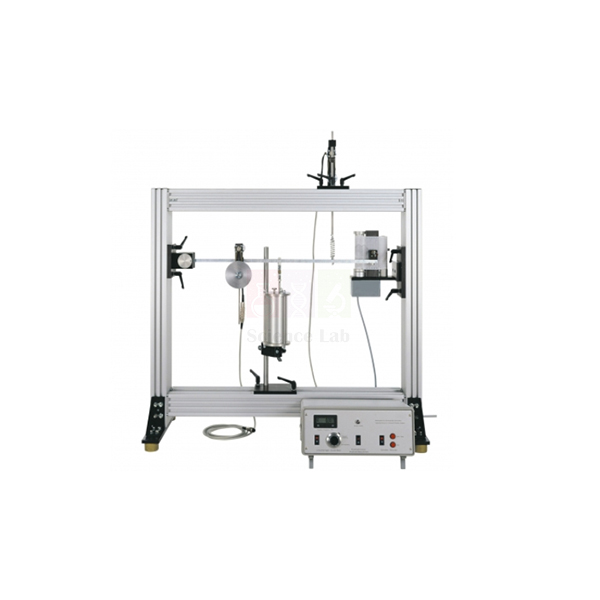
Free and Forced Vibration Apparatus
Free and Forced Vibration Apparatus (Product Code: SLE/MCE/76) is a vibration trainer used to study free, damped and forced mechanical vibration of a bar-type oscillator in mechanical engineering laboratories. Its electronically controlled exciter runs from 0 to 50 Hz, an oil-filled hydraulic damper gives adjustable damping, and a mechanical drum recorder traces each response on paper. It is made by Jain Scientific Equipments Pvt Ltd (ScienceLab), an OEM manufacturer, at its own factory in Ambala, India.
Specifications
| Parameter | Detail |
|---|---|
| Topics | Fundamentals of mechanical vibration theory: free, damped and forced |
| Bar-type oscillator (L x W x H) | 700 x 25 x 12 mm, 1.6 kg |
| Coil springs | 0.75 N/mm, 1.5 N/mm, 3.0 N/mm |
| Exciter frequency | 0–50 Hz, electronically controlled; set and displayed on a control unit |
| Imbalance exciter | Imbalance 0–1000 mmg |
| Displacement exciter | Stroke 20 mm |
| Damper | Oil hydraulic, oil-filled; damper constant 5–15 Ns/m, adjustable damping level |
| Drum recorder | Mechanical; feed 20 mm/s; paper width 100 mm |
| Data acquisition | Optional unit for displaying and analysing measured values on a PC |
| Dimensions | 1200 x 600 x 1400 mm |
| Weight | 125 kg |
| Power supply | 230 V, 50 Hz, 1 phase; or 230 V, 60 Hz, 1 phase; or 120 V, 60 Hz, 1 phase |
| Product code | SLE/MCE/76 |
| Manufacturer | Jain Scientific Equipments Pvt Ltd (ScienceLab) — OEM |
| Country of origin | India (made in Ambala, Haryana) |
What Is the Free and Forced Vibration Apparatus Used For?
The bar-type oscillator works together with interchangeable coil springs and, depending on the experiment, is left to vibrate freely, slowed by the oil damper, or driven by one of the two exciters. In free vibration tests, students displace the bar, release it and use the drum recorder trace to find the natural frequency; with the damper connected, the decay of successive peaks gives the logarithmic decrement and damping ratio. Changing between the 0.75, 1.5 and 3.0 N/mm springs shows how stiffness shifts the natural frequency.
For forced vibration, the control unit sets the excitation frequency up to 50 Hz, driving the bar through either the imbalance exciter (0–1000 mmg) or the displacement exciter (20 mm stroke). Stepping through the range and recording amplitude reveals resonance, and repeating the sweep at several damper settings shows how damping flattens the resonance peak. This makes the unit core engineering lab equipment for dynamics of machinery courses in India; let the exciter settle at each frequency before taking a trace.
What to Specify When Ordering
- Power supply version: 230 V 50 Hz, 230 V 60 Hz or 120 V 60 Hz, single phase
- Whether the optional data acquisition unit for PC display and analysis is required
- Spare 100 mm recorder paper for the drum recorder, if needed (ask us)
- Quantity and delivery location in India or abroad
OEM Manufacturer
This vibration trainer is manufactured by ScienceLab as the OEM. Jain Scientific Equipments Private Limited, whose trading name is ScienceLab, produces it at its own licensed factory at Saha, Ambala, Haryana, India, and quotes it directly to universities, engineering colleges, dealers and importers.
With the manufacturer as your single point of contact, questions on the power supply version, the optional data acquisition unit, or spares for the recorder and damper are answered by the people who build the unit. Visit the company profile for more about ScienceLab.
Related Theory of Machines Equipment
Apparatus that complements this trainer in a vibrations and dynamics laboratory:
- Free And Forced Vibrations — a further apparatus on the same topic for additional student groups.
- Damper Kit — for additional damping experiments.
- Vibration Of Spiral Spring Apparatus — torsional free vibration of a spiral spring.
- Free Vibrations Test Frame — a test frame for free vibration experiments.
The Theory of Machines category lists further vibration, balancing and mechanism equipment.
Frequently Asked Questions
What types of vibration can be studied on the Free and Forced Vibration Apparatus?
The Free and Forced Vibration Apparatus covers the fundamentals of mechanical vibration theory: free vibration, damped vibration using an adjustable oil hydraulic damper, and forced vibration driven by an electronically controlled exciter from 0 to 50 Hz.
Which springs does the Free and Forced Vibration Apparatus use?
The Free and Forced Vibration Apparatus lists three coil springs rated 0.75 N/mm, 1.5 N/mm and 3.0 N/mm. Changing the spring changes the natural frequency of the bar-type oscillator, which measures 700 x 25 x 12 mm and weighs 1.6 kg.
How are results recorded on the Free and Forced Vibration Apparatus?
The Free and Forced Vibration Apparatus records vibrations on a mechanical drum recorder with 20 mm/s feed and 100 mm paper width. An optional data acquisition unit lets measured values be displayed and analysed on a PC; ask us whether to include it in your quotation.
What power supply does the Free and Forced Vibration Apparatus need?
The Free and Forced Vibration Apparatus runs on single-phase power in one of three versions: 230 V 50 Hz, 230 V 60 Hz or 120 V 60 Hz. State your mains supply when ordering so that the matching version is quoted.
How much space does the Free and Forced Vibration Apparatus need?
The Free and Forced Vibration Apparatus measures 1200 x 600 x 1400 mm and weighs 125 kg. Plan a fixed position near a power outlet with enough room around it for a group of students to watch the recorder.
Who manufactures the Free and Forced Vibration Apparatus?
The Free and Forced Vibration Apparatus is manufactured by Jain Scientific Equipments Pvt Ltd (ScienceLab), the OEM, at its own licensed factory at Saha, Ambala, Haryana, India. Buyers deal with the manufacturer directly for quotations and spares.
Request a Quote
For a quotation on the Free and Forced Vibration Apparatus (SLE/MCE/76), tell us your power supply version, quantity and delivery location through the contact page, or add it to the enquiry cart. The quote comes direct from the manufacturer.
Last updated: 24 September 2026
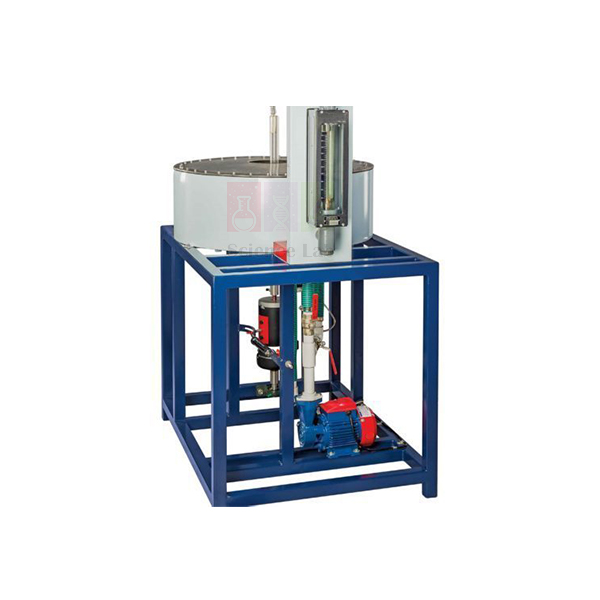
Corollis Component of Acceleration Apparatus
Corollis Component of Acceleration Apparatus (Product Code: SLE/MCE/77) is a self-contained water-jet rig used to determine the Coriolis component of acceleration at different rotation speeds and water flow rates in theory of machines laboratories. Water leaves rotating arms with 9 mm and 6 mm orifice diameters, while a 250–2500 LPH rotameter shows the flow and a variable-speed swinging-field motor sets the speed. It is made by Jain Scientific Equipments Pvt Ltd (ScienceLab), an OEM manufacturer, at its own factory in Ambala, India.
Specifications
| Parameter | Detail |
|---|---|
| Water tank | Stainless steel |
| Rotating arms | 9 mm / 6 mm orifice diameter, length 300 mm |
| Rotameter | 250 to 2500 LPH |
| Electric motor | Swinging field type, variable speed, with its own speed control unit |
| Pump | FHP (fractional horsepower) pump for water circulation |
| Water circuit | Self-contained, water re-circulating |
| Frame | Powder-coated rigid structure |
| Dimensions | 800 x 800 x 1200 mm |
| Weight | 115 kg |
| Power supply | 230 V, 50 Hz, 1 phase; or 230 V, 60 Hz, 1 phase; or 120 V, 60 Hz, 1 phase |
| Product code | SLE/MCE/77 |
| Manufacturer | Jain Scientific Equipments Pvt Ltd (ScienceLab) — OEM |
| Country of origin | India (made in Ambala, Haryana) |
What Is the Coriolis Acceleration Apparatus Used For?
When a body moves outward along a link that is itself rotating, it gains an extra acceleration at right angles to the link, equal to twice the product of the angular velocity and the sliding velocity. This is the Coriolis component, a key idea in the kinematics of slotted-link and quick-return mechanisms. In this apparatus the moving body is water flowing out along the rotating arms, which makes the effect measurable in a classroom.
A typical session holds the flow steady on the rotameter, runs the arms at several speeds with the speed control unit, then repeats at other flow rates, so students see how the component depends on both angular velocity and flow velocity and compare their results with theory. Because the tank, pump and arms form a closed re-circulating circuit on one powder-coated frame, the rig needs no water supply line, which suits engineering lab equipment rooms in India and abroad. Check the water level before each run and raise the speed gradually.
What to Specify When Ordering
- Power supply version: 230 V 50 Hz, 230 V 60 Hz or 120 V 60 Hz, single phase
- Number of units required
- Delivery location, so that the quotation matches your destination
OEM Manufacturer
ScienceLab builds this rig as the OEM. Its legal entity, Jain Scientific Equipments Private Limited, manufactures the Corollis Component of Acceleration Apparatus at its own licensed factory at Saha, Ambala, Haryana, and supplies it directly to engineering institutions, laboratory dealers and importers, with no trading intermediary in between.
For vendor files, the company is registered as an MSME enterprise whose major activity is manufacturing (Udyam UDYAM-HR-01-0003714), and overseas orders ship under DGFT Importer-Exporter Code AAECJ8618A. Learn more on the ScienceLab profile.
Related Theory of Machines Equipment
Other apparatus for rotating systems and the flow measurement behind this experiment:
- Flow Meter Demonstration Unit — explains the flow measurement principles behind the rotameter reading.
- Governor — another speed-dependent rotating mechanism in the same course.
- Gyroscope Experiment Manual — gyroscopic effects, a further topic in rotating-frame dynamics.
- Static and Dynamic Balancing Apparatus — inertia forces of rotating masses.
Find more equipment in the Theory of Machines category.
Frequently Asked Questions
What does the Corollis Component of Acceleration Apparatus measure?
The Corollis Component of Acceleration Apparatus is used to determine the Coriolis component of acceleration at various speeds of rotation and water flow rates, so students can compare their measured results with the theoretical value from angular velocity and flow velocity.
What flow range does the Corollis Component of Acceleration Apparatus cover?
The Corollis Component of Acceleration Apparatus has a rotameter reading from 250 to 2500 LPH (litres per hour). The water leaves rotating arms that have 9 mm and 6 mm orifice diameters and a length of 300 mm.
Does the Corollis Component of Acceleration Apparatus need a water connection?
No water line is listed: the Corollis Component of Acceleration Apparatus is self-contained and water re-circulating, with its own stainless steel tank, speed control unit and FHP circulating pump. Fill the tank before use and connect single-phase power.
What power supply does the Corollis Component of Acceleration Apparatus need?
The Corollis Component of Acceleration Apparatus needs single-phase power in one of three versions: 230 V 50 Hz, 230 V 60 Hz or 120 V 60 Hz. Tell us which supply your laboratory uses so that the correct version is quoted.
How big is the Corollis Component of Acceleration Apparatus?
The Corollis Component of Acceleration Apparatus measures 800 x 800 x 1200 mm and weighs 115 kg on a powder-coated rigid structure. Allow floor space for the unit plus room for students to read the rotameter safely.
Who manufactures the Corollis Component of Acceleration Apparatus?
The Corollis Component of Acceleration Apparatus is manufactured by Jain Scientific Equipments Pvt Ltd (ScienceLab), the OEM, at its own licensed factory at Saha, Ambala, Haryana, India. Quotations and spares requests are handled by the manufacturer itself.
Request a Quote
To price the Corollis Component of Acceleration Apparatus (SLE/MCE/77), send your power supply version, quantity and destination through the contact page, or add it to the enquiry cart. You receive the quotation directly from the manufacturer.
Last updated: 24 September 2026
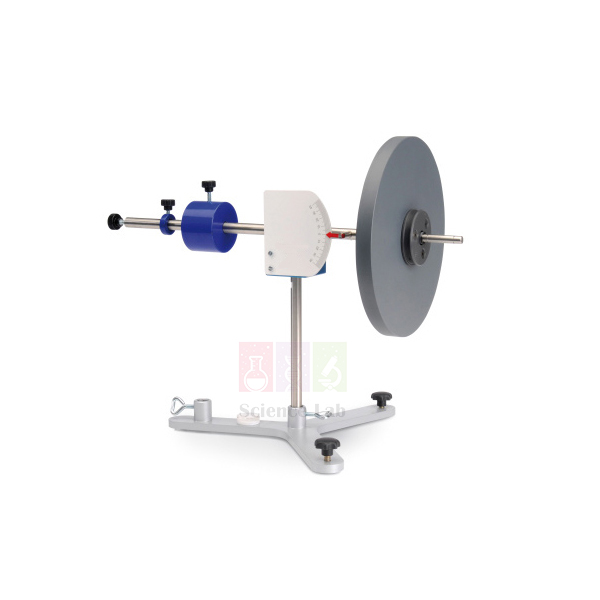
Gyroscope Experiment Manual
Gyroscope Experiment Manual (Product Code: SLE/MCE/78) is a hand-spun gyroscope apparatus used to demonstrate precession and the gyroscopic couple in theory of machines and physics laboratories. A 250 mm, 1500 g disc runs on dual ball bearings at one end of a tilting shaft, balanced by a movable 1400 g counterweight, and the shaft angle is read on a scale from -40° to +40°. It is made by Jain Scientific Equipments Pvt Ltd (ScienceLab), an OEM manufacturer, at its own factory in Ambala, India.
Specifications
| Parameter | Detail |
|---|---|
| Construction | Open design; shaft that can be tilted and rotated, attached to a stand rod |
| Disc | 250 mm diameter, 1500 g, on dual ball bearings |
| Counterweight | 1400 g, movable, for establishing equilibrium |
| Additional weight | 50 g |
| Inclination scale | -40° to +40°, 1° divisions |
| Levelling | Spirit level for adjusting the gyroscope to the horizontal |
| Fine adjustment | Thumbscrew at the end of the shaft |
| Disc drive | By hand or by means of a cord |
| Dimensions | 400 x 300 x 400 mm |
| Weight | 15 kg |
| Product code | SLE/MCE/78 |
| Manufacturer | Jain Scientific Equipments Pvt Ltd (ScienceLab) — OEM |
| Country of origin | India (made in Ambala, Haryana) |
What Is the Gyroscope Experiment Apparatus Used For?
With the disc at rest, students first use the movable counterweight, the spirit level and the thumbscrew to balance the shaft horizontally. They then spin the disc by hand or with the cord and apply the 50 g additional weight to unbalance the shaft: instead of simply dropping, the shaft swings slowly around the vertical axis. This precession is the classic gyroscopic effect, and timing it against the disc speed lets the class compare observed precession with the value predicted from the disc's angular momentum.
Because the dual ball bearings keep the rotation nearly frictionless, the disc keeps turning for long periods, leaving time for several readings from one spin. The open construction lets a whole group watch the shaft's motion, while the inclination scale records how far the shaft tilts. The apparatus links physics lab equipment in India for angular momentum with engineering cases such as the gyroscopic couple on ships, aircraft and vehicles taking a turn.
OEM Manufacturer
ScienceLab is the original equipment manufacturer of this gyroscope. Jain Scientific Equipments Private Limited, known to buyers as ScienceLab, makes it at its own licensed factory at Saha, Ambala, Haryana, India, and dispatches it factory-direct to schools, colleges, dealers and importers.
Queries on repeat orders, or on replacement parts such as the cord or weights, come straight to the maker; ask us for details. The ScienceLab company profile has more about the company.
Related Theory of Machines Equipment
Useful companions for angular momentum and rotating-system experiments:
- Gyroscope — a physics-lab gyroscope for introductory demonstrations.
- Rotational Moment of Inertia Apparatus — measures the moment of inertia that sets a disc's angular momentum.
- Stopwatch, Digital — times the precession of the shaft.
- Corollis Component of Acceleration Apparatus — another rotating-system effect in the same course.
Browse the Theory of Machines category for related trainers.
Frequently Asked Questions
Is the Gyroscope Experiment Manual a printed manual?
No. The Gyroscope Experiment Manual listed here is a gyroscope apparatus with a disc, counterweight and inclination scale, and its disc is set rotating by hand or with a cord. If you also need written experiment instructions, ask us through the contact page.
What are the disc details of the Gyroscope Experiment Manual?
The Gyroscope Experiment Manual has a disc of 250 mm diameter and 1500 g mass, mounted on dual ball bearings so that rotation is nearly frictionless. A 1400 g counterweight and a 50 g additional weight are also listed.
How is the Gyroscope Experiment Manual balanced before a test?
The Gyroscope Experiment Manual is balanced by moving the counterweight along the shaft, checking the horizontal position with the built-in spirit level and making the final correction with the thumbscrew at the end of the shaft.
What tilt range does the Gyroscope Experiment Manual scale show?
The inclination scale on the Gyroscope Experiment Manual reads from -40° to +40° in 1° divisions, so students can record how far the shaft tilts during precession experiments and when weights are added.
How large is the Gyroscope Experiment Manual?
The Gyroscope Experiment Manual measures 400 x 300 x 400 mm and weighs 15 kg. It stands on a laboratory bench, and its open construction lets students watch the gyroscopic motion clearly from around the table.
Who manufactures the Gyroscope Experiment Manual?
The Gyroscope Experiment Manual is manufactured by Jain Scientific Equipments Pvt Ltd (ScienceLab), the OEM, at its own licensed factory at Saha, Ambala, Haryana, India. Quotations for India and international markets come directly from the manufacturer.
Request a Quote
For a price on the Gyroscope Experiment Manual (SLE/MCE/78), contact us through the contact page or add it to the enquiry cart, stating quantity and delivery location. The manufacturer prepares your quotation directly.
Last updated: 24 September 2026
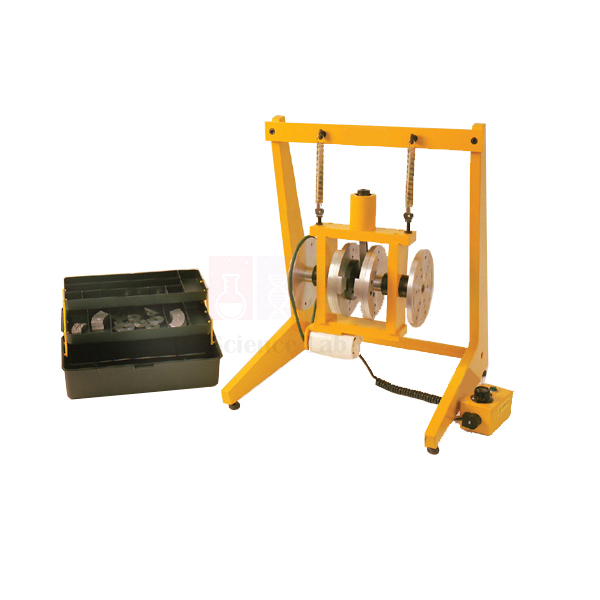
Static and Dynamic Balancing Apparatus
Static and Dynamic Balancing Apparatus (Product Code: SLE/MCE/79) is a rotating-shaft trainer used to show the difference between static and dynamic imbalance and to practise balancing rotating masses in theory of machines laboratories. Four imbalance masses attach to a smooth shaft at any angular and longitudinal position, and a variable-speed motor with belt drive turns the shaft up to 1400 rpm with a digital speed display. It is made by Jain Scientific Equipments Pvt Ltd (ScienceLab), an OEM manufacturer, at its own factory in Ambala, India.
Specifications
| Parameter | Detail |
|---|---|
| Main element | Smooth shaft mounted on ball bearings |
| Imbalance masses | 4, attachable at any angular and longitudinal position |
| Total imbalance | 880 cmg |
| Drive | Variable-speed electric motor with belt drive |
| Speed measuring range | 0–1400 min⁻¹ (rpm), displayed digitally |
| Guard | Transparent cover against contact with rotating parts, with a clear view of the shaft |
| Dimensions | 600 x 300 x 600 mm |
| Weight | 32 kg |
| Power supply | 230 V, 50 Hz, 1 phase; or 230 V, 60 Hz, 1 phase; or 120 V, 60 Hz, 1 phase |
| Product code | SLE/MCE/79 |
| Manufacturer | Jain Scientific Equipments Pvt Ltd (ScienceLab) — OEM |
| Country of origin | India (made in Ambala, Haryana) |
What Is the Static and Dynamic Balancing Apparatus Used For?
A rotor is statically balanced when it stays put in any angular position, yet it can still shake when it spins if its masses lie in different planes along the shaft; that is dynamic imbalance. On this unit, students first arrange the four imbalance masses so the shaft rests in any position, comparing the moment they produce about the shaft with the moment of the imbalance masses. They then run the motor and see whether the shaft turns smoothly or vibrates, which shows why static balance alone is not enough.
The usual exercise is to calculate the angular and axial positions of the masses by the graphical or analytical method taught in dynamics of machinery, set them on the shaft, and confirm the result by running at increasing speed on the digital display. Close the transparent cover before starting the motor and tighten every mass securely. For colleges building a set of mechanics lab equipment in India, it pairs naturally with whirling-of-shaft and vibration apparatus.
OEM Manufacturer
The Static and Dynamic Balancing Apparatus is produced by ScienceLab as the OEM. Jain Scientific Equipments Private Limited, which operates under the ScienceLab name, manufactures it at its own licensed factory at Saha, Ambala, Haryana, India, so universities, polytechnics, laboratory suppliers and importers can buy straight from the source.
Repeat orders and requests for spare imbalance masses or a replacement drive belt are handled by the manufacturer itself; ask us. More information is on the ScienceLab company profile.
Related Theory of Machines Equipment
Rotating-shaft apparatus often installed in the same dynamics laboratory:
- Whirling of Shaft Apparatus — critical speeds of slender rotating shafts.
- Free and Forced Vibration Apparatus — the forced vibration that an unbalanced rotor produces.
- Journal Bearing Demonstration — how shafts are supported in bearings.
See all apparatus in the Theory of Machines category.
Frequently Asked Questions
What does the Static and Dynamic Balancing Apparatus demonstrate?
The Static and Dynamic Balancing Apparatus demonstrates the difference between static and dynamic imbalance on a rotating shaft, and lets students balance four masses by calculation before checking the result with the shaft running under motor drive.
How many imbalance masses does the Static and Dynamic Balancing Apparatus have?
The Static and Dynamic Balancing Apparatus has four variable imbalance masses with a total imbalance of 880 cmg. Each mass can be attached to the smooth shaft at any angular and longitudinal position.
What speed range does the Static and Dynamic Balancing Apparatus cover?
The Static and Dynamic Balancing Apparatus runs from 0 to 1400 min⁻¹ (rpm). A variable-speed electric motor drives the shaft through a belt, and the shaft speed is displayed digitally for each test.
How are students protected on the Static and Dynamic Balancing Apparatus?
The Static and Dynamic Balancing Apparatus has a transparent cover that protects against contact with the rotating parts while leaving a clear view of the shaft. Keep the cover closed whenever the motor is running.
What power supply and space does the Static and Dynamic Balancing Apparatus need?
The Static and Dynamic Balancing Apparatus is offered for 230 V 50 Hz, 230 V 60 Hz or 120 V 60 Hz single-phase supply. It measures 600 x 300 x 600 mm and weighs 32 kg, so it fits on a sturdy bench.
Who manufactures the Static and Dynamic Balancing Apparatus?
The Static and Dynamic Balancing Apparatus is manufactured by Jain Scientific Equipments Pvt Ltd (ScienceLab), the OEM, at its own licensed factory at Saha, Ambala, Haryana, India. Orders from India and international markets are quoted directly by the manufacturer.
Request a Quote
Send the quantity, power supply version and delivery location for the Static and Dynamic Balancing Apparatus (SLE/MCE/79) through our contact page, or add it to the enquiry cart. The manufacturer replies with the quotation directly.
Last updated: 24 September 2026
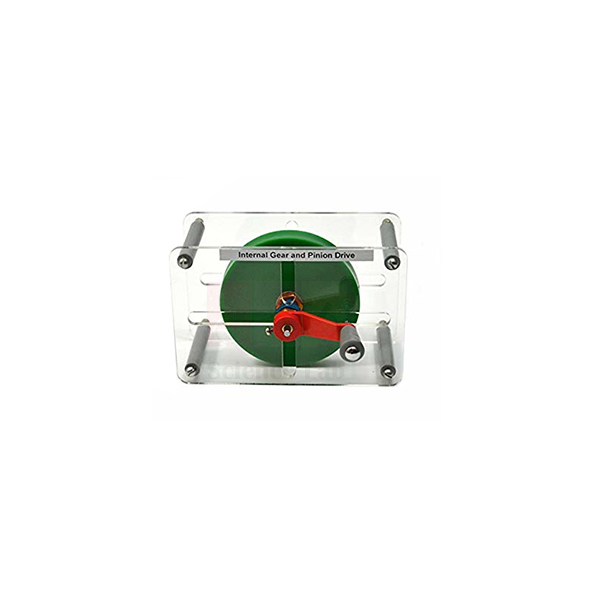
Internal Gear Pinion Drive
Internal Gear Pinion Drive (Product Code: SLE/MCE/80) is a hand-cranked bench-top model used to demonstrate the fundamentals of how an internal gear and pinion drive works in theory of machines and technical training classrooms. The gear train is left open for study between two clear plastic plates, and two dials show rotation so students can compare the movement of the gears. It is made by Jain Scientific Equipments Pvt Ltd (ScienceLab), an OEM manufacturer, at its own factory in Ambala, India.
Specifications
| Parameter | Detail |
|---|---|
| Operation | Manual, by hand crank |
| Construction | Heavy duty metal and plastic |
| Gear train | Open system for study, sandwiched between two clear plastic plates |
| Indicators | 2 dials to show rotation |
| Layout | On base; bench top or desktop use |
| Dimensions | 400 x 200 x 300 mm |
| Weight | 5 kg |
| Product code | SLE/MCE/80 |
| Manufacturer | Jain Scientific Equipments Pvt Ltd (ScienceLab) — OEM |
| Country of origin | India (made in Ambala, Haryana) |
What Is the Internal Gear and Pinion Drive Used For?
In an internal gear drive, a small pinion meshes with teeth cut on the inside of a larger ring gear. Unlike an ordinary external gear pair, both gears turn in the same direction and the centre distance is shorter, which is why the arrangement appears in planetary gearboxes and compact reduction drives. Turning the hand crank slowly lets students watch the teeth engage through the clear plates and see the same-direction rotation for themselves.
Using the two dials, the class can count turns and compare the result with the ratio of tooth numbers, then discuss why internal gearing gives a compact reduction. At 5 kg and 400 x 200 x 300 mm, the model is easy to carry between classroom and workshop, making it handy engineering educational equipment in India for ITI, polytechnic and first-year engineering courses. Wipe the plastic plates with a soft cloth so the mesh stays clearly visible.
OEM Manufacturer
This demonstrator is an OEM product. Jain Scientific Equipments Private Limited, trading as ScienceLab, manufactures the Internal Gear Pinion Drive at its own licensed factory at Saha, Ambala, Haryana, India, rather than reselling a bought-in model.
Training institutes, schools, dealers and importers order it directly from the manufacturer, which also handles repeat orders when more classrooms need the same model. Read more on the ScienceLab company profile.
Related Theory of Machines Equipment
Gear and mechanism models that complete a power transmission lesson:
- Gear Trainer Demonstrator — external gear pairs for direct comparison with internal gearing.
- Gear Train Model — gear trains and their overall speed ratio.
- Geared Systems — further geared arrangements for advanced classes.
- Cam Mechanism — another way of converting rotary motion.
More models are listed in the Theory of Machines category.
Frequently Asked Questions
What does the Internal Gear Pinion Drive demonstrate?
The Internal Gear Pinion Drive demonstrates the fundamentals of how an internal gear and pinion drive works: a pinion meshing inside a ring gear, same-direction rotation of both gears, and the speed ratio shown on its two rotation dials.
How is the Internal Gear Pinion Drive operated?
The Internal Gear Pinion Drive is operated manually with a hand crank, so no electrical connection is listed. Students control the speed themselves, which makes it easy to stop at any position and examine how the teeth mesh.
What is the Internal Gear Pinion Drive made of?
The Internal Gear Pinion Drive is constructed from heavy duty metal and plastic. Its open gear system sits between two clear plastic plates on a base, so the working parts remain visible from both sides during a demonstration.
How big is the Internal Gear Pinion Drive?
The Internal Gear Pinion Drive measures 400 x 200 x 300 mm and weighs 5 kg. It is designed as a bench top or desktop item, so it needs no special stand or floor space.
Who manufactures the Internal Gear Pinion Drive?
The Internal Gear Pinion Drive is manufactured by Jain Scientific Equipments Pvt Ltd (ScienceLab), the OEM, at its own licensed factory at Saha, Ambala, Haryana, India. It is supplied factory-direct to institutions, dealers and importers.
Can the Internal Gear Pinion Drive be ordered for several classrooms?
Yes, the Internal Gear Pinion Drive can be quoted in multiple units for schools, training institutes and dealers in India and international markets. Send the quantity and destination through the contact page for a single consolidated quotation.
Request a Quote
To order the Internal Gear Pinion Drive (SLE/MCE/80), use the contact page or add it to the enquiry cart with your quantity. Quotations are issued directly by the manufacturer in Ambala.
Last updated: 24 September 2026
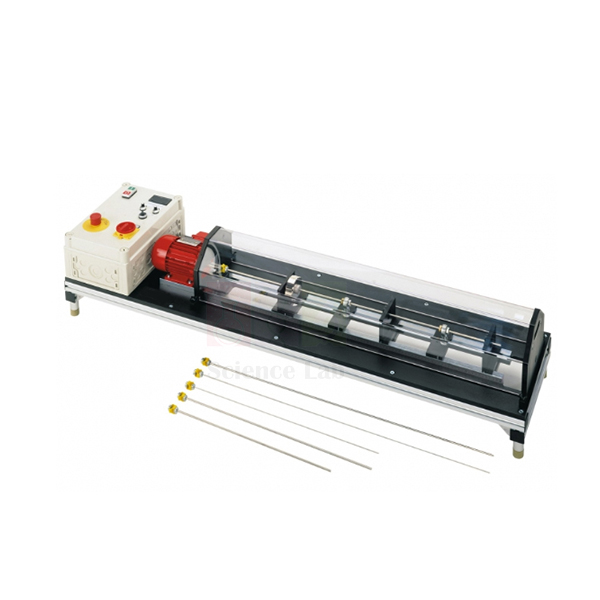
Whirling of Shaft Apparatus
Whirling of Shaft Apparatus (Product Code: SLE/MCE/81) is a rotor dynamics trainer used to find the critical (whirling) speeds and mode shapes of slender rotating shafts in mechanical engineering laboratories. Six high-strength steel rotor shafts of 3, 6 and 7 mm diameter and 600 or 900 mm length are driven by a 0.37 kW adjustable-speed motor up to 6000 rpm behind a transparent protective cover. It is made by Jain Scientific Equipments Pvt Ltd (ScienceLab), an OEM manufacturer, at its own factory in Ambala, India.
Specifications
| Parameter | Detail |
|---|---|
| Rotor shafts | 6, high-strength steel |
| Shaft diameters | 3 mm, 6 mm, 7 mm |
| Shaft lengths | 600 mm, 900 mm |
| Other listed data | Diameter 80 mm; weight 1 kg |
| Experiment variables | Bearing spacing and shaft diameter; mode shapes of continuous rotor shafts |
| Motor | 0.37 kW, adjustable speed, digital display, potentiometer adjustment, 2 preselectable rotational speeds |
| Speed range | 0–6000 min⁻¹ (rpm) |
| Guard | Transparent protective cover for clear observation |
| Dimensions | 1400 x 600 x 800 mm |
| Weight | 85 kg |
| Power supply | 230 V, 50 Hz, 1 phase; or 230 V, 60 Hz, 1 phase; or 120 V, 60 Hz, 1 phase |
| Product code | SLE/MCE/81 |
| Manufacturer | Jain Scientific Equipments Pvt Ltd (ScienceLab) — OEM |
| Country of origin | India (made in Ambala, Haryana) |
What Is the Whirling of Shaft Apparatus Used For?
Every slender shaft has speeds at which it bows outward and whirls, because the running speed coincides with a natural frequency of transverse vibration. Students fit a rotor shaft, raise the motor speed slowly with the potentiometers, and note on the digital display the speed at which the shaft visibly whirls, then compare it with the value calculated from shaft stiffness, mass and support conditions.
Repeating the run with the 3, 6 and 7 mm shafts, the 600 and 900 mm lengths and different bearing spacing shows how diameter, length and support position move the critical speed, while higher speeds reveal the mode shapes of a continuous rotor. The two preselectable speeds make it quick to return to a point of interest. Keep the cover closed and pass steadily through each critical speed; as engineering lab equipment in India for dynamics of machinery, it shows clearly why turbine and pump shafts are designed to run away from their critical speeds.
What to Specify When Ordering
- Power supply version: 230 V 50 Hz, 230 V 60 Hz or 120 V 60 Hz, single phase
- Spare rotor shafts, if you expect heavy student use (ask us)
- Number of units and the delivery location
OEM Manufacturer
ScienceLab manufactures the Whirling of Shaft Apparatus as the OEM at the licensed factory of Jain Scientific Equipments Private Limited in Saha, Ambala, Haryana, India. Engineering institutions, dealers and importers buy directly from the maker, so quotations, spare shafts and repeat orders are all handled by one company.
For institutional and tender vendor registration, the company's details are GSTIN 06AAECJ8618A1ZT and LEI 3358004HRD1JIVXKYX49. See the ScienceLab profile for more about the company.
Related Theory of Machines Equipment
Apparatus that builds the same rotor dynamics topic from different angles:
- Static and Dynamic Balancing Apparatus — the imbalance that excites whirling in real rotors.
- Free and Forced Vibration Apparatus — resonance studied on a spring-mounted beam.
- Free Vibrations Of A Cantilever — transverse vibration of a non-rotating member for comparison.
- Journal Bearing Demonstration — how rotating shafts are supported.
The Theory of Machines category lists all related trainers.
Frequently Asked Questions
What does the Whirling of Shaft Apparatus measure?
The Whirling of Shaft Apparatus is used to find the critical (whirling) speeds of rotating shafts and to observe the mode shapes of continuous rotor shafts, while varying bearing spacing and shaft diameter to see how each changes the result.
Which rotor shafts come with the Whirling of Shaft Apparatus?
The Whirling of Shaft Apparatus lists six rotor shafts of high-strength steel, with diameters of 3, 6 and 7 mm and lengths of 600 and 900 mm. Ask us through the contact page to confirm the exact diameter and length combination in the set.
What motor and speed range does the Whirling of Shaft Apparatus have?
The Whirling of Shaft Apparatus uses a 0.37 kW adjustable-speed motor running from 0 to 6000 min⁻¹ (rpm). Speed is set with potentiometers, shown on a digital display, and two rotational speeds can be preselected.
How does the Whirling of Shaft Apparatus protect users?
The Whirling of Shaft Apparatus has a transparent protective cover over the rotating shaft, so students can observe whirling and mode shapes closely without contact with moving parts. Keep the cover closed whenever the motor runs.
What space and power does the Whirling of Shaft Apparatus need?
The Whirling of Shaft Apparatus measures 1400 x 600 x 800 mm and weighs 85 kg. It is offered for 230 V 50 Hz, 230 V 60 Hz or 120 V 60 Hz single-phase supply, so state your mains supply when ordering.
Who manufactures the Whirling of Shaft Apparatus?
The Whirling of Shaft Apparatus is manufactured by Jain Scientific Equipments Pvt Ltd (ScienceLab), the OEM, at its own licensed factory at Saha, Ambala, Haryana, India. Quotations for India and international markets come directly from the manufacturer.
Is a calibration certificate available for the Whirling of Shaft Apparatus speed display?
Calibration documents for the Whirling of Shaft Apparatus speed display are not stated in the product listing. If your department requires a calibration certificate, mention it in your enquiry so that availability can be discussed with us before ordering.
Request a Quote
Request a quotation for the Whirling of Shaft Apparatus (SLE/MCE/81) through the contact page, or add it to the enquiry cart with your power supply version and quantity. The manufacturer quotes you directly.
Last updated: 24 September 2026
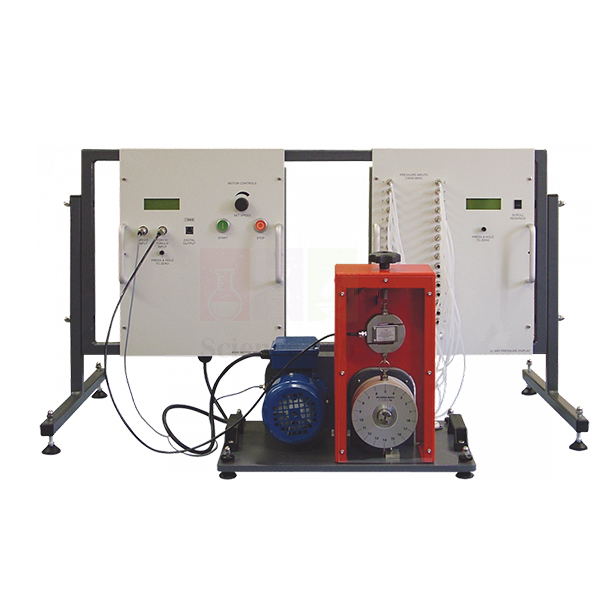
Air Bearing Apparatus
Air Bearing Apparatus (Product Code: SLE/ETM/01) is a bearing trainer used to show how a pressurised air film forms between a spinning shaft and its bush and supports load, in theory of machines and tribology laboratories. Students set shaft speed through a belt-driven motor drive module, load the bush by hand against a load cell, and read film pressure at tappings spaced evenly around the bush on a multichannel digital display. It is made by Jain Scientific Equipments Pvt Ltd (ScienceLab), an OEM engineering lab equipment manufacturer, at its own factory in Ambala, India.
Key Details
| Parameter | Detail |
|---|---|
| Drive | Variable-speed motor turning a belt drive to a precision bearing shaft |
| Shaft | High-quality surface finish; spins inside a vertically loaded bush |
| Bearing bush | Pressure tappings equally spaced around its circumference |
| Pressure display | Multichannel digital pressure display unit connected to the tappings |
| Loading | Hand-operated load control with a bearing bush load cell |
| Motor Drive Module | Varies bearing speed; displays bearing speed and the load at the load cell (speed sensor and load cell connect to it) |
| Instrument Frame | Holds the Motor Drive Module and Pressure Display Module, with extra space for an optional frame-mounted data acquisition unit |
| Product code | SLE/ETM/01 |
| Manufacturer | Jain Scientific Equipments Pvt Ltd (ScienceLab) — OEM |
| Country of origin | India (made in Ambala, Haryana) |
What Is the Air Bearing Apparatus Used For?
The apparatus lets students see the pressure distribution that allows a journal bearing to carry load without metal-to-metal contact. With the shaft running at a chosen speed, they read each tapping on the multichannel display, plot pressure against angular position around the bush, and repeat at other speeds and loads. Comparing the area under the pressure curve with the load cell reading links the measured film pressure to the load the bearing supports.
Typical exercises cover how peak pressure and its position shift as load rises, how speed affects the film’s load capacity, and where the film starts to break down at low speed. Bring the shaft up to speed before adding load, increase the hand-operated load in small steps, and let the display settle before recording. This makes it useful engineering educational equipment in India for mechanical engineering, tribology and machine design courses.
What to Specify When Ordering
- Whether the optional frame-mounted data acquisition unit is required (ask us about availability)
- Number of sets for your laboratory
- Whether related bearing apparatus, such as the Journal Bearing Demonstration, should be quoted together
OEM Manufacturer
ScienceLab is the trading name of Jain Scientific Equipments Private Limited, and the company is the OEM (original equipment manufacturer) of this air bearing apparatus. It builds and assembles the unit at its own licensed factory at Saha, Ambala, Haryana, India, rather than buying it in from a trader, and supplies it factory-direct to engineering colleges, universities, polytechnics, dealers and importers.
Because the maker handles your order directly, questions about the motor drive module, the pressure display or replacement parts go straight to the people who build them — just ask us. Read more on the ScienceLab company profile.
Related Theory of Machines Equipment
Apparatus for a complete bearings and tribology practical:
- Journal Bearing Demonstration — an oil-lubricated journal bearing for comparing liquid and gas films.
- Michell Pad Apparatus — hydrodynamic lubrication in a tilting-pad bearing.
- Hertzian Contact Apparatus — contact between two surfaces pressed together without a separating film.
- Whirling of Shaft Apparatus — the dynamic behaviour of shafts running at speed.
Browse all apparatus in the Theory of Machines category.
Frequently Asked Questions
What does the Air Bearing Apparatus measure?
The Air Bearing Apparatus measures film pressure at tappings equally spaced around the bearing bush, together with shaft speed and the load applied to the bush, so students can relate the pressure distribution to speed and load.
How is load applied to the bearing?
Load on the Air Bearing Apparatus is applied with a hand-operated load control acting on the vertically loaded bush, and a load cell measures it. The Motor Drive Module displays the measured load alongside the bearing speed.
How is shaft speed controlled?
The Air Bearing Apparatus uses a variable-speed motor and belt drive to turn its precision bearing shaft. The Motor Drive Module lets the user vary bearing speed and shows the value read from a speed sensor.
Can results be logged to a computer?
The Air Bearing Apparatus has an Instrument Frame with extra space for an optional frame-mounted data acquisition unit. Ask us about data acquisition availability when you enquire, since it is an option rather than part of the basic unit.
Who manufactures the Air Bearing Apparatus?
The Air Bearing Apparatus is manufactured by Jain Scientific Equipments Pvt Ltd (ScienceLab), the OEM, at its own licensed factory in Saha, Ambala, Haryana, India, and is supplied factory-direct to institutions in India and international markets.
Is a calibration certificate available?
Calibration-certificate availability for the Air Bearing Apparatus load cell and pressure display should be discussed with us before ordering. Share your documentation requirements through the contact page and we will confirm what can be provided.
What does a quotation request need?
For an Air Bearing Apparatus quotation, state the number of sets, whether the optional data acquisition unit is needed, and the delivery location. Send these through the contact page or add the apparatus to the enquiry cart.
Request a Quote
Quotations for the Air Bearing Apparatus come directly from the manufacturer. Send your requirements through the contact page or add the apparatus to the enquiry cart.
Last updated: 24 September 2026
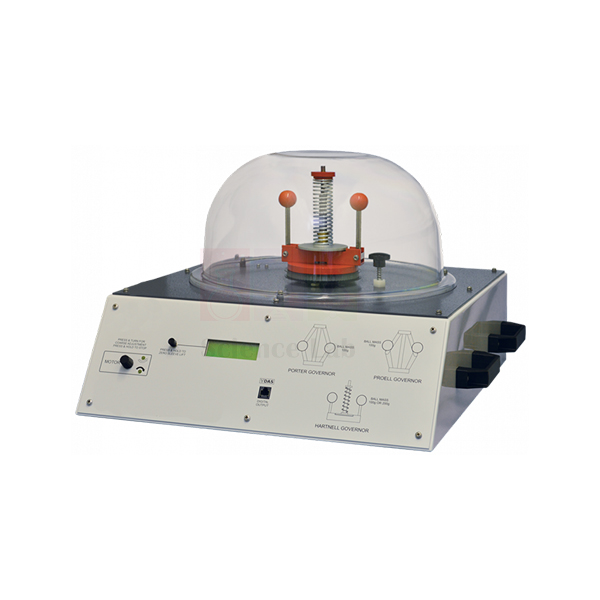
Governor
Governor (Product Code: SLE/ETM/02) is a centrifugal governor apparatus used to study how rotating masses lift a sleeve as speed increases, comparing Porter, Proell and Hartnell governors in theory of machines laboratories. A variable-speed motor in the base unit drives each of the three governors, a sensor records sleeve lift, and a clear dome with a power interlock lets students watch safely. It is built by Jain Scientific Equipments Pvt Ltd (ScienceLab), an OEM and technical educational equipment manufacturer, at its own factory in Ambala, India.
Key Details
| Parameter | Detail |
|---|---|
| Governors included | Porter, Proell and Hartnell |
| Drive | Base unit with a variable-speed motor that turns each governor |
| Operating principle | Rotating weights (masses) and levers raise a sleeve |
| Porter and Proell governors | Sleeve raised against gravity; additional weights (supplied) vary the sleeve mass |
| Hartnell governor | Sleeve raised against a compression spring; adjustable arm length and rotating mass |
| Measurement | Sensor measures the position (lift) of each governor sleeve |
| Safety | Clear dome with an interlock that shuts off power to the motor |
| Product code | SLE/ETM/02 |
| Manufacturer | Jain Scientific Equipments Pvt Ltd (ScienceLab) — OEM |
| Country of origin | India (made in Ambala, Haryana) |
What Is the Governor Apparatus Used For?
A governor regulates engine speed by moving a sleeve, and through it a fuel or steam control, as its rotating masses swing outward. With this apparatus students run each governor across a speed range, record sleeve lift from the sensor at each speed and plot the characteristic curve of lift against speed. Comparing the dead-weight Porter and Proell designs with the spring-loaded Hartnell shows how the controlling force shapes sensitivity and stability.
Further runs add the supplied weights to the Porter and Proell sleeves, or change the Hartnell arm length and rotating mass, and show how the curve shifts, which leads naturally to governor effort, power and hunting. Close the clear dome before starting, since the interlock cuts motor power while it is open, and raise speed gradually as readings are taken. It is core mechanics lab equipment in India for dynamics of machinery syllabi.
OEM Manufacturer
Jain Scientific Equipments Private Limited, known by its trading name ScienceLab, is the original equipment manufacturer (OEM) of this governor apparatus. The company manufactures it at its own licensed factory at Saha, Ambala, Haryana, India, and supplies the complete set factory-direct to universities, engineering colleges, polytechnics, ITIs, dealers and importers in India and international markets.
Buying from the manufacturer means repeat orders for extra sets, replacement sleeve weights or other spare parts are handled by the same team that produces the governors — ask us for details. The ScienceLab profile page tells you more about the company.
Related Theory of Machines Equipment
Other apparatus from the same dynamics of machinery course:
- Cam Mechanism — follower motion studies, often taught alongside governors.
- Gyroscope Experiment Manual — gyroscopic couple, another rotating-mass experiment.
- Static and Dynamic Balancing Apparatus — balancing of rotating masses on a shaft.
- Engine Speed Control Apparatus — speed regulation seen from the control engineering side.
See the full Theory of Machines range.
Frequently Asked Questions
Which governors are included with the Governor apparatus?
The Governor apparatus includes three governors — Porter, Proell and Hartnell — each driven by the variable-speed motor in the base unit, so students can compare dead-weight and spring-loaded designs on one machine.
How is sleeve lift measured?
On the Governor apparatus, a sensor measures the position, or lift, of each governor sleeve as it rises with speed, giving the readings needed to plot lift against speed for every governor.
What can students adjust on the governors?
With the Governor apparatus, students can add the supplied weights to change the sleeve mass of the Porter and Proell governors, and adjust the arm length and rotating mass of the Hartnell governor to see how each change alters its characteristic.
What safety features does the Governor apparatus have?
The Governor apparatus has a clear dome with an interlock that shuts off power to the motor. Students can watch the governors in motion safely, yet still reach them to examine or adjust them when the motor is stopped.
Who manufactures the Governor apparatus?
The Governor apparatus is manufactured by Jain Scientific Equipments Pvt Ltd (ScienceLab), which is the OEM and produces it at its own licensed factory in Saha, Ambala, Haryana, India, for supply to institutions in India and international markets.
What does a quotation request need?
For a Governor apparatus quotation, give the number of sets, the delivery location and whether spare sleeve weights or other parts should be included. Quotations come directly from the manufacturer through the contact page or the enquiry cart.
Request a Quote
Ask the manufacturer directly for a Governor apparatus quotation through the contact page, or add it to the enquiry cart together with other theory of machines apparatus.
Last updated: 24 September 2026
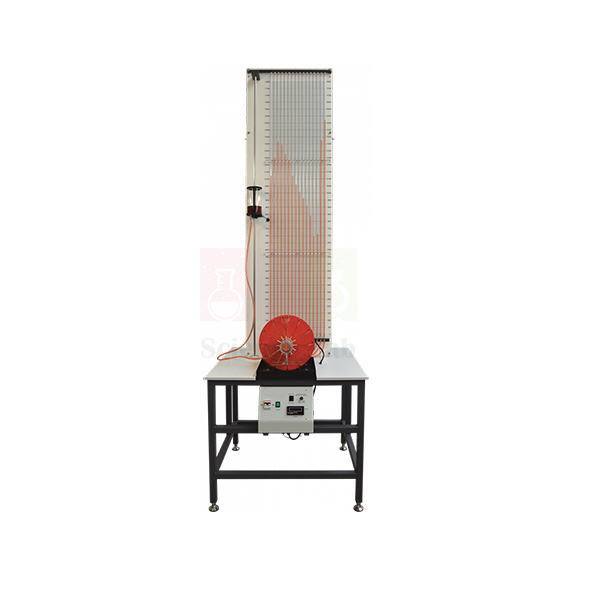
Journal Bearing Demonstration
Journal Bearing Demonstration (Product Code: SLE/ETM/03) is a floor-standing lubrication apparatus used to show how an oil film builds pressure around a rotating shaft in theory of machines and tribology laboratories. A motor-driven steel shaft turns inside a clear acrylic bearing with an extra-large clearance, and 16 pressure tappings feed a rear manometer panel so the oil pressure head at every point is visible at once. It is produced by Jain Scientific Equipments Pvt Ltd (ScienceLab), an OEM manufacturer, at its own factory in Ambala, India, as part of its lab equipment for technical institutes.
Specifications
| Parameter | Detail |
|---|---|
| Construction | Floor-standing |
| Shaft | Plain steel, directly driven by an electric motor |
| Bearing | Clear acrylic shell, freely supported on the motor shaft and sealed with a rubber diaphragm |
| Clearance | Especially large, to show the oil in the bearing clearly |
| Pressure tappings | 12 equi-spaced around the circumference plus 4 along the topside and on a vertical radial plane (16 in total) |
| Manometer | Rear manometer panel connected by light, flexible plastic tubes; shows the oil pressure head at all 16 points |
| Loading | Weights attached to arms connected to the bearing |
| Speed control | Control unit adjusts motor speed in both directions; display shows motor speed |
| Oil supply | Adjustable reservoir feeding the low-pressure region at both ends of the bearing |
| Supplied with | A container of suitable oil |
| Product code | SLE/ETM/03 |
| Manufacturer | Jain Scientific Equipments Pvt Ltd (ScienceLab) — OEM |
| Country of origin | India (made in Ambala, Haryana) |
What Is the Journal Bearing Demonstration Used For?
Students load the bearing with weights on its arms, run the shaft at a set speed and read the oil pressure head on all 16 manometer tubes at once. The 12 circumferential readings give a polar plot of pressure around the journal, showing where the film pressure peaks and where it falls away, while the four extra tappings show how pressure varies along the top of the bearing and on the vertical plane.
Repeating the test at different speeds and loads, and in both directions of rotation, shows how the pressure pattern follows the running conditions, while the extra-large clearance makes the oil wedge visible through the acrylic. Set the reservoir level before starting, clear any air from the manometer tubes, and let readings stabilise after each change. The unit suits tribology and machine design classes that rely on engineering lab equipment in India.
OEM Manufacturer
This journal bearing demonstration is manufactured by ScienceLab, the trading name of Jain Scientific Equipments Private Limited, which is its OEM. Production and assembly take place at the company’s own licensed factory at Saha, Ambala, Haryana, India, and the apparatus is supplied factory-direct to technical universities, engineering colleges, TVET institutes, dealers and importers in India and international markets.
If you later need replacement manometer tubing, a spare diaphragm or additional sets, the manufacturer can quote them directly — ask us. Company details are on the ScienceLab profile.
Related Theory of Machines Equipment
Apparatus that extends a lubrication and bearings practical:
- Air Bearing Apparatus — the same pressure-distribution study with an air film.
- Michell Pad Apparatus — oil-film lubrication in a tilting-pad bearing.
- Hertzian Contact Apparatus — contact between surfaces with no lubricant film between them.
- Friction Slide Apparatus — dry sliding friction, for comparison with lubricated contact.
More apparatus is listed under Theory of Machines.
Frequently Asked Questions
How many pressure tappings does the Journal Bearing Demonstration have?
The Journal Bearing Demonstration has 16 pressure tappings: 12 equally spaced around the bearing circumference and four more along its topside and on a vertical radial plane, all connected to the rear manometer panel.
How is the bearing loaded?
Students load the Journal Bearing Demonstration by attaching weights to arms connected to the bearing, which is freely supported on the motor shaft. Changing the weights shows how load alters the oil pressure distribution.
Can the shaft run in both directions?
Yes. The control unit of the Journal Bearing Demonstration adjusts motor speed in both directions of rotation, and a display shows the motor speed, so the effect of reversing the shaft on the oil film can be observed.
Is oil included with the apparatus?
Yes, a container of suitable oil is supplied with the Journal Bearing Demonstration. An adjustable reservoir feeds this oil to the low-pressure region at both ends of the bearing during operation.
Why is the bearing clearance so large?
The Journal Bearing Demonstration uses an especially large clearance so the oil in the bearing can be seen clearly through the clear acrylic shell, making the formation of the lubricating film visible to a whole class.
Who manufactures the Journal Bearing Demonstration?
The Journal Bearing Demonstration is manufactured by Jain Scientific Equipments Pvt Ltd (ScienceLab), the OEM, at its own licensed factory in Saha, Ambala, Haryana, India, and is supplied factory-direct to institutions in India and international markets.
What should a quotation request include?
For a Journal Bearing Demonstration quotation, give the number of units, the delivery location and any spare parts you want included. Quotations are issued directly by the manufacturer through the contact page or the enquiry cart.
Request a Quote
Request a price for the Journal Bearing Demonstration straight from the manufacturer via the contact page, or add it to the enquiry cart with any other bearing apparatus you need.
Last updated: 24 September 2026
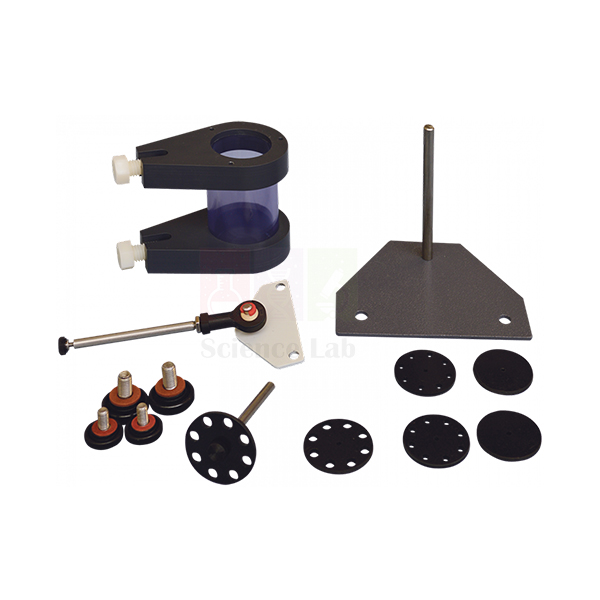
Damper Kit
Damper Kit (Product Code: SLE/ETM/04) is a dashpot damping accessory used to add viscous damping to beam vibration experiments on the Free Vibrations Test Frame in theory of machines laboratories. A simple piston disc moving in a cylinder fits to the Test Frame beneath the beam, and the damping level is set by the non-toxic fluid students pour in, which is not supplied. It is made by Jain Scientific Equipments Pvt Ltd (ScienceLab), an OEM and TVET lab equipment manufacturer in India, at its own factory in Ambala.
Key Details
| Parameter | Detail |
|---|---|
| Type | Dashpot damper formed by a simple piston disc and cylinder |
| Mounting | Fits to the Test Frame under the beam |
| Damping fluid | Easily found non-toxic fluids (not supplied) |
| Damping level | Varied by the choice of fluid |
| Project work | Students may try their own fluids and their own piston discs |
| Product code | SLE/ETM/04 |
| Manufacturer | Jain Scientific Equipments Pvt Ltd (ScienceLab) — OEM |
| Country of origin | India (made in Ambala, Haryana) |
What Is the Damper Kit Used For?
Real machines and structures never vibrate for ever, because friction and fluid resistance remove energy in every cycle. Fitted beneath the beam, the kit’s piston disc has to push fluid aside in the cylinder each time the beam moves, turning an almost undamped oscillation into a decaying one. By comparing successive peaks, students calculate the logarithmic decrement and damping ratio and see how both change with the fluid used.
Start with the cylinder empty to record the undamped response, then repeat with fluids of increasing viscosity that are safe and easy to obtain, keeping the fill level the same each time. Because students may also make their own piston discs, the kit supports project work on how disc size or shape alters damping. It is straightforward engineering educational equipment for vibration and dynamics courses in India.
What to Specify When Ordering
- The Free Vibrations Test Frame, if your laboratory does not already have one (the kit fits to it)
- The beam experiment it will be used with, for example the Free Vibration Of Beam Spring
- Number of kits per laboratory
- Damping fluids are not supplied, so plan to source suitable non-toxic fluids locally
OEM Manufacturer
ScienceLab is the trading name of Jain Scientific Equipments Private Limited, the OEM that makes this damper kit at its own licensed factory at Saha, Ambala, Haryana, India. Colleges, polytechnics and training institutes, as well as dealers and importers, buy it factory-direct together with the test frame and the vibration experiments it serves.
Institutional and tender buyers registering the company as a vendor can use GSTIN 06AAECJ8618A1ZT and LEI 3358004HRD1JIVXKYX49. Replacement piston discs or extra kits can be quoted by the manufacturer on request — ask us, and see the company profile for more about ScienceLab.
Related Theory of Machines Equipment
Parts of the same free vibrations set-up:
- Free Vibrations Test Frame — the frame the damper kit mounts on.
- Free Vibration Of Beam Spring — the pivoted-beam experiment it damps.
- Free Vibrations Of A Cantilever — another free vibration experiment for the same frame.
- Damper Kit For Mass/Spring — the dash-pot version for mass-spring experiments.
View all apparatus in Theory of Machines.
Frequently Asked Questions
What is the Damper Kit?
The Damper Kit is a dashpot damper made from a simple piston disc and cylinder. It fits to the Free Vibrations Test Frame under the beam and adds viscous damping to free vibration experiments.
Is damping fluid included with the Damper Kit?
No. The Damper Kit works with easily found non-toxic fluids, which are not supplied, so each laboratory chooses and sources its own fluids to obtain different damping levels.
Which experiments is the Damper Kit used with?
The Damper Kit fits to the Test Frame beneath the beam, so it is used with beam-type free vibration experiments on that frame, such as the Free Vibration Of Beam Spring set-up, to compare undamped and damped motion.
Can students modify the Damper Kit for projects?
Yes. The Damper Kit is intended so students may try their own fluids and their own piston discs, which makes it suitable for project work on how fluid and disc design affect the damping produced.
Who manufactures the Damper Kit?
The Damper Kit is manufactured by Jain Scientific Equipments Pvt Ltd (ScienceLab), the OEM, at its own licensed factory in Saha, Ambala, Haryana, India, and is supplied factory-direct with or without the matching test frame.
What does a quotation request need?
For a Damper Kit quotation, state how many kits you need, whether the Free Vibrations Test Frame and beam experiments should be quoted too, and the delivery location. The manufacturer replies directly through the contact page or the enquiry cart.
Request a Quote
Quotes for the Damper Kit come straight from the manufacturer. Use the contact page or add the kit to the enquiry cart along with the rest of your free vibrations equipment.
Last updated: 24 September 2026
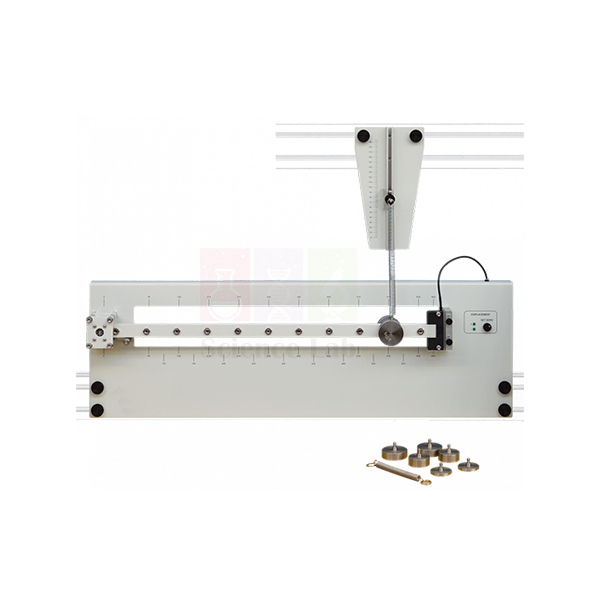
Free Vibration Of Beam Spring
Free Vibration Of Beam Spring (Product Code: SLE/ETM/05) is a one-degree-of-freedom vibration experiment used to study how a rigid beam, pivoted at one end and hung from a coiled spring at the other, oscillates in theory of machines laboratories. It mounts on the Free Vibrations Test Frame through a back panel carrying self-aligning pivot bearings and a non-contacting displacement sensor, so oscillations are measured with negligible damping. It is manufactured by Jain Scientific Equipments Pvt Ltd (ScienceLab), an OEM vocational training lab equipment manufacturer in India, at its own factory in Ambala.
Key Details
| Parameter | Detail |
|---|---|
| System | Simple one-degree-of-freedom free vibration system |
| Beam | Rigid beam pivoted at its left-hand end; right-hand end suspended by a coiled spring |
| Pivot | High-quality self-aligning bearings allowing the beam to rotate through a small angle |
| Sensor | Non-contacting displacement sensor measuring oscillations at the right-hand end with negligible damping, while helping to guide the movement |
| Back panel | Fixes to the Test Frame; holds the pivot and the sensor |
| Topics | Moment of inertia; oscillation damping; spring constant and Hooke’s Law; simple harmonic motion and frequency of oscillation; phase difference between displacement and its derivatives |
| Real-world link | The beam-and-spring system appears in machines and vehicle suspensions |
| Product code | SLE/ETM/05 |
| Manufacturer | Jain Scientific Equipments Pvt Ltd (ScienceLab) — OEM |
| Country of origin | India (made in Ambala, Haryana) |
What Is the Beam Spring Vibration Experiment Used For?
The beam, pivot and spring form the same arrangement found in many machines and in vehicle suspensions, reduced to a single degree of freedom that students can analyse by hand. They can determine the spring constant by static loading to confirm Hooke’s Law, work out the beam’s moment of inertia about the pivot and predict its natural frequency. Displacing the free end and releasing it lets the non-contacting sensor record the oscillation, so the measured frequency can be checked against the prediction.
Because the sensor does not touch the beam, inherent damping is negligible, which makes any added damping easy to see; fitting the separate Damper Kit beneath the beam extends the study to damped motion. The recorded trace also shows the phase difference between displacement and its derivatives, velocity and acceleration, linking the experiment to simple harmonic motion theory. It is a compact piece of mechanics lab equipment in India for dynamics and vibrations courses.
What to Specify When Ordering
- The Free Vibrations Test Frame, if not already in your laboratory (the experiment fixes to it)
- The Damper Kit, if damped vibration is part of your syllabus
- Number of sets per laboratory
OEM Manufacturer
Jain Scientific Equipments Private Limited, trading as ScienceLab, is the original equipment manufacturer (OEM) of this beam-spring vibration experiment and produces it at its own licensed factory at Saha, Ambala, Haryana, India. Engineering colleges, universities and polytechnics order it factory-direct, often as one of several free vibration experiments sharing a single test frame, and dealers and importers source it from the manufacturer in the same way.
Spare springs, additional sets or matching experiments can be discussed directly with the maker — ask us. More about the company is on the ScienceLab profile page.
Related Theory of Machines Equipment
Items that complete or extend this free vibration study:
- Free Vibrations Test Frame — the bench frame this experiment fixes to.
- Damper Kit — adds dashpot damping beneath the beam.
- Free Vibrations Of A Cantilever — a companion experiment where beam stiffness replaces the spring.
- Free and Forced Vibration Apparatus — takes the study on to forced vibration and resonance.
Find more apparatus in the Theory of Machines category.
Frequently Asked Questions
What does the Free Vibration Of Beam Spring experiment demonstrate?
The Free Vibration Of Beam Spring experiment demonstrates free vibration of a one-degree-of-freedom system: a rigid beam pivoted at one end and suspended by a coiled spring at the other, an arrangement also found in machines and vehicle suspensions.
How are the oscillations measured?
A non-contacting displacement sensor on the back panel measures the oscillations at the right-hand end of the beam. Because it never touches the beam, the Free Vibration Of Beam Spring experiment runs with negligible damping from the measurement.
Which topics does the experiment cover?
The Free Vibration Of Beam Spring experiment covers moment of inertia, oscillation damping, spring constant and Hooke’s Law, simple harmonic motion and frequency of oscillation, and the phase difference between displacement and its derivatives.
Does it need the Free Vibrations Test Frame?
Yes. The Free Vibration Of Beam Spring experiment has a back panel that fixes to the Free Vibrations Test Frame, which holds it steady and level. Order the frame as well if your laboratory does not already have one.
Who manufactures the Free Vibration Of Beam Spring experiment?
The Free Vibration Of Beam Spring experiment is manufactured by Jain Scientific Equipments Pvt Ltd (ScienceLab), the OEM, at its own licensed factory in Saha, Ambala, Haryana, India, and supplied factory-direct to institutions in India and international markets.
What does a quotation request need?
For a Free Vibration Of Beam Spring quotation, give the number of sets, whether the Test Frame and Damper Kit are needed, and the delivery location. The manufacturer quotes directly through the contact page or the enquiry cart.
Request a Quote
For a manufacturer-direct price on the Free Vibration Of Beam Spring experiment, write through the contact page or add it to the enquiry cart with the test frame and any other vibration experiments.
Last updated: 24 September 2026
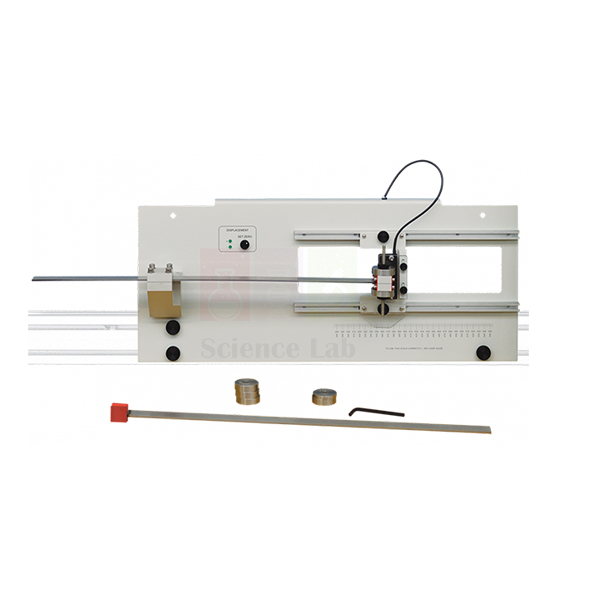
Free Vibrations Of A Cantilever
Free Vibrations Of A Cantilever (Product Code: SLE/ETM/06) is a vibration experiment used to show how a clamped beam with an end mass oscillates like a mass-spring system, its own stiffness acting as the spring, in theory of machines laboratories. Students set the oscillating length with a sturdy clamp on a back panel that fixes to the Free Vibrations Test Frame, while a non-contacting sensor on two runners follows the tip without touching it. It is made by Jain Scientific Equipments Pvt Ltd (ScienceLab), an OEM laboratory equipment manufacturer in India, at its own factory in Ambala.
Key Details
| Parameter | Detail |
|---|---|
| System | One-degree-of-freedom free vibration; a beam with a mass at the end behaves like a mass-spring system, with beam stiffness replacing spring stiffness |
| Purpose | Examines what happens when the spring element is not light |
| Back panel | Fixes to the Test Frame; holds a sturdy clamp and two runners |
| Clamp | Holds the beam and is used to adjust the oscillating length of the cantilever |
| Sensor | Non-contacting sensor on the runners, measuring oscillations at the end of the cantilever with negligible damping |
| Topics | Simple harmonic motion (SHM) and frequency of oscillation; beam stiffness; Rayleigh’s method; Dunkerley’s method; second moment of area; phase difference between displacement and its derivatives |
| Real-world link | A visual example of oscillations that occur in real structures such as aircraft wings |
| Product code | SLE/ETM/06 |
| Manufacturer | Jain Scientific Equipments Pvt Ltd (ScienceLab) — OEM |
| Country of origin | India (made in Ambala, Haryana) |
What Is the Cantilever Vibration Experiment Used For?
A cantilever with an end mass is the simplest model of a structure that vibrates under its own stiffness, from a diving board to an aircraft wing. Students clamp the beam at a chosen length, deflect the tip and release it while the non-contacting sensor records the oscillation; repeating at several lengths shows how frequency falls as the cantilever gets longer. Measured frequencies are then compared with values predicted from the beam’s stiffness and second moment of area.
Because the beam is not a light spring, its own mass affects the result, so the experiment is used to compare simple predictions with Rayleigh’s method and Dunkerley’s method, which account for distributed mass. The trace also shows the phase difference between displacement, velocity and acceleration. Tighten the clamp firmly at each new length, keep the sensor runners in line with the tip, and use small initial deflections for clean, repeatable traces.
What to Specify When Ordering
- The Free Vibrations Test Frame, if your laboratory does not already have one
- Number of cantilever sets needed for your student groups
- Any companion experiments for the same frame, such as the Free Vibration Of Beam Spring
OEM Manufacturer
ScienceLab, the trading name of Jain Scientific Equipments Private Limited, manufactures this cantilever vibration experiment as the OEM at its own licensed factory at Saha, Ambala, Haryana, India. Institutions building a vibrations laboratory can source the experiment, the test frame and companion set-ups factory-direct from one manufacturer, whether they are universities, polytechnics, dealers or importers.
Repeat orders and replacement parts are quoted by the manufacturer itself — just ask us. Read about ScienceLab on the company profile.
Related Theory of Machines Equipment
Apparatus that works alongside the cantilever experiment:
- Free Vibrations Test Frame — holds the cantilever’s back panel steady and level.
- Free Vibration Of Beam Spring — the companion experiment with a separate coiled spring.
- Vibration Of Spiral Spring Apparatus — torsional free vibration using a spiral spring.
- Whirling of Shaft Apparatus — another case where an elastic member’s stiffness sets a critical frequency.
The rest of the range is in Theory of Machines.
Frequently Asked Questions
What does the Free Vibrations Of A Cantilever experiment show?
The Free Vibrations Of A Cantilever experiment shows that a beam with a mass at its end vibrates like a mass-spring system, with the beam’s stiffness replacing the spring’s, and examines what happens when the spring element is not light.
Can the cantilever length be changed?
Yes. On the Free Vibrations Of A Cantilever experiment, a sturdy clamp on the back panel holds the beam, and students use it to adjust the oscillating length of the cantilever between tests.
How are the oscillations measured?
A non-contacting sensor held on two runners measures the oscillations at the end of the cantilever. Because it has no physical contact with the beam, the Free Vibrations Of A Cantilever experiment runs with negligible damping from the measurement.
Which theory topics does it support?
The Free Vibrations Of A Cantilever experiment supports simple harmonic motion and frequency of oscillation, beam stiffness, Rayleigh’s method, Dunkerley’s method, second moment of area, and the phase difference between displacement and its derivatives.
Who manufactures the Free Vibrations Of A Cantilever experiment?
The Free Vibrations Of A Cantilever experiment is manufactured by Jain Scientific Equipments Pvt Ltd (ScienceLab), the OEM, at its own licensed factory in Saha, Ambala, Haryana, India, and is supplied factory-direct in India and international markets.
What does a quotation request need?
For a Free Vibrations Of A Cantilever quotation, state the number of sets, whether the Free Vibrations Test Frame is required, and the delivery location. Quotes come directly from the manufacturer via the contact page or the enquiry cart.
Request a Quote
To get the manufacturer’s price for the Free Vibrations Of A Cantilever experiment, use the contact page or add it to the enquiry cart, listing any frame or companion experiments you also need.
Last updated: 24 September 2026
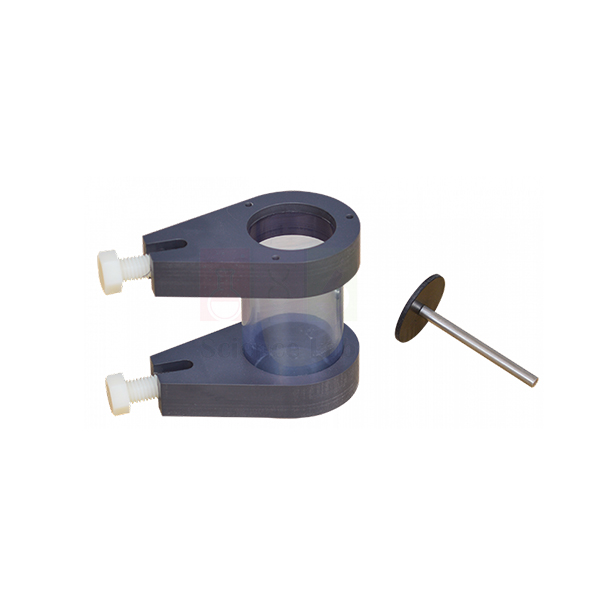
Damper Kit For Mass/Spring
Damper Kit For Mass/Spring (Product Code: SLE/ETM/07) is a dash-pot damping accessory used to add viscous damping to a mass-spring vibration experiment, fitting to the guide rods under its platform, in theory of machines laboratories. Its piston disc and cylinder work with easily found non-toxic fluids, so students can move from light to heavy damping simply by changing the fluid. It is produced by Jain Scientific Equipments Pvt Ltd (ScienceLab), an OEM scientific equipment manufacturer in India, at its own factory in Ambala.
Key Details
| Parameter | Detail |
|---|---|
| Type | Dash-pot damper formed by a piston disc and cylinder |
| Mounting | Fits to the guide rods under the platform of the mass-spring experiment |
| Damping fluid | Works with easily found non-toxic fluids, chosen for different damping levels |
| Project work | Students may try their own fluids and their own piston discs |
| Data analysis | With a data acquisition system, displayed data can be fitted to underdamped and overdamped viscous damping models |
| Product code | SLE/ETM/07 |
| Manufacturer | Jain Scientific Equipments Pvt Ltd (ScienceLab) — OEM |
| Country of origin | India (made in Ambala, Haryana) |
What Is the Mass-Spring Damper Kit Used For?
A mass bouncing on a spring is the textbook single-degree-of-freedom system, and adding a dash-pot turns it into the damped model used for vehicle suspensions and machine mounts. Mounted on the guide rods beneath the platform, the piston disc moves through fluid in the cylinder each time the mass oscillates, taking energy out of the motion. With a thin fluid the platform rings down gradually (underdamped); with a thick one it creeps back without overshooting (overdamped).
When the motion is recorded with a data acquisition system, the displayed data can be fitted to underdamped and overdamped viscous damping models, so students can extract a damping coefficient and compare it with theory. Try a series of non-toxic fluids of increasing thickness, fill the cylinder to the same level each time, and clean the piston disc between fluids. Students may also design their own piston discs, which makes the kit a good base for project work.
What to Specify When Ordering
- The mass-spring experiment the kit will be fitted to (it mounts on the guide rods under the platform)
- Whether data acquisition for fitting damping models is required (ask us about options)
- Number of kits for your student groups
OEM Manufacturer
The Damper Kit For Mass/Spring is manufactured by ScienceLab — the trading name of Jain Scientific Equipments Private Limited — which is its OEM and makes it at its own licensed factory at Saha, Ambala, Haryana, India. Because the related vibration apparatus comes from the same manufacturer, colleges, training institutes, dealers and importers can order the damper and the experiments it serves factory-direct from one source.
Additional piston discs or kits for extra student groups can be requested directly from the maker — ask us. See the ScienceLab profile for company background.
Related Theory of Machines Equipment
Other vibration apparatus for damping and oscillation studies:
- Damper Kit — the dashpot version that fits under the beam on the Test Frame.
- Free and Forced Vibration Apparatus — spring, mass and damper behaviour including forced vibration.
- Free And Forced Vibrations — a further apparatus on free and forced vibration.
- Vibration Of Spiral Spring Apparatus — the torsional counterpart of a mass-spring system.
Browse the Theory of Machines category for more.
Frequently Asked Questions
What is the Damper Kit For Mass/Spring?
The Damper Kit For Mass/Spring is a dash-pot damper made from a piston disc and cylinder. It fits to the guide rods under the platform of a mass-spring vibration experiment and adds viscous damping to its motion.
How is the damping level changed?
The damping level of the Damper Kit For Mass/Spring is changed by the fluid in the cylinder. It works with easily found non-toxic fluids, so thinner fluids give light damping and thicker fluids give heavier damping.
Can the results be fitted to damping models?
Yes. When the Damper Kit For Mass/Spring is used with a data acquisition system, the displayed data can be fitted to underdamped and overdamped viscous damping models. Ask us about data acquisition options for your laboratory.
How does it differ from the Damper Kit for the beam?
The Damper Kit For Mass/Spring fits to the guide rods under a mass-spring platform, whereas the separate Damper Kit fits to the Test Frame under a beam. Both use a simple piston disc and cylinder dash-pot.
Is damping fluid included?
The Damper Kit For Mass/Spring is designed for easily found non-toxic fluids, so laboratories can usually source their own. Ask us whether any fluid is included when you request a quotation.
Who manufactures the Damper Kit For Mass/Spring?
The Damper Kit For Mass/Spring is manufactured by Jain Scientific Equipments Pvt Ltd (ScienceLab), the OEM, at its own licensed factory in Saha, Ambala, Haryana, India, and supplied factory-direct in India and international markets.
What does a quotation request need?
For a Damper Kit For Mass/Spring quotation, give the number of kits, the mass-spring experiment it will be used with, any data acquisition needs, and the delivery location, through the contact page or the enquiry cart.
Request a Quote
The manufacturer quotes the Damper Kit For Mass/Spring directly. Send your enquiry through the contact page or add the kit to the enquiry cart.
Last updated: 24 September 2026
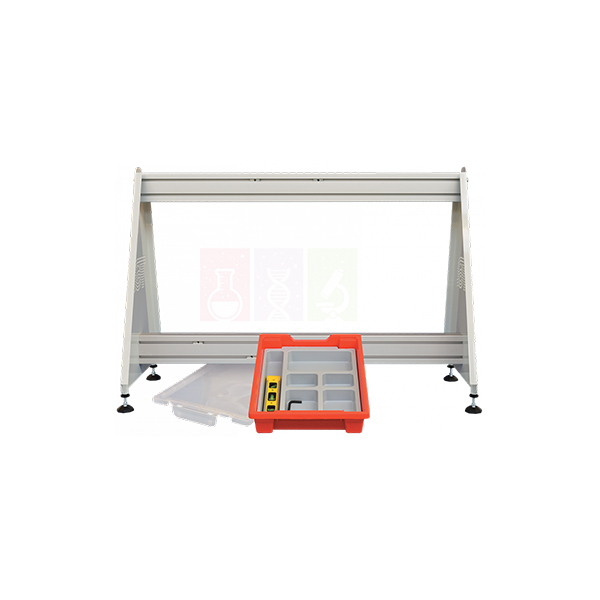
Free Vibrations Test Frame
Free Vibrations Test Frame (Product Code: SLE/ETM/08) is a bench-mounted frame used to hold free vibration experiments steady and level in theory of machines laboratories. Two extruded alloy members with slotted fixing points on all four sides span two triangular ends with adjustable levelling feet, and a storage tray, lid, hexagon tool and spirit level come with it. It is manufactured by Jain Scientific Equipments Pvt Ltd (ScienceLab), an OEM maker of engineering lab equipment in India, at its own factory in Ambala.
Key Details
| Parameter | Detail |
|---|---|
| Use | Mounting frame for free vibrations experiments |
| Placement | Fits on any standard desk or bench |
| Horizontal members | Two extruded alloy members, each with slotted fixing points on all four sides |
| Ends | Two triangular sides, each with adjustable levelling feet |
| Included | Storage tray and lid; hexagon tool; spirit level |
| Construction | Sturdy, for accurate results and a long service life |
| Portability | Light enough for two people to move around the classroom |
| Product code | SLE/ETM/08 |
| Manufacturer | Jain Scientific Equipments Pvt Ltd (ScienceLab) — OEM |
| Country of origin | India (made in Ambala, Haryana) |
What Is the Free Vibrations Test Frame Used For?
Vibration measurements are only repeatable when the structure holding the experiment neither flexes nor rocks. Students, teachers or lecturers fix the back panel of each free vibration experiment to the slotted alloy members, level the frame with its adjustable feet and the spirit level, and then run the test; changing to another experiment means removing one panel and fitting the next.
One frame can therefore serve a sequence of experiments, including the beam-spring, cantilever and damper studies, which saves bench space and makes it practical lab equipment for technical institutes. The storage tray and lid keep tools and small parts of optional experiments together so they are not lost or damaged between classes. Two people can carry the frame around the classroom, but recheck the level with the spirit level whenever it is moved.
What to Specify When Ordering
- Which free vibration experiments will be fitted, for example the beam-spring, cantilever or Damper Kit
- Number of frames, usually one for each student group working at the same time
- Delivery location in India or abroad
OEM Manufacturer
ScienceLab is the trading name of Jain Scientific Equipments Private Limited (CIN U29309HR2020PTC087597), the OEM that manufactures this test frame at its licensed factory at 449, HSIIDC Industrial Area, Saha, Ambala, Haryana (Factory Licence AMB-ONLINE-CHD-J-414). The frame and the experiments that mount on it are supplied factory-direct to engineering colleges, universities, polytechnics, dealers and importers in India and international markets.
Additional frames for extra student groups, or replacement tools and levelling feet, can be quoted by the manufacturer — ask us. More details are on the company profile.
Related Theory of Machines Equipment
Experiments and accessories that mount on or complement this frame:
- Free Vibration Of Beam Spring — fixes to the frame through its back panel.
- Free Vibrations Of A Cantilever — clamps its beam on a back panel fitted to the frame.
- Damper Kit — mounts to the frame beneath the beam for damping studies.
- Free and Forced Vibration Apparatus — for forced vibration and resonance studies.
See all apparatus in the Theory of Machines category.
Frequently Asked Questions
What is the Free Vibrations Test Frame used for?
The Free Vibrations Test Frame is a bench-mounted frame for free vibration experiments. Students, teachers or lecturers fit the parts of each experiment to it, and its stable, level construction gives repeatable and accurate vibration results.
What is included with the Free Vibrations Test Frame?
The Free Vibrations Test Frame includes a storage tray and lid, a hexagon tool for assembly and a spirit level for levelling. The tray keeps tools and smaller parts of optional experiments together to prevent loss or damage.
How is the frame levelled?
Each of the two triangular sides of the Free Vibrations Test Frame has adjustable levelling feet. Using the supplied spirit level, users adjust the feet until the frame is level, which is essential for repeatable vibration measurements.
Does the frame need a special bench?
No. The Free Vibrations Test Frame fits on any standard desk or bench, and despite its sturdy construction it is light enough for two people to move around the classroom.
Which experiments fit the frame?
Experiments with a back panel for the Test Frame, such as the Free Vibration Of Beam Spring and the Free Vibrations Of A Cantilever, fix to the Free Vibrations Test Frame’s slotted alloy members, as does the Damper Kit.
Who manufactures the Free Vibrations Test Frame?
The Free Vibrations Test Frame is manufactured by Jain Scientific Equipments Pvt Ltd (ScienceLab), the OEM, at its own licensed factory in Saha, Ambala, Haryana, India, and is supplied factory-direct with or without the experiments it carries.
What does a quotation request need?
For a Free Vibrations Test Frame quotation, give the number of frames, the experiments you plan to mount, and the delivery location. The manufacturer quotes directly through the contact page or the enquiry cart.
Request a Quote
Quotations for the Free Vibrations Test Frame come directly from the manufacturer. Contact us through the contact page or add the frame to the enquiry cart together with its experiments.
Last updated: 24 September 2026
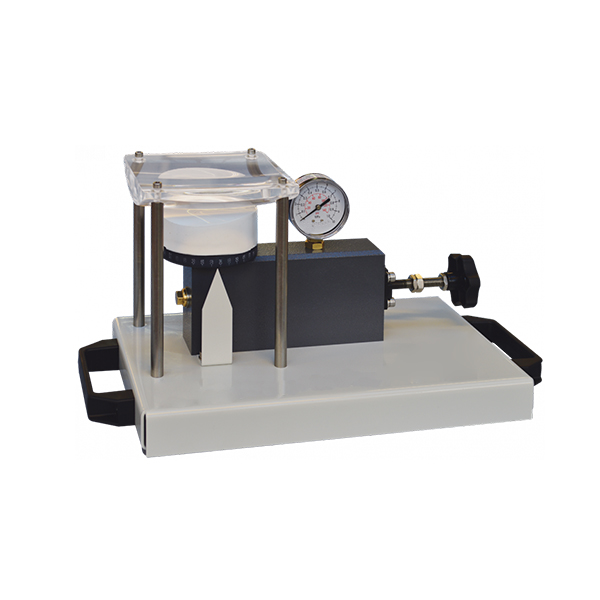
Hertzian Contact Apparatus
Hertzian Contact Apparatus (Product Code: SLE/ETM/09) is a self-contained bench unit used to show how two curved surfaces meet under load, so that measured contact shapes can be checked against Hertz’s original theories in engineering laboratories. Mechanical engineering students use it because the lower pad rotates against a pointer, turning the contact zone from circular to elliptical. It is made by Jain Scientific Equipments Pvt Ltd (ScienceLab), an OEM manufacturer, at its own factory in Ambala, India.
Key Details
| Parameter | Detail |
|---|---|
| Type | Self-contained, easy-to-use contact mechanics unit |
| Loading | Hand-operated hydraulic pump and cylinder force the two pads together |
| Contact pads | Two pads with curved contact surfaces; the upper pad has compound radii |
| Lower pad | Rotatable, with a pointer showing the angle of rotation |
| Contact zone | Circular or elliptical, depending on the relative angular position of the pads |
| Measuring aid | Transparent scale (supplied) to measure contact shape and angle |
| Overload protection | Locknuts on the pump threads limit the maximum pressure |
| Theory compared | Hertz’s original contact theories |
| Product code | SLE/ETM/09 |
| Manufacturer | Jain Scientific Equipments Pvt Ltd (ScienceLab) — OEM |
| Country of origin | India (made in Ambala, Haryana) |
What Is the Hertzian Contact Apparatus Used For?
Whenever a ball meets its race, a gear tooth meets its mate or a wheel rolls on a rail, the load passes through a very small patch of contact, and the size and shape of that patch decide the contact stress. This apparatus lets a class see that patch for itself. The hydraulic cylinder presses the two curved pads together, students read the contact outline with the transparent scale, and the result is compared with the size predicted by Hertz theory.
Turning the lower pad changes the relative curvature of the two surfaces, because the upper pad has compound radii. At some angles the contact is circular; at others it stretches into an ellipse, which makes the unit a practical piece of engineering lab equipment in India for tribology, machine design and theory of machines courses. Record the pointer angle for every reading, and leave the pump locknuts at their set position so the maximum pressure stays limited.
OEM Manufacturer
The Hertzian Contact Apparatus is built by Jain Scientific Equipments Private Limited, which trades as ScienceLab, at its own licensed factory at Saha, Ambala, Haryana, India. Because the maker supplies it factory-direct, engineering colleges, polytechnics, dealers and importers deal with the people who assemble the pads, pump and scale — for quotations, repeat orders and replacement parts, ask us.
Company background is on the ScienceLab profile.
Related Theory of Machines Equipment
Contact, bearing and gearing experiments that fit the same course:
- Journal Bearing Demonstration — moves from dry contact to a lubricated rotating bearing.
- Michell Pad Apparatus — shows how an oil film carries load in a tilting pad bearing.
- Cam Analysis Machine — a cam and follower is another curved contact under changing load.
- Gear Train Model — for discussing where gear teeth touch and transmit force.
Browse the full Theory of Machines range.
Frequently Asked Questions
What does the Hertzian Contact Apparatus demonstrate?
The Hertzian Contact Apparatus demonstrates the nature of contact between two curved surfaces under load. Students measure the contact shape and compare it with predictions from Hertz’s original theories, and they see how changing the relative curvature changes the contact zone.
How is the load applied?
On the Hertzian Contact Apparatus SLE/ETM/09, a hand-operated hydraulic pump and cylinder force the two pads together. Locknuts on the threads of the pump limit the maximum pressure, which protects the pads and the rest of the equipment from damage.
Why does the contact zone change from circular to elliptical?
In the Hertzian Contact Apparatus, the upper pad has compound radii, so rotating the lower pad changes the relative curvature at the point of contact. Depending on the angle shown by the pointer, the contact zone is circular or elliptical.
What is included with the Hertzian Contact Apparatus?
The Hertzian Contact Apparatus comprises two pads with curved contact surfaces, a rotatable lower pad with pointer, and a hand-operated hydraulic pump and cylinder. A transparent scale for measuring the contact shape and angle is supplied with it.
Who manufactures the Hertzian Contact Apparatus?
Jain Scientific Equipments Pvt Ltd, trading as ScienceLab, is the OEM manufacturer of the Hertzian Contact Apparatus SLE/ETM/09. It is produced at the company’s own licensed factory at Saha, Ambala, Haryana, India, and sold direct by the maker.
Can I get a calibration certificate with the Hertzian Contact Apparatus?
Calibration paperwork for the Hertzian Contact Apparatus is not described in its listing. If your institution needs a calibration certificate, mention it when you request a quotation and we will discuss what can be provided.
What should I include in a quotation request?
For the Hertzian Contact Apparatus SLE/ETM/09, state the number of units, the institution or dealer name and the delivery location in India or abroad. Send these details through the ScienceLab contact page and the quotation comes straight from the manufacturer.
Request a Quote
To order the Hertzian Contact Apparatus (SLE/ETM/09), send your requirement through the contact page or add it to the enquiry cart. Quotations are issued directly by the manufacturer, for single labs, bulk orders and export.
Last updated: 24 September 2026
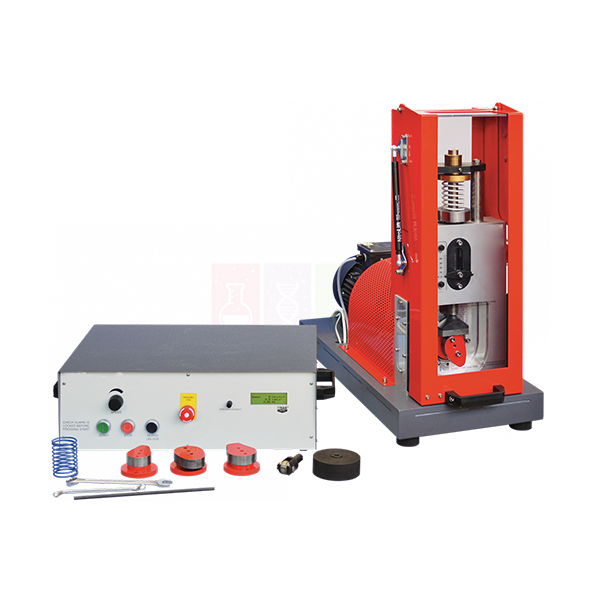
Cam Analysis Machine
Cam Analysis Machine (Product Code: SLE/ETM/10) is a motor-driven test machine used to study how a follower responds to a rotating cam at different speeds, spring preloads and follower masses in engineering laboratories. Mechanical engineering students use it because the precision machined heavy steel base carries a high-torque direct-drive variable-speed motor and a flywheel that steadies the drive. It is made by Jain Scientific Equipments Pvt Ltd (ScienceLab), an OEM manufacturer, at its own factory in Ambala, India.
Key Details
| Parameter | Detail |
|---|---|
| Base | Precision machined heavy steel base |
| Drive | High-torque direct-drive variable-speed motor, coupled to the main shaft |
| Main shaft | Supported by self-aligning heavy-duty bearings; carries a substantial flywheel |
| Flywheel | Reduces speed variations as torque demand changes during the cam cycle |
| Cam mounting | Cam fits to the end of the main shaft, accurately mounted axially and radially for repeatability |
| Follower | Fits to the bottom of a vertical shaft running in low-friction linear bearings |
| Followers | Choice of two, with a tool for easy changeover |
| Springs | Choice of two compression springs with adjustable preload |
| Follower mass | Adjustable by adding different masses |
| Product code | SLE/ETM/10 |
| Manufacturer | Jain Scientific Equipments Pvt Ltd (ScienceLab) — OEM |
| Country of origin | India (made in Ambala, Haryana) |
What Is the Cam Analysis Machine Used For?
Cams open engine valves, index machine tools and drive packaging lines, and at speed a follower may no longer track the cam profile faithfully. The Cam Analysis Machine lets students explore that behaviour on the bench: they choose a cam and follower, set the motor speed, and watch how the follower responds as the speed rises. The flywheel on the main shaft keeps the drive speed steady even though the torque demand changes through each rotation.
The follower is held against the cam face by its own weight, the weight of the vertical shaft and, when fitted, one of the two compression springs. Changing the spring, adjusting its preload or adding masses changes the force on the cam, so a class can compare several set-ups in one session. This makes it useful mechanics lab equipment in India for theory of machines and machine dynamics practicals.
What to Specify When Ordering
- The number of machines for your laboratory.
- Which cams you need — the listing does not state how many cams come with the machine, so ask us.
- Whether you need extra masses for the follower, beyond what is quoted.
- Your mains supply, so we can confirm the motor arrangement.
OEM Manufacturer
ScienceLab is the trading name of Jain Scientific Equipments Private Limited, the OEM that produces the Cam Analysis Machine at its own licensed factory at Saha, Ambala, Haryana, India. Institutes buy it from the manufacturer rather than a reseller, so questions about cams, followers, springs and later replacement parts are answered by the maker — ask us.
See the ScienceLab profile for more about the company.
Related Theory of Machines Equipment
Other mechanism and dynamics apparatus for the same laboratory:
- Cam Mechanism — a simpler set-up for introducing cam and follower profiles.
- Governor — another speed-dependent mechanism study.
- Four Bar Chain Apparatus — linkage motion to compare with cam-driven motion.
- Hertzian Contact Apparatus — looks at the contact between curved surfaces such as a cam and follower.
See all items in the Theory of Machines category.
Frequently Asked Questions
What can students investigate with the Cam Analysis Machine?
With the Cam Analysis Machine, students investigate how a follower behaves on a rotating cam as motor speed, follower type, spring preload and follower mass change. The selection of springs, followers and cams allows a wide range of investigations.
Why does the Cam Analysis Machine have a flywheel?
The Cam Analysis Machine SLE/ETM/10 has a substantial flywheel on its main shaft because the torque needed to turn the cam changes during each rotation. The flywheel reduces the resulting speed variations, so test conditions stay steadier.
How many followers and springs are provided?
The Cam Analysis Machine offers a choice of two followers, with a tool for easy changeover, and a choice of two compression springs whose preload can be adjusted. Different masses can also be added to change the follower mass.
How is the cam mounted?
On the Cam Analysis Machine SLE/ETM/10, the cam under test fits to the end of the main shaft and is accurately mounted both axially and radially. This helps ensure repeatable results when cams are changed between experiments.
Who manufactures the Cam Analysis Machine?
The Cam Analysis Machine is manufactured by Jain Scientific Equipments Pvt Ltd (ScienceLab), the OEM, at its licensed factory in Saha, Ambala, Haryana, India. Orders, repeat purchases and spare-part enquiries are handled by the manufacturer itself.
Can the Cam Analysis Machine be supplied in quantity or exported?
Yes, the Cam Analysis Machine SLE/ETM/10 is supplied to engineering colleges, dealers and importers across India and international markets. Share the quantity and delivery destination on the contact page to receive a quotation.
Request a Quote
Ask for a quotation on the Cam Analysis Machine (SLE/ETM/10) using the contact page, or add it to the enquiry cart with other laboratory items. Your quote comes directly from the manufacturer.
Last updated: 24 September 2026
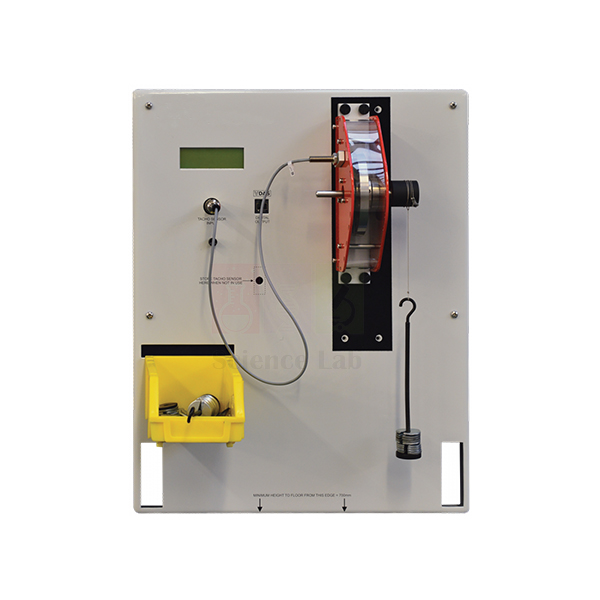
Acceleration & Static Test Stand
Acceleration & Static Test Stand (Product Code: SLE/ETM/11) is a separate bench stand used to measure angular acceleration, find inertia by experiment and run static efficiency tests on a gear drive in engineering laboratories. Students use it alongside dynamic gear-drive tests, because a sensor and multiline display calculate the flywheel’s angular acceleration automatically. It is made by Jain Scientific Equipments Pvt Ltd (ScienceLab), an OEM manufacturer, at its own factory in Ambala, India.
Key Details
| Parameter | Detail |
|---|---|
| Experiments | Angular acceleration, inertia by experiment, static efficiency of a gear drive |
| Loading | Sets of weights apply turning forces to the flywheel shaft |
| Flywheel | A simplified version of one of the gears in the gear drive |
| Measurement | Sensor and multiline display that automatically calculate angular acceleration |
| Storage | Slot at the front holds a tray for the weights and other loose items |
| Comparison | Static efficiency results can be compared with dynamic tests on the base unit |
| Product code | SLE/ETM/11 |
| Manufacturer | Jain Scientific Equipments Pvt Ltd (ScienceLab) — OEM |
| Country of origin | India (made in Ambala, Haryana) |
What Is the Acceleration & Static Test Stand Used For?
Before students can predict how quickly a gearbox speeds up, they need a feel for rotational inertia. On this stand a set of weights applies a known turning force to the flywheel shaft, the sensor follows the flywheel as it speeds up, and the multiline display works out the angular acceleration. From the applied torque and the measured acceleration, the class calculates the flywheel’s inertia and checks it against theory.
Because the flywheel is a simplified version of one of the gears in the gear drive, the experiment is a stepping stone to inertia calculations for complete gear trains. The same stand also runs simple static efficiency tests on the gear drive, giving a second set of figures to set beside dynamic results from the base unit — a useful comparison for moment of inertia and flywheel experiment work in Indian engineering colleges. Keep the weights in the front tray between runs so none go missing.
What to Specify When Ordering
- Whether you already own the gear drive and base unit, or need them quoted with the stand.
- The number of stands, based on how many student groups work at once.
- Your mains supply, so the sensor and display arrangement can be confirmed.
OEM Manufacturer
Jain Scientific Equipments Private Limited, known by its trading name ScienceLab, makes the Acceleration & Static Test Stand as the original equipment manufacturer at its licensed factory at Saha, Ambala, Haryana, India. Colleges that add the stand to an existing gear-drive set-up can talk directly to the maker about matching items, extra weights or replacement parts — ask us.
More about the company: ScienceLab profile.
Related Theory of Machines Equipment
Items that pair with inertia and gear-drive experiments:
- Geared Systems — the base unit for dynamic gear-drive tests, for comparison with the stand’s static results.
- Rotational Moment of Inertia Apparatus — a further way to measure rotational inertia.
- Gear Trainer Demonstrator — shows gear arrangements before efficiency testing.
- Static and Dynamic Balancing Apparatus — another static-versus-dynamic comparison on rotating parts.
The complete range is in the Theory of Machines category.
Frequently Asked Questions
What experiments does the Acceleration & Static Test Stand add?
The Acceleration & Static Test Stand adds experiments in measuring angular acceleration, finding inertia by experiment and testing the static efficiency of a gear drive. Its static results can be compared with those from dynamic tests on the base unit.
How is angular acceleration measured?
On the Acceleration & Static Test Stand SLE/ETM/11, a sensor and a multiline display automatically calculate the angular acceleration of the flywheel while sets of weights apply turning forces to its shaft. Students then use the result to find inertia.
Does the Acceleration & Static Test Stand work with the Geared Systems base unit?
The Acceleration & Static Test Stand is described as a separate stand whose static gear-drive results are compared with dynamic tests on the base unit, such as Geared Systems SLE/ETM/12. Confirm the exact combination you need with us before ordering.
Why is the flywheel shaped like a gear?
The flywheel of the Acceleration & Static Test Stand forms a simplified version of one of the gears in the gear drive. That gives students a starting point for understanding the inertia calculations of more complex gear drives.
Who manufactures the Acceleration & Static Test Stand?
Jain Scientific Equipments Pvt Ltd (ScienceLab) manufactures the Acceleration & Static Test Stand SLE/ETM/11 as the OEM, at its own licensed factory in Saha, Ambala, Haryana, India. Quotations and follow-up orders come directly from the manufacturer.
Can I order the stand for several laboratories or for export?
Yes, the Acceleration & Static Test Stand is supplied to institutions, dealers and importers in India and international markets. Tell us the number of stands, whether gear drives are also needed, and the delivery destination.
Request a Quote
Send your requirement for the Acceleration & Static Test Stand (SLE/ETM/11) through the contact page or place it in the enquiry cart. The manufacturer replies with the quotation directly.
Last updated: 24 September 2026
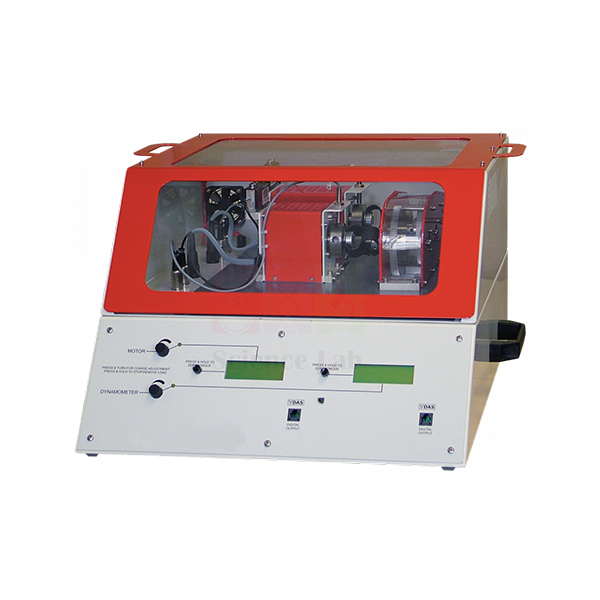
Geared Systems
Geared Systems (Product Code: SLE/ETM/12) is a bench-mounting base unit used to test the performance and efficiency of gear drives and other drive units under power in engineering laboratories. Students measure power in from a variable-speed, low-voltage motor and power out to an electromagnetic hysteresis dynamometer, and a three-shaft gear drive unit comes as standard. It is made by Jain Scientific Equipments Pvt Ltd (ScienceLab), an OEM manufacturer, at its own factory in Ambala, India.
Key Details
| Parameter | Detail |
|---|---|
| Base unit | Bench-mounting; the main part of this set of products |
| Input (effort) | Variable-speed, low-voltage motor driving the input shaft |
| Output (load) | Dynamometer using electromagnetic braking and a hysteresis effect: variable load at constant torque irrespective of speed |
| Sensors | On the motor and dynamometer, measuring shaft speed and torque, and therefore power in and out |
| Torque measurement | Motor and dynamometer held in axial trunnions with race bearings, rotating freely against load cell sensors |
| Couplings | Flexible couplings with collets for quick and accurate alignment of the drive unit |
| Standard drive unit | Three-shaft gear drive unit |
| Other drive units | Optional (ask us) |
| Product code | SLE/ETM/12 |
| Manufacturer | Jain Scientific Equipments Pvt Ltd (ScienceLab) — OEM |
| Country of origin | India (made in Ambala, Haryana) |
What Is the Geared Systems Base Unit Used For?
Efficiency is the question every drive designer asks: how much of the power put into a gearbox actually reaches the output shaft? In a dynamic test on this base unit, the motor turns the input of the drive unit at a chosen speed while its input power is measured, and the dynamometer brakes the output while the output power is measured. Dividing one by the other gives efficiency, and repeating the run at other speeds and loads builds a full performance picture.
Because the hysteresis dynamometer holds a constant torque regardless of speed, students can change speed without the load drifting. The motor and dynamometer sit in trunnions and push against load cells, so torque readings come from the reaction on the housing. Flexible couplings with collets make it quick to swap the standard three-shaft gear drive for optional drive units, which suits engineering lab equipment for technical institutes that run several groups in one session.
What to Specify When Ordering
- Which optional drive units you want in addition to the standard three-shaft gear drive — ask us what is offered.
- Whether the Acceleration & Static Test Stand should be quoted with the base unit.
- Your mains supply, so the motor and sensor arrangement can be confirmed.
- The number of base units for your laboratory.
OEM Manufacturer
Geared Systems is manufactured by Jain Scientific Equipments Private Limited, trading as ScienceLab, at the company’s own licensed factory at Saha, Ambala, Haryana, India. As the OEM, the company quotes the base unit, the standard gear drive and add-on units together, and handles repeat orders and replacement parts itself — ask us.
The company is a registered MSME whose major activity is manufacturing (Udyam UDYAM-HR-01-0003714), and its export shipments are handled under Importer-Exporter Code AAECJ8618A (DGFT). See the ScienceLab profile.
Related Theory of Machines Equipment
Apparatus that complements drive-efficiency testing:
- Acceleration & Static Test Stand — static gear-drive efficiency and inertia tests to compare with dynamic results.
- Gear Train Model — for explaining gear ratios before testing a powered drive.
- Internal Gear Pinion Drive — another gearing arrangement for the same course.
- Pulley Demonstration Set — a simple mechanical-advantage comparison with geared drives.
Explore the Theory of Machines category for more.
Frequently Asked Questions
What does the Geared Systems base unit measure?
The Geared Systems base unit measures shaft speed and torque at both the motor and the dynamometer, and therefore the power into and out of the drive unit. Students use these measurements to find the performance and efficiency of the drive.
How does the dynamometer load the drive?
The dynamometer on Geared Systems SLE/ETM/12 uses electromagnetic braking and a hysteresis effect to provide a variable load at a constant torque, irrespective of speed. It supplies the output braking force while its sensors measure the output power.
Which drive unit comes with Geared Systems?
Geared Systems is supplied with a three-shaft gear drive unit as standard. The base unit can also dynamically test other optional drive units; ask us which ones are available and include them in your quotation request.
How is torque measured accurately?
In Geared Systems, axial trunnions with race bearings hold the motor and the dynamometer so they rotate freely against their load cell sensors. The reaction on each load cell gives an accurate torque reading at input and output.
Who manufactures Geared Systems SLE/ETM/12?
Geared Systems SLE/ETM/12 is manufactured by Jain Scientific Equipments Pvt Ltd (ScienceLab), the OEM, at its own licensed factory in Saha, Ambala, Haryana, India. The company supplies it factory-direct to institutions, dealers and importers.
Is a calibration certificate available for the sensors?
The Geared Systems listing does not describe calibration paperwork for its speed and torque sensors. If your institution needs a calibration certificate, raise it in your enquiry and we will discuss what can be arranged.
Request a Quote
For a quotation on Geared Systems (SLE/ETM/12), with or without optional drive units, use the contact page or the enquiry cart. Quotes are issued directly by the manufacturer, for orders within India and for export.
Last updated: 24 September 2026
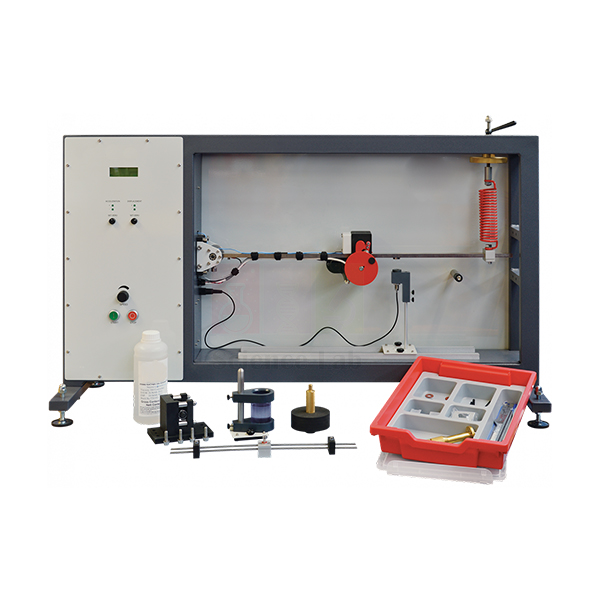
Free And Forced Vibrations
Free And Forced Vibrations (Product Code: SLE/ETM/13) is a beam vibration apparatus used to study free, forced and damped oscillations in engineering and theory of machines laboratories. Students can set the beam vibrating by hand or force it with a variable-speed servomotor driving a rotating offset mass, while a non-contacting sensor records displacement without adding damping. It is made by Jain Scientific Equipments Pvt Ltd (ScienceLab), an OEM manufacturer, at its own factory in Ambala, India.
Key Details
| Parameter | Detail |
|---|---|
| Beam | High-grade ground steel |
| Pivots | High-quality ball races for lowest friction and incidental damping |
| Excitation | Manual, or a variable-speed servomotor driving a rotating offset mass (‘exciter’) |
| Speed control | Servomotor with its own encoder and advanced controller for accurate speed regulation |
| Exciter position | Encoder linked to the rotating exciter mass measures its dynamic position |
| Displacement sensing | Non-contacting sensor with no physical contact with the oscillating system |
| Acceleration sensing | Accelerometer built into the exciter assembly |
| Damping | Variable-area viscous dashpot damper, with non-toxic fluid of stable viscosity (supplied) |
| Set-up | Simple and quick set-up and changeover; designed for repeatable results over a range of ambient temperatures |
| Analysis | Software compares measured acceleration with that derived from displacement |
| Product code | SLE/ETM/13 |
| Manufacturer | Jain Scientific Equipments Pvt Ltd (ScienceLab) — OEM |
| Country of origin | India (made in Ambala, Haryana) |
What Is the Free And Forced Vibrations Apparatus Used For?
Engines, pumps and building floors all vibrate, and engineers need to know the natural frequency of a structure and how strongly it responds when something drives it near that frequency. With this apparatus, a class first plucks the beam by hand to watch free vibration die away, then switches on the exciter and raises the servomotor speed step by step to trace the forced response and find resonance.
Fitting the dashpot and changing its open area adds controlled viscous damping, so students can see how damping lowers the resonant peak. Because the displacement sensor never touches the beam and the pivots run on ball races, very little unwanted damping creeps in. The accelerometer in the exciter shows the phase between displacement and acceleration — a strong SHM and vibration practical for mechanics lab equipment in India.
What to Specify When Ordering
- The computer arrangement for the software — ask us what the software runs on.
- Your mains supply, so the servomotor controller arrangement can be confirmed.
- Whether you need extra dashpot fluid with the order.
- The number of units for your vibration laboratory.
OEM Manufacturer
Jain Scientific Equipments Private Limited, which sells under the ScienceLab name, is the OEM for the Free And Forced Vibrations apparatus and produces it at its own licensed factory at Saha, Ambala, Haryana, India. Engineering colleges and dealers deal with the maker itself for quotations, repeat orders and parts such as the dashpot or sensors — ask us.
Read about the company on the ScienceLab profile.
Related Theory of Machines Equipment
Other vibration apparatus for building a complete practical set:
- Free and Forced Vibration Apparatus — a separate ScienceLab model to compare when choosing equipment.
- Free Vibrations Of A Cantilever — free vibration of a cantilever beam.
- Damper Kit — for further damping experiments.
- Whirling of Shaft Apparatus — resonance of rotating shafts.
All models are listed in the Theory of Machines category.
Frequently Asked Questions
How are vibrations produced on the Free And Forced Vibrations apparatus?
On the Free And Forced Vibrations apparatus, students may vibrate the system manually for free vibration, or force it using a variable-speed servomotor driving a rotating offset mass. The servomotor has its own encoder and controller for accurate speed regulation.
Why is a non-contacting displacement sensor used?
The Free And Forced Vibrations apparatus SLE/ETM/13 measures beam displacement with a non-contacting sensor, so the sensor has no physical contact with the oscillating system. That keeps added damping negligible and the measured response closer to the true behaviour of the beam.
What does the accelerometer show?
The accelerometer built into the exciter assembly of the Free And Forced Vibrations apparatus shows the phase relationship between beam displacement and acceleration. The software also compares measured acceleration with acceleration derived from the displacement readings.
Is damping included?
Yes. The Free And Forced Vibrations apparatus includes a variable-area viscous dashpot damper for use with a non-toxic fluid of stable viscosity, and the fluid is supplied. Changing the damper area lets students compare different levels of damping.
Who manufactures the Free And Forced Vibrations apparatus?
Jain Scientific Equipments Pvt Ltd (ScienceLab) is the OEM manufacturer of the Free And Forced Vibrations apparatus SLE/ETM/13, producing it at its own licensed factory in Saha, Ambala, Haryana, India, and selling it direct.
What computer does the software need?
The Free And Forced Vibrations listing refers to software for comparing acceleration with displacement but does not state its computer requirements. Ask us through the contact page, and include your preferred set-up when you request a quotation.
Request a Quote
Request a quotation for the Free And Forced Vibrations apparatus (SLE/ETM/13) on the contact page or add it to your enquiry cart. The manufacturer answers directly, for Indian and export orders alike.
Last updated: 24 September 2026
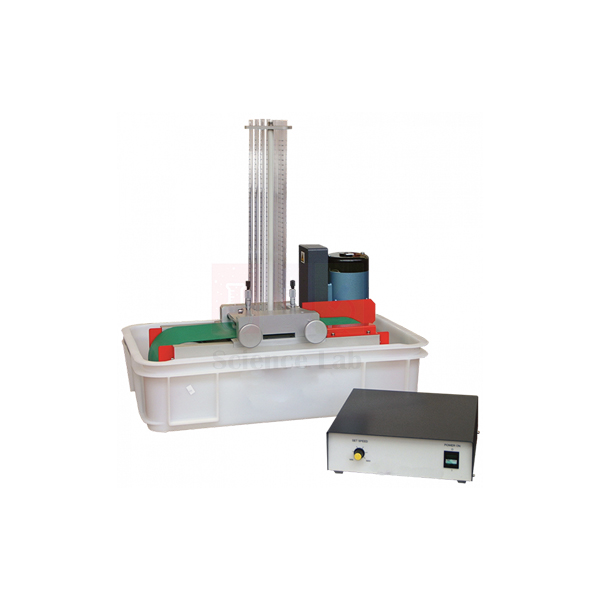
Michell Pad Apparatus
Michell Pad Apparatus (Product Code: SLE/ETM/14) is a bench-mounted, self-contained apparatus used to demonstrate the pressure distribution across the oil film in a Michell tilting pad slider bearing in engineering laboratories. Students read oil pressure on a set of thirteen graduated tubes while adjusting pad tilt and belt speed. It is made by Jain Scientific Equipments Pvt Ltd (ScienceLab), an OEM manufacturer, at its own factory in Ambala, India.
Specifications
| Parameter | Detail |
|---|---|
| Type | Bench-mounted, self-contained Michell tilting pad slider bearing demonstration |
| Pad | Aluminium plate mounted above a continuous loop flat belt |
| Pad adjustment | Held on two eccentric shafts to set the angle of tilt |
| Pressure readout | Set of 13 graduated tubes showing oil pressure across and along the film |
| Pad position | Micrometers measure leading and trailing edge positions |
| Belt drive | Motor with variable speed control |
| Included | Container of oil and a viscometer for measuring oil viscosity |
| Product code | SLE/ETM/14 |
| Manufacturer | Jain Scientific Equipments Pvt Ltd (ScienceLab) — OEM |
| Country of origin | India (made in Ambala, Haryana) |
What Is the Michell Pad Apparatus Used For?
Large thrust bearings in turbines and ship propeller shafts rely on the tilting pad principle: a slightly inclined pad drags oil into a converging gap, and the wedge of oil builds enough pressure to carry the load without metal-to-metal contact. On this apparatus the moving flat belt plays the part of the runner, the aluminium pad sits above it, and the oil film forms in between, so the whole effect can be seen and measured on a bench.
Students set a tilt with the eccentric shafts, record the leading and trailing edge positions with the micrometers, and read the thirteen tubes to plot pressure under the pad. Changing the belt speed and measuring the oil with the included viscometer then links sliding speed, viscosity and film thickness to pressure distribution — a clear viscosity measurement and lubrication practical for engineering colleges. Keep the oil container closed between sessions so the oil stays clean.
OEM Manufacturer
The Michell Pad Apparatus comes from Jain Scientific Equipments Private Limited, trading as ScienceLab, which manufactures it as the OEM at its own licensed factory at Saha, Ambala, Haryana, India. Laboratories, dealers and importers order it straight from the manufacturer, and questions about oil, tubes or other replacement parts go to the same team — ask us.
Company details are on the ScienceLab profile.
Related Theory of Machines Equipment
Bearing and lubrication apparatus that extend the same topic:
- Journal Bearing Demonstration — hydrodynamic lubrication in a rotating journal bearing.
- Air Bearing Apparatus — a bearing that uses a film of air instead of oil.
- Hertzian Contact Apparatus — dry contact between curved surfaces, for contrast with a full oil film.
- Friction Slide Apparatus — sliding friction without lubrication.
Find more in the Theory of Machines category.
Frequently Asked Questions
What does the Michell Pad Apparatus demonstrate?
The Michell Pad Apparatus demonstrates the pressure distribution across the film of oil in a Michell tilting pad slider bearing. Students find how pressure distribution relates to film thickness, sliding speed and oil viscosity.
How is the oil pressure measured?
On the Michell Pad Apparatus SLE/ETM/14, a set of thirteen graduated tubes shows the oil pressure across and along the film under the pad. Readings from all the tubes let students plot the pressure profile for each set-up.
Can the pad angle and belt speed be changed?
Yes. On the Michell Pad Apparatus, two eccentric shafts hold the pad so the angle of tilt can be adjusted, and micrometers measure the leading and trailing edge positions. A variable speed control sets the speed of the motor that turns the belt.
Is oil supplied with the Michell Pad Apparatus?
Yes. A container of oil and a viscometer to measure the viscosity of the oil are included with the Michell Pad Apparatus. For repeat supplies of oil, ask us when you place or plan your order.
Who manufactures the Michell Pad Apparatus?
The Michell Pad Apparatus SLE/ETM/14 is manufactured by Jain Scientific Equipments Pvt Ltd (ScienceLab), the OEM, at its licensed factory at Saha, Ambala, Haryana, India. Quotations and after-sales enquiries are handled by the maker directly.
What details should a quotation request include?
When asking for a Michell Pad Apparatus quotation, give the quantity, your mains supply, the institution or dealer name and the delivery location in India or abroad. Send them through the contact page for a reply from the manufacturer.
Request a Quote
Get a quotation for the Michell Pad Apparatus (SLE/ETM/14) via the contact page, or collect it with other items in the enquiry cart. Quotes come straight from the manufacturer.
Last updated: 24 September 2026
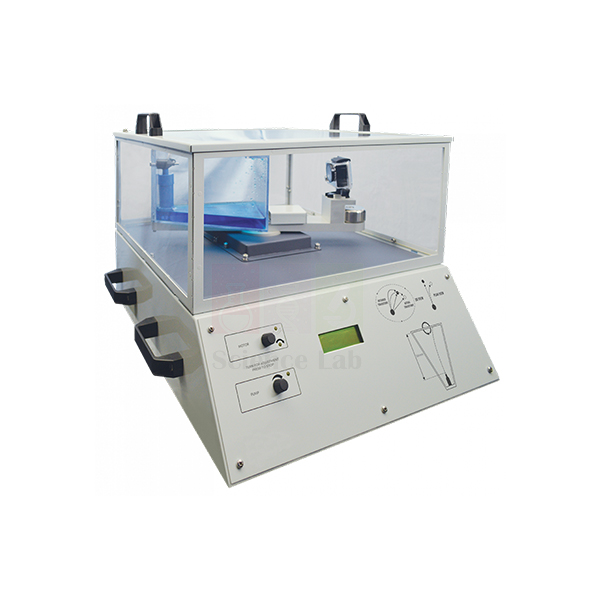
Coriolis Force
Coriolis Force (Product Code: SLE/ETM/15) is a benchtop apparatus used to show the Coriolis force by making a jet of water visibly deflect inside a rotating frame of reference, in physics and engineering laboratories. Students control the arm’s speed and direction of rotation and the pump rate from dials and a digital display on the base unit. It is made by Jain Scientific Equipments Pvt Ltd (ScienceLab), an OEM manufacturer, at its own factory in Ambala, India.
Key Details
| Parameter | Detail |
|---|---|
| Base | Benchtop base unit supporting a rotating arm |
| On the arm | Transparent water tank and counterbalance |
| Water jet | Produced by a submersible pump housed in the water tank |
| Controls | Dials and a digital display for speed and direction of rotation, and for pump rate |
| Observation | The jet of water deflects when the arm rotates |
| Principle | Coriolis force: a fictitious force that appears to act on objects moving within a rotating frame of reference |
| Product code | SLE/ETM/15 |
| Manufacturer | Jain Scientific Equipments Pvt Ltd (ScienceLab) — OEM |
| Country of origin | India (made in Ambala, Haryana) |
What Is the Coriolis Force Apparatus Used For?
The Coriolis effect explains why winds curve across the Earth, why long-range projectiles drift and why fluids behave unexpectedly in rotating machinery, yet it is hard to picture from equations alone. Here the whole reference frame spins: the water tank rides on the rotating arm, the submersible pump fires a jet across it, and anyone watching sees the jet bend away from a straight line as soon as the arm turns.
Students can reverse the direction of rotation and watch the deflection swap sides, raise the speed to see a stronger effect, or change the pump rate to alter the jet velocity. Those three variables make it a memorable physics demonstration kit for dynamics and fluid mechanics lectures. Fill the tank to a sensible level and check that the counterbalance is in place before starting rotation.
OEM Manufacturer
This Coriolis Force apparatus is produced by Jain Scientific Equipments Private Limited, whose trading name is ScienceLab, as the OEM at its own licensed factory at Saha, Ambala, Haryana, India. Universities, colleges and distributors order it factory-direct, so pump, tank or display queries and repeat orders are dealt with by the manufacturer — ask us.
Learn more on the ScienceLab profile.
Related Theory of Machines Equipment
Other rotating-system apparatus for the same syllabus:
- Corollis Component of Acceleration Apparatus — the Coriolis component of acceleration studied in a mechanism.
- Gyroscope Experiment Manual — another rotating-frame effect, gyroscopic couple.
- Governor — centrifugal effects on a rotating mechanism.
- Whirling of Shaft Apparatus — behaviour of a spinning shaft at critical speed.
View the whole Theory of Machines category.
Frequently Asked Questions
What does the Coriolis Force apparatus show?
The Coriolis Force apparatus shows a jet of water deflecting when the arm carrying the water tank rotates. The deflection is due to the Coriolis force, a fictitious force that appears to act on objects moving within a rotating frame of reference.
How is the water jet produced?
In the Coriolis Force apparatus SLE/ETM/15, the transparent water tank on the rotating arm houses a submersible pump that produces the jet of water. The pump rate can be adjusted from the base unit to change the jet.
Which settings can students change?
Dials and a digital display on the Coriolis Force base unit let students adjust the speed of rotation, the direction of rotation and the pump rate. Changing each one shows how the deflection of the jet responds.
Why is there a counterbalance on the arm?
The rotating arm of the Coriolis Force apparatus carries both the transparent water tank and a counterbalance. Balancing the arm helps it rotate smoothly about the benchtop base unit while the demonstration runs.
Who manufactures the Coriolis Force apparatus?
Jain Scientific Equipments Pvt Ltd (ScienceLab) is the OEM manufacturer of the Coriolis Force apparatus SLE/ETM/15, which is made at its own licensed factory in Saha, Ambala, Haryana, India, and sold direct by the maker.
Can the Coriolis Force apparatus be ordered in bulk or exported?
Yes, the Coriolis Force apparatus is supplied to institutions, dealers and importers across India and international markets. Share your quantity, mains supply and delivery destination on the contact page to receive a quotation.
Request a Quote
To receive a quotation for the Coriolis Force apparatus (SLE/ETM/15), write to us through the contact page or add it to the enquiry cart. The manufacturer sends the quote directly.
Last updated: 24 September 2026