- Physics Lab Equipment
- Chemistry Lab Equipment
- Biology Lab Equipment
- Anatomical Lab Equipment
- Learning
- Educational Lab Equipment
- Magnets
- Agriculture
- Astronomy
- Earth Science
- Geography Lab Equipment
- Safety Lab Coat
- Laboratory
- Meteorological
- Electricity & Magnetism
- Heat
- School Lab Equipment
- Lab Glassware
- Science Lab Equipment
- Tvet Lab Equipment
- Robotics Kits Supplier and Manufacturer for Schools India
- Math Lab Equipment Manufacturers and Exporters in Ambala
- STEM Kits Manufacturers and Supplier India
- Engineering Lab Equipment
- Hospital Lab Equipment
- Water, Sanitation & Hygiene Supplies
- Cold Chain, Solar & Communication Equipment
- Nutrition
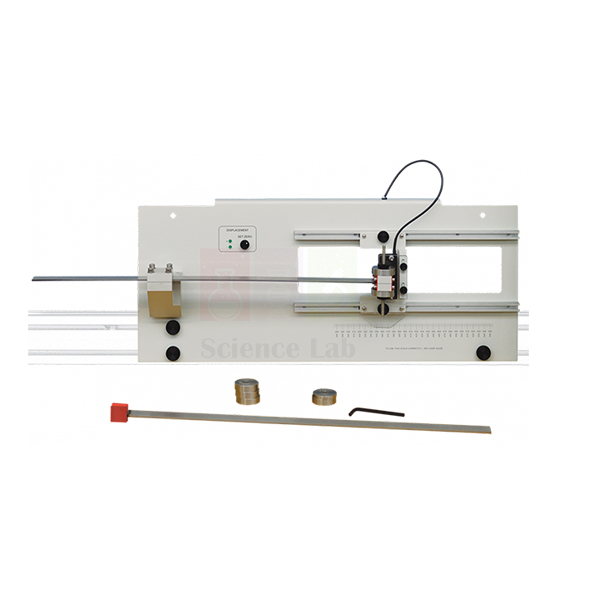
Free Vibrations Of A Cantilever
Free Vibrations Of A Cantilever (Product Code: SLE/ETM/06) is a vibration experiment used to show how a clamped beam with an end mass oscillates like a mass-spring system, its own stiffness acting as the spring, in theory of machines laboratories. Students set the oscillating length with a sturdy clamp on a back panel that fixes to the Free Vibrations Test Frame, while a non-contacting sensor on two runners follows the tip without touching it. It is made by Jain Scientific Equipments Pvt Ltd (ScienceLab), an OEM laboratory equipment manufacturer in India, at its own factory in Ambala.
Key Details
| Parameter | Detail |
|---|---|
| System | One-degree-of-freedom free vibration; a beam with a mass at the end behaves like a mass-spring system, with beam stiffness replacing spring stiffness |
| Purpose | Examines what happens when the spring element is not light |
| Back panel | Fixes to the Test Frame; holds a sturdy clamp and two runners |
| Clamp | Holds the beam and is used to adjust the oscillating length of the cantilever |
| Sensor | Non-contacting sensor on the runners, measuring oscillations at the end of the cantilever with negligible damping |
| Topics | Simple harmonic motion (SHM) and frequency of oscillation; beam stiffness; Rayleigh’s method; Dunkerley’s method; second moment of area; phase difference between displacement and its derivatives |
| Real-world link | A visual example of oscillations that occur in real structures such as aircraft wings |
| Product code | SLE/ETM/06 |
| Manufacturer | Jain Scientific Equipments Pvt Ltd (ScienceLab) — OEM |
| Country of origin | India (made in Ambala, Haryana) |
What Is the Cantilever Vibration Experiment Used For?
A cantilever with an end mass is the simplest model of a structure that vibrates under its own stiffness, from a diving board to an aircraft wing. Students clamp the beam at a chosen length, deflect the tip and release it while the non-contacting sensor records the oscillation; repeating at several lengths shows how frequency falls as the cantilever gets longer. Measured frequencies are then compared with values predicted from the beam’s stiffness and second moment of area.
Because the beam is not a light spring, its own mass affects the result, so the experiment is used to compare simple predictions with Rayleigh’s method and Dunkerley’s method, which account for distributed mass. The trace also shows the phase difference between displacement, velocity and acceleration. Tighten the clamp firmly at each new length, keep the sensor runners in line with the tip, and use small initial deflections for clean, repeatable traces.
What to Specify When Ordering
- The Free Vibrations Test Frame, if your laboratory does not already have one
- Number of cantilever sets needed for your student groups
- Any companion experiments for the same frame, such as the Free Vibration Of Beam Spring
OEM Manufacturer
ScienceLab, the trading name of Jain Scientific Equipments Private Limited, manufactures this cantilever vibration experiment as the OEM at its own licensed factory at Saha, Ambala, Haryana, India. Institutions building a vibrations laboratory can source the experiment, the test frame and companion set-ups factory-direct from one manufacturer, whether they are universities, polytechnics, dealers or importers.
Repeat orders and replacement parts are quoted by the manufacturer itself — just ask us. Read about ScienceLab on the company profile.
Related Theory of Machines Equipment
Apparatus that works alongside the cantilever experiment:
- Free Vibrations Test Frame — holds the cantilever’s back panel steady and level.
- Free Vibration Of Beam Spring — the companion experiment with a separate coiled spring.
- Vibration Of Spiral Spring Apparatus — torsional free vibration using a spiral spring.
- Whirling of Shaft Apparatus — another case where an elastic member’s stiffness sets a critical frequency.
The rest of the range is in Theory of Machines.
Frequently Asked Questions
What does the Free Vibrations Of A Cantilever experiment show?
The Free Vibrations Of A Cantilever experiment shows that a beam with a mass at its end vibrates like a mass-spring system, with the beam’s stiffness replacing the spring’s, and examines what happens when the spring element is not light.
Can the cantilever length be changed?
Yes. On the Free Vibrations Of A Cantilever experiment, a sturdy clamp on the back panel holds the beam, and students use it to adjust the oscillating length of the cantilever between tests.
How are the oscillations measured?
A non-contacting sensor held on two runners measures the oscillations at the end of the cantilever. Because it has no physical contact with the beam, the Free Vibrations Of A Cantilever experiment runs with negligible damping from the measurement.
Which theory topics does it support?
The Free Vibrations Of A Cantilever experiment supports simple harmonic motion and frequency of oscillation, beam stiffness, Rayleigh’s method, Dunkerley’s method, second moment of area, and the phase difference between displacement and its derivatives.
Who manufactures the Free Vibrations Of A Cantilever experiment?
The Free Vibrations Of A Cantilever experiment is manufactured by Jain Scientific Equipments Pvt Ltd (ScienceLab), the OEM, at its own licensed factory in Saha, Ambala, Haryana, India, and is supplied factory-direct in India and international markets.
What does a quotation request need?
For a Free Vibrations Of A Cantilever quotation, state the number of sets, whether the Free Vibrations Test Frame is required, and the delivery location. Quotes come directly from the manufacturer via the contact page or the enquiry cart.
Request a Quote
To get the manufacturer’s price for the Free Vibrations Of A Cantilever experiment, use the contact page or add it to the enquiry cart, listing any frame or companion experiments you also need.
Last updated: 24 September 2026