- Physics Lab Equipment
- Chemistry Lab Equipment
- Biology Lab Equipment
- Anatomical Lab Equipment
- Learning
- Educational Lab Equipment
- Magnets
- Agriculture
- Astronomy
- Earth Science
- Geography Lab Equipment
- Safety Lab Coat
- Laboratory
- Meteorological
- Electricity & Magnetism
- Heat
- School Lab Equipment
- Lab Glassware
- Science Lab Equipment
- Tvet Lab Equipment
- Robotics Kits Supplier and Manufacturer for Schools India
- Math Lab Equipment Manufacturers and Exporters in Ambala
- STEM Kits Manufacturers and Supplier India
- Engineering Lab Equipment
- Hospital Lab Equipment
- Water, Sanitation & Hygiene Supplies
- Cold Chain, Solar & Communication Equipment
- Nutrition
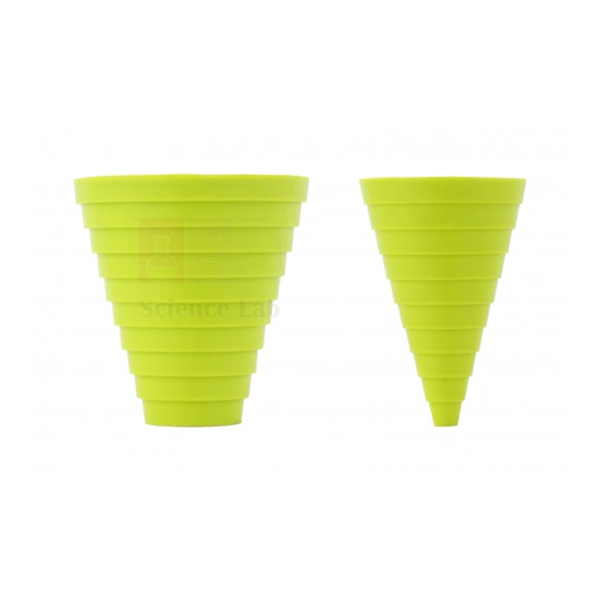
Steppa-Stoppa Large
Steppa-Stoppa Large (Product Code: SLE/CH/228) is a tapered, one-size-fits-many stopper made to replace the assortment of standard rubber stoppers most laboratories keep in a drawer. Moulded from blended polymer with an incremental taper, a single stopper closes any opening that falls between its narrow base and its wide upper end, so teachers and technicians no longer have to hunt for the right numbered bung. It is supplied by Jain Scientific Equipments Pvt Ltd (ScienceLab), Ambala, as part of its school chemistry lab equipment in India and for institutions overseas.
Specifications
| Parameter | Detail |
|---|---|
| Product type | Tapered stopper designed to replace standard rubber stoppers |
| Material | Blended polymer |
| Profile | Incremental taper to suit most applications, removing the need for multiple sized rubber stoppers |
| Dimensions | 20mm (base) x 48mm (top) x 52mm (length) |
| Sterilisation | Autoclavable |
| Pack size | Box of 10 stoppers |
| Accessory provided | Microfiber drying cloth (the stoppers grip most firmly when dry) |
| Size in this listing | Large (the stopper is also offered in a small size) |
Typical Use
In a teaching laboratory the large Steppa-Stoppa earns its place on conical flasks, wide tubes and reagent bottles that need closing between the steps of a practical — keeping a prepared solution covered overnight, stopping a flask of indicator from evaporating, or sealing a culture vessel before it goes into the autoclave. Because one tapered stopper covers a spread of neck sizes, a single box can serve a whole bench group, and stock-taking becomes far simpler than tracking a dozen rubber stopper sizes. It sits comfortably in a set of everyday lab equipment accessories alongside tongs, holders and racks.
Push the stopper into the opening with a slight twist until it seats, and do not force it further once it grips. Wipe both the stopper and the vessel neck with the microfiber cloth first, because the polymer holds most securely on a dry surface. As with any stopper, never close a vessel that is being heated or is still producing gas, and let autoclaved stoppers cool and dry before they go back into use.
Supplier
Steppa-Stoppa Large is supplied by Jain Scientific Equipments Private Limited, a company in Ambala, Haryana, that trades under the ScienceLab name. Alongside the laboratory apparatus it manufactures, the company sources practical bench accessories such as these stoppers, so that schools and colleges can complete a laboratory order through a single supplier. Read more about the business on our company profile.
Related Chemistry Lab Equipment
Items used with this stopper in the same practical or storage routine:
- Conical Flask — a common vessel for the stopper to close when solutions are stored between lessons
- Test Tube — wider tubes can be closed with the taper while samples wait for the next step
- Rubber Cork — the conventional option when a bored stopper is needed for tubing or a thermometer
- Autoclave Basket — keeps stoppers and small glassware together during sterilisation
See the complete Chemistry Lab Equipment range for more bench essentials.
Frequently Asked Questions
What is included in one box?
Ten large Steppa-Stoppa stoppers. A microfiber drying cloth is provided with the stoppers so they can be kept dry for a firm grip.
What size of opening does the large stopper fit?
It fits openings that fall along its taper, from 20mm at the base to 48mm at the wide end over a 52mm length. For narrower necks, ask us about the small size, which also comes in a box of 10.
Can the stoppers be autoclaved?
Yes. They are autoclavable, which suits microbiology and sterile-work sessions; allow them to cool and dry fully before refitting.
Is there a version with a hole for a delivery tube or thermometer?
A bored version is not listed for this product. For apparatus that needs glass tubing through the stopper, a bored rubber cork is the usual choice; contact us if you would like advice.
Why does a stopper sometimes slip out?
Moisture is the usual cause. The stoppers grip most firmly when dry, so wipe the stopper and the neck of the vessel with the drying cloth before fitting.
What should an institutional quotation request include?
List the number of boxes, whether you also need the small size, and your delivery location. We supply schools, colleges and distributors in India and international markets; send the details through our contact page.
Request a Quote
For pricing and availability, contact our team or add Steppa-Stoppa Large to the enquiry cart together with the rest of your laboratory list.
Last updated: 24 September 2026