- Physics Lab Equipment
- Chemistry Lab Equipment
- Biology Lab Equipment
- Anatomical Lab Equipment
- Learning
- Educational Lab Equipment
- Magnets
- Agriculture
- Astronomy
- Earth Science
- Geography Lab Equipment
- Safety Lab Coat
- Laboratory
- Meteorological
- Electricity & Magnetism
- Heat
- School Lab Equipment
- Lab Glassware
- Science Lab Equipment
- Tvet Lab Equipment
- Robotics Kits Supplier and Manufacturer for Schools India
- Math Lab Equipment Manufacturers and Exporters in Ambala
- STEM Kits Manufacturers and Supplier India
- Engineering Lab Equipment
- Hospital Lab Equipment
- Water, Sanitation & Hygiene Supplies
- Cold Chain, Solar & Communication Equipment
- Nutrition
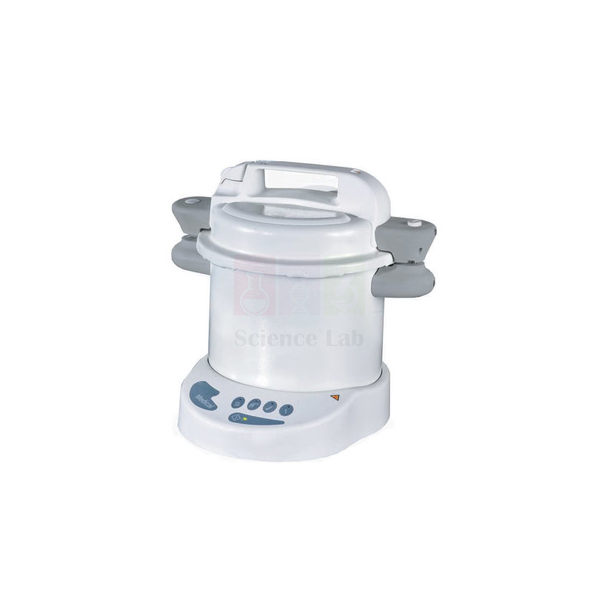
Classic Standard Autoclave
Built around culture media for school and college biology rooms, this 12 litre autoclave sterilises at 121°C and 1.05 bar, with a minimum sterilising time of 22 minutes. One button starts the cycle. Its interlock lid stays shut until the inside has cooled, and at 4.3 kg the unit is light enough to move between rooms.
12 litre media autoclave specifications
| Parameter | Detail |
|---|---|
| Capacity and chamber | 12 litres; 210 mm diameter × 318 mm height |
| Cycle | 121°C at 1.05 bar operating pressure; minimum sterilising time 22 minutes |
| Maximum load | 4 kg unwrapped; instruments up to 290 mm long |
| Overall size | 340 mm wide × 420 mm high (max) |
| Net weight | 4.3 kg (max) |
| Electrical | 230 V, 1500 W, 50–60 Hz |
| Controls | One-touch button operation |
| Lid | Interlock lid; cannot be opened until the internal temperature has fallen |
| Product code | SLE/LA/06 |
| Minimum order | 10 units |
| Dispatch | Usually within 7 to 10 working days |
| Supplied by | ScienceLab (Jain Scientific Equipments Pvt Ltd), Ambala, India |
Media preparation practicals with the 12 litre autoclave
Agar plates for a streak-plate practical. Make up nutrient agar in screw-cap conical flasks, loosen the caps and press the button to start the cycle. When the lid releases and the flask can be held comfortably, pour the agar into triple-vent Petri dishes beside a Bunsen burner and let the plates set.
Broth for a growth-curve exercise. Sterilise nutrient broth in a baffled culture flask with its cap loosened. Once it has cooled, inoculate it with an inoculation loop, then incubate and shake it, taking samples at set times.
Clearing up after the class. Collect used plates in a disposable autoclave bag, keep the load within 4 kg, and run a cycle before the bag goes out as waste.
Frequently Asked Questions About the Classic Standard Autoclave
Why does the lid stay locked after the cycle ends?
The interlock holds the lid until the temperature inside has fallen. Agar and broth can still be above their boiling point just after a cycle. Opening then would let them boil up and spill, or crack the glass. Wait for the lock to release on its own and never force the lid.
Is the 22 minute cycle long enough for large volumes of agar?
Not always. The 22 minutes is a minimum sterilising time, and a large volume in one flask takes longer to reach 121°C in the middle. Split media into several smaller bottles or flasks, which heat through faster and are easier for students to pour.
How long should sterilised agar cool before pouring?
Until the flask can be held in a bare hand for a few seconds, while the agar is still liquid. Poured too hot, it fogs the lids with condensation that drips onto the plates. Left too long, it starts to set in the flask and pours in lumps.
How can scalds be avoided when unloading hot media?
Wear heat-resistant gloves, lift each flask straight up and keep it upright. Do not shake or swirl hot agar, which can boil up suddenly. Keep students back from the bench while the chamber is emptied, and unload only after the lid has released by itself.
How much can one load hold?
Up to 4 kg unwrapped, and instruments up to 290 mm long, in a chamber 210 mm across and 318 mm high. Leave space between flasks so steam reaches each one, rather than packing the full 12 litres tight.
Can surplus autoclaved agar be kept for another lesson?
Yes. Tighten the caps once the bottles have cooled and store them away from dust. Before the next lesson, melt the agar in a water bath rather than over a flame. Keep poured plates upside down in a sealed bag in a refrigerator.
Media flasks, plates and sterilising items
- Baffled Culture Flask
- Petri Dish, Triple Vent
- Petri Dish Rack
- Autoclave Bag Disposable
- Autoclave, Stainless Steel, 15 Litre
To request a quotation, send the product name, code and quantity through our contact page or add the item to your enquiry cart.
Last updated: 14 November 2026
