- Physics Lab Equipment
- Chemistry Lab Equipment
- Biology Lab Equipment
- Anatomical Lab Equipment
- Learning
- Educational Lab Equipment
- Magnets
- Agriculture
- Astronomy
- Earth Science
- Geography Lab Equipment
- Safety Lab Coat
- Laboratory
- Meteorological
- Electricity & Magnetism
- Heat
- School Lab Equipment
- Lab Glassware
- Science Lab Equipment
- Tvet Lab Equipment
- Robotics Kits Supplier and Manufacturer for Schools India
- Math Lab Equipment Manufacturers and Exporters in Ambala
- STEM Kits Manufacturers and Supplier India
- Engineering Lab Equipment
- Hospital Lab Equipment
- Water, Sanitation & Hygiene Supplies
- Cold Chain, Solar & Communication Equipment
- Nutrition
Testing Equipments in the ScienceLab catalogue are polymer, plastics and packaging-film testing machines for engineering colleges, polytechnics and plastics-technology departments, covering melt flow, tensile strength, notched impact, softening temperature, surface friction and heat sealing. The range is supplied by Jain Scientific Equipments Pvt Ltd (ScienceLab), Ambala. It gives students hands-on practice in characterising thermoplastics and films, as part of our engineering lab equipment in India.
What Does the Testing Equipments Range Include?
| Topic | What it covers | Example products |
|---|---|---|
| Flow and thermal behaviour of plastics | Melt flow of thermoplastics under set weights; Vicat softening point and heat deflection temperature under load | Melt Flow Index Tester, Computerised VSP & HDT Apparatus |
| Mechanical strength | Tensile load, yield and elongation; pendulum impact strength of notched specimens and notch preparation | Computerised Tensile Tester, Computerised Izod Impact Tester, Motorized Notch Cutter (Variable Speed) |
| Film friction | Static and kinetic friction of films and sheets, including film-to-film, film-to-metal and film-to-glass on an inclined plane | Static and Kinetic Friction Tester, Inclined Plane Tester |
| Sealing | Table-top heat sealing with two temperature zones | Heat Sealer |
Featured Testing Equipments
| Product | Product Code | Typical Use |
|---|---|---|
| Melt Flow Index Tester | SLE/ET/01 | Melt flow tests with 2.16 kg and 5 kg weights, PID temperature control and a digital timer |
| Computerised Tensile Tester | SLE/ET/02 | Tensile tests up to 500 kg with peak load, break load, yield stress and % elongation displayed |
| Computerised Izod Impact Tester | SLE/ET/03 | Pendulum impact tests up to 25 J, with impact strength shown in J/m and kg-cm/cm |
| Motorized Notch Cutter (Variable Speed) | SLE/ET/04 | Cutting 45° notches in impact specimens behind an acrylic safety jacket |
| Computerised VSP & HDT Apparatus | SLE/ET/05 | Vicat softening and heat deflection tests from ambient to 300 °C, with 2 to 6 stations |
| Static and Kinetic Friction Tester | SLE/ET/06 | Static and kinetic friction values of film samples using a 200 g sled |
| Inclined Plane Tester | SLE/ET/07 | Coefficient of friction between film and film, metal or glass |
| Heat Sealer | SLE/ET/08 | Two-zone table-top heat sealing with PID temperature control and pneumatic clamping jaws |
Supply & Company Details
ScienceLab (Jain Scientific Equipments Private Limited) supplies this range from Ambala, Haryana, to engineering colleges, polytechnics, plastics and packaging institutes, dealers, tender buyers and importers in India and international markets. Options such as the number of VSP & HDT stations are confirmed at the quotation stage. For vendor registration, the company is incorporated under CIN U29309HR2020PTC087597 and registered for GST as 06AAECJ8618A1ZT.
Related Ranges
- Engineering Lab Equipment — the parent hub for all engineering-college, polytechnic and TVET lab ranges.
- Materials Testing and Properties — teaching apparatus for metals and mechanics of materials (hardness, fatigue, springs, strain gauges), whereas this page is about plastics and films.
- General Products — structures and statics apparatus for beams, frames, trusses and bridges.
- Civil Engineering Lab Equipment — testing apparatus for construction materials rather than polymers.
Frequently Asked Questions
What does the Testing Equipments range include?
The Testing Equipments range includes eight polymer and film testing machines: a melt flow index tester, computerised tensile, Izod impact and VSP & HDT apparatus, a motorised notch cutter, two friction testers and a heat sealer, covering flow, strength, thermal and surface properties.
Which courses use these Testing Equipments?
These Testing Equipments suit polymer technology, plastics engineering, packaging and mechanical engineering courses in colleges, polytechnics and technical institutes, where students learn how thermoplastics and films are characterised for flow, strength, softening and friction.
How is Testing Equipments different from Materials Testing and Properties?
Testing Equipments concentrates on plastics and film testing machines, while Materials Testing and Properties covers bench-scale teaching apparatus for metals and mechanics of materials, such as hardness, fatigue, spring and thin-cylinder experiments. Departments teaching both polymers and metals may need both ranges.
Who supplies the Testing Equipments range?
The Testing Equipments range is supplied by Jain Scientific Equipments Private Limited, trading as ScienceLab, from Ambala, Haryana, to engineering colleges, polytechnics, institutions, dealers, tender buyers and importers in India and abroad.
What should a quotation request for Testing Equipments include?
A quotation request for Testing Equipments should list the product codes (SLE/ET/01 to SLE/ET/08), quantities, any options such as the number of VSP & HDT stations, the delivery destination and whether the order is for a tender or an export shipment.
Request a Quote or Catalogue
Send product codes and quantities through our contact page or the shopping cart for a quotation or catalogue.
Last updated: 24 September 2026
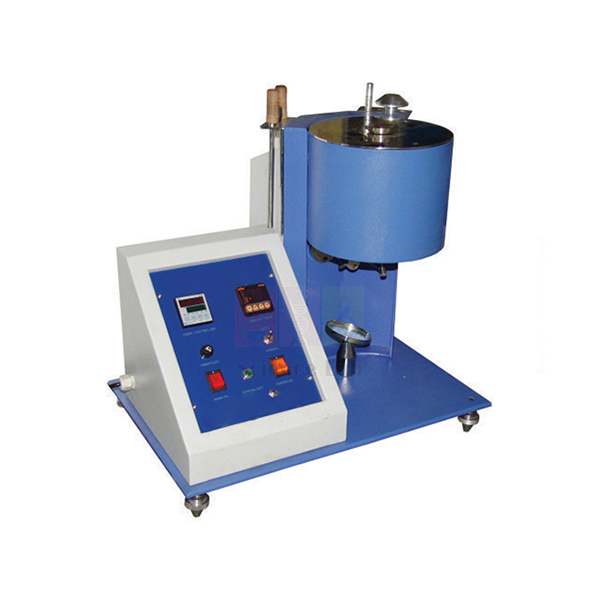
Melt Flow Index Tester
Melt Flow Index Tester (Product Code: SLE/ET/01) is a plastics testing instrument used to measure how easily a molten thermoplastic flows through a die under a set load and temperature, a routine check in polymer engineering labs and quality-control rooms. It uses a microprocessor-based, auto-tuned PID temperature controller with 0.1 °C resolution, weights of 2.16 kg and 5 kg, and a digital presettable timer up to 999 seconds. It is supplied by Jain Scientific Equipments Pvt Ltd (ScienceLab), Ambala, India, to buyers of engineering lab equipment in India and abroad.
Specifications
| Parameter | Detail |
|---|---|
| Temperature (as listed) | Ambient: 400 °C |
| Temperature control | Microprocessor-based, auto-tuned PID controller with temperature range |
| Resolution | 0.1 °C |
| Accuracy | ± 0.1 °C |
| Weights | 2.16 kg and 5 kg |
| Sample cutting | Manual |
| Timer | Digital, presettable, range up to 999 seconds, with buzzer output |
| Power | 230 V, 50 Hz, single phase |
| Product code | SLE/ET/01 |
| Supplied by | Jain Scientific Equipments Pvt Ltd (ScienceLab), Ambala, India |
What Is the Melt Flow Index Tester Used For?
The melt flow index expresses how much molten polymer is pushed through a standard die in a fixed time. Granules are loaded into the heated barrel, allowed to melt at the set temperature, and a weighted piston drives the melt out through the die. The operator cuts the extrudate at timed intervals, weighs the pieces and works out the flow rate. A higher value means an easier-flowing, usually lower-viscosity grade.
Plastics processors use the test to check incoming raw material batches, confirm a grade before moulding or extrusion, and spot degradation in recycled material, while engineering colleges and polytechnics use it to teach polymer processing. The digital timer's buzzer signals each manual cut, and the two weights let the lab test under a lighter or heavier load as its method requires. Let the temperature settle before loading, clean the barrel and die while still hot, and wear heat-resistant gloves.
What to Specify When Ordering
- Confirmation that your site has a 230 V, 50 Hz, single-phase supply.
- The test temperatures and materials you plan to test, so the working range can be confirmed.
- Which weights you need (2.16 kg, 5 kg or both).
- Whether a calibration certificate or other documents are required, to be discussed at quotation stage.
Supplier
Jain Scientific Equipments Private Limited, which trades as ScienceLab, supplies the Melt Flow Index Tester from Ambala, Haryana, to engineering colleges, polytechnics, polymer testing labs and dealers in India and international markets. Buyers setting up a plastics testing room can source it together with related test apparatus on one order.
For availability, documentation and delivery questions, ask us. Company details are on the ScienceLab profile.
Related Testing Equipments
Other instruments often used in the same plastics testing lab:
- Computerised Tensile Tester — measures how plastic specimens behave when pulled.
- Computerised Izod Impact Tester — tests the impact strength of notched specimens.
- Motorized Notch Cutter (Variable Speed) — prepares the notches for impact test specimens.
- Computerised VSP & HDT Apparatus — finds softening and heat deflection temperatures.
See the full Testing Equipments category.
Frequently Asked Questions
What weights does the Melt Flow Index Tester use?
The Melt Flow Index Tester is specified with weights of 2.16 kg and 5 kg. The weight sits on the piston and sets the load that pushes molten polymer through the die, so the chosen weight must match your test method.
How precise is the temperature control of the Melt Flow Index Tester?
The Melt Flow Index Tester uses a microprocessor-based, auto-tuned PID controller with a resolution of 0.1 °C and a listed accuracy of ± 0.1 °C, which keeps the barrel steady at the set test temperature.
What temperature range does the Melt Flow Index Tester cover?
The Melt Flow Index Tester specification lists the temperature as “Ambient: 400 °C”. Please confirm the exact working range and your test temperatures with us through the contact page so the quotation matches your materials.
What power supply does the Melt Flow Index Tester need?
The Melt Flow Index Tester runs on 230 V, 50 Hz, single-phase power. If your lab uses a different supply, tell us before ordering so we can advise on suitability.
Is a calibration certificate available with the Melt Flow Index Tester?
Calibration documents for the Melt Flow Index Tester should be discussed with us when you request a quotation. Tell us what your lab or auditor requires, and we will confirm what can be provided before the order is placed.
Who supplies the Melt Flow Index Tester?
The Melt Flow Index Tester is supplied by Jain Scientific Equipments Pvt Ltd (ScienceLab), Ambala, Haryana, India, to colleges, polymer testing labs and dealers in India and international markets.
Request a Quote
Send your requirements through the contact page or add the Melt Flow Index Tester to the enquiry cart for a quotation.
Last updated: 24 September 2026
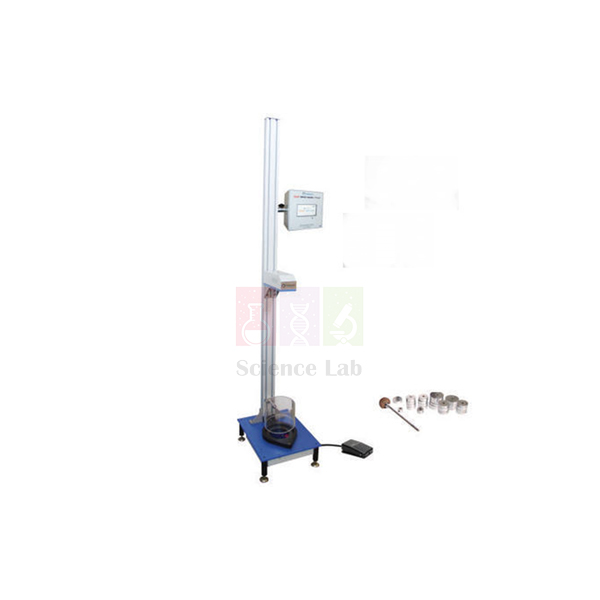
Computerised Tensile Tester
Computerised Tensile Tester (Product Code: SLE/ET/02) is a motorised tensile testing instrument used to pull a specimen to failure while recording its load, yield and elongation in materials and polymer testing laboratories. Engineering colleges and quality-control labs use it for loads up to 500 kg on one load cell, with up to 1000 mm of cross travel and speeds from 10 to 500 mm/minute. It is supplied by Jain Scientific Equipments Pvt Ltd (ScienceLab), Ambala, India, as part of its range of test and measurement instruments in India.
Specifications
| Parameter | Detail |
|---|---|
| Load capacity | Up to 500 kg |
| Number of load cells | One |
| Cross travel | Up to 1000 mm |
| Test speed | Variable, 10 mm/minute to 500 mm/minute |
| Display | Direct display through microcontroller |
| Values displayed | Peak load, break load, tensile strength at peak, tensile strength at break, yield load, yield stress, % elongation at peak |
| Power supply | 230 V, 50 Hz, single phase |
| Product code | SLE/ET/02 |
| Supplied by | Jain Scientific Equipments Pvt Ltd (ScienceLab), Ambala, India |
What Is the Computerised Tensile Tester Used For?
A tensile test holds a strip or shaped specimen at both ends and draws the ends apart at a steady rate until the specimen breaks. On this instrument the microcontroller follows the load cell throughout the pull and shows peak load, break load, tensile strength at peak and at break, yield load, yield stress and percentage elongation at peak, so students and technicians read results directly instead of working them out from a chart.
Typical exercises include comparing the strength and ductility of different materials, relating yield stress to peak strength, and checking how the pulling rate changes a result. Use slower speeds near 10 mm/minute for stiff or brittle samples and faster settings for very extensible ones, measure specimen width and thickness carefully because tensile strength is load divided by cross-sectional area, and keep expected loads inside the 500 kg rating. It is useful engineering lab equipment in India for strength-of-materials and polymer courses.
What to Specify When Ordering
- The highest load your specimens will reach, confirming it is within the 500 kg capacity
- Specimen material, shape and size, so gripping arrangements can be confirmed with us
- The test speeds your method requires within the 10 to 500 mm/minute range
- Mains supply at the installation site (listed supply: 230 V, 50 Hz, single phase)
- Quantity and delivery location in India or abroad
Supplier
ScienceLab is the trading name of Jain Scientific Equipments Private Limited of Ambala, Haryana. The company supplies this computerised tensile tester to engineering colleges, polytechnics, training institutes and industrial quality-control laboratories in India and international markets; questions about grips, spares or service support can be raised with us when you enquire.
For vendor registration and export paperwork, buyers can quote the supplying company’s Importer-Exporter Code AAECJ8618A (DGFT) and GSTIN 06AAECJ8618A1ZT. More about the company is on the ScienceLab company profile.
Related Testing Equipment
Other instruments that sit alongside this tester in a plastics or materials testing laboratory:
- Computerised Izod Impact Tester — measures notched impact strength, complementing slow-pull tensile data.
- Melt Flow Index Tester — checks the flow behaviour of a polymer grade before test pieces are moulded from it.
- Computerised VSP & HDT Apparatus — adds softening and heat deflection temperatures to the material profile.
- Tensile Tester Kit — a kit-based option for classroom tensile experiments.
Browse the full range on the Testing Equipments category page.
Frequently Asked Questions
What results does the Computerised Tensile Tester display?
The Computerised Tensile Tester shows peak load, break load, tensile strength at peak, tensile strength at break, yield load, yield stress and percentage elongation at peak directly on its microcontroller display, so each result is available as soon as the specimen fails.
What load capacity and travel does the Computerised Tensile Tester offer?
The Computerised Tensile Tester (SLE/ET/02) measures loads up to 500 kg through one load cell and provides cross travel of up to 1000 mm, which leaves room for specimens that stretch considerably before they break.
Can the test speed be adjusted?
Yes. The Computerised Tensile Tester has a variable speed from 10 mm/minute to 500 mm/minute, so the pulling rate can be matched to the specimen material and to the test method followed in your laboratory.
What power supply does the Computerised Tensile Tester need?
The Computerised Tensile Tester is listed for 230 volts, 50 Hz, single-phase mains. If your laboratory has a different supply, mention it in your enquiry so the requirement can be discussed before an order is placed.
Who supplies the Computerised Tensile Tester?
The Computerised Tensile Tester is supplied by Jain Scientific Equipments Pvt Ltd (ScienceLab), Ambala, Haryana, India, to engineering colleges, polytechnics and testing laboratories across India and international markets, with quotations issued directly by the company.
Is a calibration certificate available for the load cell?
Calibration-certificate availability for the Computerised Tensile Tester should be discussed with us before ordering. State your documentation needs through the contact page and we will confirm what can accompany the instrument.
What information does a quotation request need?
For a Computerised Tensile Tester quotation, give the quantity, delivery location, specimen types and highest expected loads, and any documentation requirements. Send these through the contact page or add the product to the enquiry cart.
Request a Quote
To receive pricing and delivery details for the Computerised Tensile Tester, write to us through the contact page or add it to the enquiry cart. ScienceLab supplies institutions, dealers and importers in India and international markets.
Last updated: 24 September 2026

Computerised Izod Impact Tester
Computerised Izod Impact Tester (Product Code: SLE/ET/03) is a pendulum impact testing instrument used to measure how much energy a notched specimen absorbs when a single swing breaks it, in plastics and materials testing laboratories. Its pendulum is released from 150°, energy ranges extend to 25.00 joules, and a microcontroller shows impact strength directly in J/m and kg-cm/cm. It is supplied by Jain Scientific Equipments Pvt Ltd (ScienceLab), Ambala, India, a laboratory instruments supplier in India serving colleges and test labs.
Specifications
| Parameter | Detail |
|---|---|
| Capacity | Up to 25.00 J |
| Pendulum release angle | 150° |
| Energy ranges | 0–2.71 J, 0–5.42 J, 0–10.84 J, 0–21.68 J and 0–25.00 J |
| Minimum resolution | 0.02 J, 0.05 J, 0.1 J, 0.2 J and 0.2 J on the respective ranges |
| Direct display | Impact strength in J/m and kg-cm/cm, through microcontroller |
| PC graph | Impact energy vs angular displacement |
| PC reports | Numeric impact-strength values in different units, printed by attaching a printer to the PC; the product specification lists reporting to ASTM and IS test methods |
| Power supply | 230 V, 50 Hz, single phase |
| Product code | SLE/ET/03 |
| Supplied by | Jain Scientific Equipments Pvt Ltd (ScienceLab), Ambala, India |
What Is the Izod Impact Tester Used For?
In an Izod test the notched specimen is clamped upright as a short cantilever with the notch facing the striker. The pendulum is lifted to its 150° release position and let go; it breaks the specimen and swings on, and the energy it has lost is the energy absorbed in fracture. The microcontroller turns this into impact strength in J/m or kg-cm/cm, while the PC software can plot impact energy against angular displacement.
Laboratories use it to compare the toughness of plastic grades, to see how fillers, moulding conditions or temperature change brittleness, and to teach fracture behaviour in materials courses. Pick the smallest energy range that covers the expected break so the finer resolution is used, for example 0.02 J on the 0–2.71 J range, and notch every specimen the same way, because notch geometry strongly affects the result. This makes it practical engineering lab equipment in India for polymer and mechanical engineering departments.
What to Specify When Ordering
- The energy ranges your specimens need, from 0–2.71 J up to 0–25.00 J
- Units required on displayed and printed results (J/m or kg-cm/cm)
- Whether a PC and printer for graphs and reports should be quoted or will be provided by your lab (confirm with us)
- Notch preparation equipment, if your lab does not already cut notches
- Quantity and delivery location
Supplier
Jain Scientific Equipments Private Limited trades as ScienceLab and operates from Ambala, Haryana, India. It supplies the Computerised Izod Impact Tester to polymer-processing units, engineering colleges, polytechnics and testing laboratories, and can quote it together with related instruments when a buyer is equipping a complete plastics testing room.
Ask us about pendulum spares or specimen accessories when you enquire. Background on the company is available on the ScienceLab profile page.
Related Testing Equipment
Instruments often ordered with an impact tester for polymer and materials work:
- Motorized Notch Cutter (Variable Speed) — cuts the uniform notches that Izod specimens need.
- Impact Testing Machine-Digital — another impact testing option from the materials testing range.
- Computerised Tensile Tester — adds tensile strength and elongation data for the same material.
- Melt Flow Index Tester — characterises the melt flow of the polymer grade being impact tested.
See every instrument in the Testing Equipments category.
Frequently Asked Questions
What energy ranges does the Computerised Izod Impact Tester cover?
The Computerised Izod Impact Tester measures impact energy up to 25.00 J, with ranges of 0–2.71 J, 0–5.42 J, 0–10.84 J, 0–21.68 J and 0–25.00 J, and minimum resolution from 0.02 J on the lowest range to 0.2 J on the highest.
How does the Computerised Izod Impact Tester show results?
The Computerised Izod Impact Tester displays impact strength directly through its microcontroller in J/m and kg-cm/cm. With a PC connected, it can also show an impact energy versus angular displacement graph and print numeric reports in different units on an attached printer.
Are the reports based on a test standard?
The product specification for the Computerised Izod Impact Tester lists PC reports of impact-strength values to ASTM and IS test methods, in different units. Because specimen and notch requirements differ between methods, confirm the exact method your laboratory follows with us before ordering.
What is the pendulum release angle?
The pendulum of the Computerised Izod Impact Tester is released from 150°. A fixed release angle gives the same starting energy for every swing, which keeps results comparable from one specimen to the next.
Do specimens need to be notched before testing?
Yes, Izod specimens are normally notched before testing, and notch shape strongly affects the result. ScienceLab's Motorized Notch Cutter (Variable Speed) prepares consistent notches and can be quoted together with the Computerised Izod Impact Tester.
Who supplies the Computerised Izod Impact Tester?
The Computerised Izod Impact Tester is supplied by Jain Scientific Equipments Pvt Ltd (ScienceLab), Ambala, Haryana, India, to plastics laboratories, engineering colleges and institutions in India and international markets.
Is a calibration certificate available?
Calibration-certificate availability for the Computerised Izod Impact Tester should be discussed with us before an order is confirmed. Tell us your documentation requirements through the contact page so we can confirm what can be provided with the instrument.
Request a Quote
For a price and delivery schedule on the Computerised Izod Impact Tester, send your ranges, units and quantity through the contact page, or place it in the enquiry cart with any other testing instruments you need.
Last updated: 24 September 2026
688.jpg)
Motorized Notch Cutter (Variable Speed)
Motorized Notch Cutter (Variable Speed) (Product Code: SLE/ET/04) is a specimen-preparation machine used to cut a precise notch into test bars before pendulum impact testing in plastics and materials laboratories. Its 45° cutter is driven by a 1440 rpm motor through a vector-controlled variable speed drive, its 0–25 mm range reads to 0.01 mm, and an acrylic safety jacket guards the cutting area. It is supplied by Jain Scientific Equipments Pvt Ltd (ScienceLab), Ambala, India, a laboratory equipment supplier in India for materials testing rooms.
Specifications
| Parameter | Detail |
|---|---|
| Cutting angle | 45° |
| Range | 0–25 mm |
| Least count | 0.01 mm |
| Operation | Motorized, with a 1440 rpm motor |
| Drive | Vector-controlled variable speed drive for adjusting the cutting speed |
| Safety | Acrylic safety jacket |
| Power supply | 230 V, 50 Hz, single phase |
| Product code | SLE/ET/04 |
| Supplied by | Jain Scientific Equipments Pvt Ltd (ScienceLab), Ambala, India |
What Is the Notch Cutter Used For?
Impact results can only be compared when every specimen carries the same notch, and hand-filed notches rarely match. This machine cuts the notch with a motor-driven 45° cutter, and its 0–25 mm range is read to a least count of 0.01 mm, so each bar in a batch can be given the same setting.
The vector-controlled drive lets the operator lower the cutting speed for heat-sensitive thermoplastics, which can smear or melt at the notch root if cut too fast, and raise it for tougher materials. Clamp each bar firmly, keep the acrylic jacket closed while the motor runs, clear chips between cuts and inspect the notch before the specimen goes to the impact tester. It is a sensible addition to engineering lab equipment in India wherever Izod or similar impact tests are taught.
What to Specify When Ordering
- Confirmation that the 45° cutting angle matches the notch your test method calls for
- Your specimen sizes, so fit within the 0–25 mm range can be checked with us
- Site supply (listed: 230 V, 50 Hz, single phase)
- Whether an impact tester should be quoted with it
- Quantity and delivery location
Supplier
ScienceLab, the trading name of Jain Scientific Equipments Private Limited in Ambala, Haryana, supplies this notch cutter mainly as part of impact-testing set-ups for plastics laboratories, engineering colleges and polytechnics in India and international markets.
Because a cutter wears with use, ask us about replacement cutters when you send your enquiry. Company details are on the ScienceLab profile.
Related Testing Equipment
Instruments that use or complement notched and moulded test specimens:
- Computerised Izod Impact Tester — breaks the notched bars and reports impact strength.
- Impact Testing Machine-Digital — an alternative impact tester that also works with notched specimens.
- Computerised Tensile Tester — for tensile specimens cut from the same material.
- Computerised VSP & HDT Apparatus — thermal softening and deflection tests on the same polymer.
The complete list is on the Testing Equipments category page.
Frequently Asked Questions
What notch angle does the Motorized Notch Cutter (Variable Speed) cut?
The Motorized Notch Cutter (Variable Speed) has a 45° cutting angle. Check that this matches the notch specified in your impact test method before ordering, and tell us if your laboratory works to a different notch profile.
What range and least count does the notch cutter offer?
The Motorized Notch Cutter (Variable Speed) has a range of 0–25 mm read with a least count of 0.01 mm, allowing fine, repeatable settings from one specimen to the next when a batch of impact test bars is prepared.
Why does a notch cutter need variable speed?
Variable speed lets the Motorized Notch Cutter (Variable Speed) match cutting speed to the material. Its vector-controlled drive adjusts the speed of the motorised cutter, so it can be reduced for heat-sensitive plastics that might smear or melt and increased for tougher materials.
What safety features does the Motorized Notch Cutter have?
The Motorized Notch Cutter (Variable Speed) has an acrylic safety jacket around the cutting area. Keep the jacket in place while the motor runs, and switch off the 230 V supply before clearing chips or changing specimens.
Who supplies the Motorized Notch Cutter (Variable Speed)?
The Motorized Notch Cutter (Variable Speed) is supplied by Jain Scientific Equipments Pvt Ltd (ScienceLab), Ambala, Haryana, India, to plastics testing laboratories and engineering institutions in India and international markets.
What should a quotation request include?
For a Motorized Notch Cutter (Variable Speed) quotation, state the quantity, delivery location, specimen sizes and the notch your method requires, and whether an impact tester should be quoted too. Use the contact page or the enquiry cart.
Request a Quote
Send your notch cutter requirements through the contact page, or add the machine to the enquiry cart together with your impact tester, and ScienceLab will reply with pricing and delivery terms.
Last updated: 24 September 2026
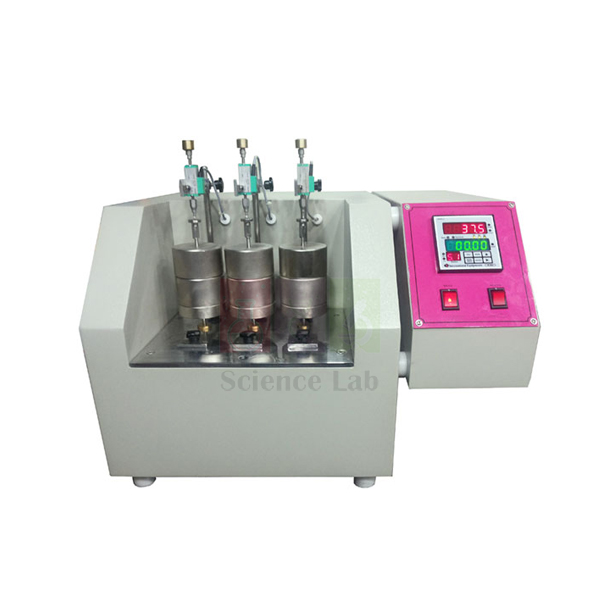
Computerised VSP & HDT Apparatus
Computerised VSP & HDT Apparatus (Product Code: SLE/ET/05) is a heated-bath testing instrument used to find the Vicat softening point (VSP) and heat deflection temperature (HDT) of plastics in polymer testing and quality-control laboratories. Loaded specimens are heated from ambient to 300 °C at 120 °C/hour or 50 °C/hour while sensors with 0.01 mm resolution follow them, and 2 to 6 stations can be specified. It is supplied by Jain Scientific Equipments Pvt Ltd (ScienceLab), Ambala, India, among its test and measurement instruments in India.
Specifications
| Parameter | Detail |
|---|---|
| Temperature range | Ambient to 300 °C |
| Rate of heating | 120 °C/hour and 50 °C/hour |
| Number of stations | Options from 2 to 6 stations |
| Sensor | Range up to 10 mm, resolution 0.01 mm |
| Weights | Set ranging from 5 g to 2000 g for incremental loads |
| Inner bath | Stainless steel |
| Outer body | Mild steel |
| Direct display | VSP and HDT results, through microcontroller |
| PC output | Penetration/deflection vs temperature graph and numeric reports of Vicat softening temperature and heat deflection temperature, printed by attaching a printer to the PC |
| Power supply | 230 V, 50 Hz, single phase |
| Product code | SLE/ET/05 |
| Supplied by | Jain Scientific Equipments Pvt Ltd (ScienceLab), Ambala, India |
What Is the VSP & HDT Apparatus Used For?
Both tests show how a plastic behaves as it warms under load. In the Vicat test a flat-ended needle rests on the specimen under a set load, and the bath temperature at which it penetrates a specified depth is taken as the softening point; in the HDT test a bar is loaded in bending, and the temperature at which it deflects by a specified amount is recorded. The microcontroller shows both results directly, and the PC software plots penetration or deflection against temperature.
Material suppliers, moulders and polymer courses use these results to compare grades and judge the temperature limit of a moulded part. Choose the heating rate your method requires, build the load from the 5 g to 2000 g weight set, and zero each sensor before heating begins. With several stations, specimens from one batch run side by side under identical heating, which makes the unit a productive choice among polymer laboratory instruments in India.
What to Specify When Ordering
- Number of stations, from 2 to 6
- Heating rate required: 120 °C/hour, 50 °C/hour or both
- The loads your method needs, so the 5 g to 2000 g weight set can be checked against it
- Whether a PC and printer for graphs and reports should be quoted (confirm with us)
- Quantity and delivery location
Supplier
ScienceLab is the name under which Jain Scientific Equipments Private Limited of Ambala, Haryana, trades. The company supplies this VSP and HDT apparatus to plastics compounders, packaging and moulding units, engineering colleges and research laboratories in India and international markets.
Station count, heating-rate options and extra weights can be discussed with us before a quotation is issued. Read about the company on the ScienceLab profile page.
Related Testing Equipment
Instruments that complete a polymer property testing set-up:
- Melt Flow Index Tester — measures how the same grade flows when molten, another heat-related property.
- Computerised Izod Impact Tester — adds impact toughness to the thermal results.
- Computerised Tensile Tester — records tensile strength and elongation of the material.
More instruments are listed under Testing Equipments.
Frequently Asked Questions
What do VSP and HDT stand for?
VSP is the Vicat softening point and HDT is the heat deflection temperature. The Computerised VSP & HDT Apparatus measures both, recording the temperature at which a loaded plastic specimen penetrates or deflects by a set amount as its bath heats up.
What temperature range and heating rates does it offer?
The Computerised VSP & HDT Apparatus heats from ambient to 300 °C at either 120 °C/hour or 50 °C/hour, so the rate can be chosen to suit the test method your laboratory follows.
How many specimens can be tested at once?
The Computerised VSP & HDT Apparatus is offered with options from 2 to 6 stations, so two to six specimens can be tested in a single heating run. State the number of stations you need when you enquire.
Which weights are supplied with the apparatus?
A set of weights ranging from 5 grams to 2000 grams is supplied with the Computerised VSP & HDT Apparatus for applying incremental loads to the specimens at each station.
How fine are the displacement sensors?
Each sensor on the Computerised VSP & HDT Apparatus has a range up to 10 mm and a resolution of 0.01 mm, which is fine enough to follow the small penetrations and deflections these tests measure.
Who supplies the Computerised VSP & HDT Apparatus?
The Computerised VSP & HDT Apparatus is supplied by Jain Scientific Equipments Pvt Ltd (ScienceLab), Ambala, Haryana, India, to polymer, packaging and engineering laboratories in India and international markets.
Is a calibration certificate available?
Calibration-certificate availability for the Computerised VSP & HDT Apparatus, including its temperature and displacement sensors, should be discussed with us before ordering. Send your documentation needs through the contact page for confirmation.
Request a Quote
Tell us the number of stations, heating rates and quantity you need through the contact page, or add the apparatus to the enquiry cart, and ScienceLab will send a quotation.
Last updated: 24 September 2026
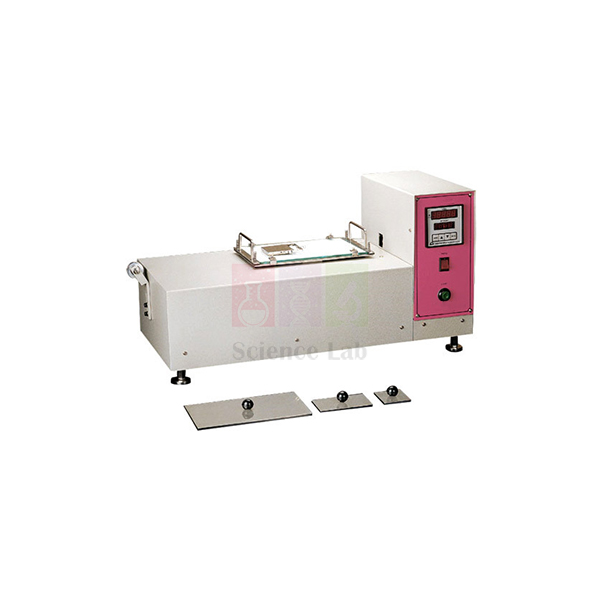
Static and Kinetic Friction Tester
Static and Kinetic Friction Tester (Product Code: SLE/ET/06) is a motorised coefficient-of-friction instrument used to measure the force needed to start, and then keep, a sled sliding over a film, sheet or other flat sample in packaging and materials testing laboratories. A 200 gram sled is drawn at 150 mm/minute, readings go up to 9.999 kg, and static and kinetic friction values appear directly on the display. It is supplied by Jain Scientific Equipments Pvt Ltd (ScienceLab), Ambala, India, for buyers of laboratory instruments in India and abroad.
Specifications
| Parameter | Detail |
|---|---|
| Capacity | Up to 9.999 kg |
| Test speed | 150 mm/minute |
| Sled weight | 200 g |
| Direct display | Static and kinetic friction values |
| Accessories | Three stainless steel (S.S) templates |
| Computerised model | Micro-controller with RS 232 communication in place of the digital controller; interface software offered for installation on the user’s PC |
| Power supply | 230 V, 50 Hz, single phase |
| Product code | SLE/ET/06 |
| Supplied by | Jain Scientific Equipments Pvt Ltd (ScienceLab), Ambala, India |
What Is the Static and Kinetic Friction Tester Used For?
Packaging films, laminates, papers and coated sheets must slide neither too easily nor too reluctantly on filling lines and in stacks, so their coefficient of friction is checked routinely. In a typical test one piece of material is held flat, a second piece is fitted to the 200 gram sled, and the sled is pulled across at a constant 150 mm/minute; the force needed to break it free gives the static value and the steadier force while sliding gives the kinetic value.
Quality-control labs use it to accept incoming film batches and compare slip additives, while engineering students use it to see the real difference between static and kinetic friction. Keep the sled face and templates clean, avoid touching the test surfaces, and let samples settle to room conditions first, since dust or handling can shift the reading. On the computerised model, the RS 232 link and interface software let results be kept on a PC.
What to Specify When Ordering
- Standard digital-controller model, or computerised model with micro-controller, RS 232 communication and PC interface software
- A PC to run the interface software, if you choose the computerised model
- Any templates needed beyond the three stainless steel templates included (ask us)
- Quantity and delivery location
Supplier
Jain Scientific Equipments Private Limited, which trades as ScienceLab from Ambala, Haryana, supplies this friction tester to packaging converters, film producers, engineering colleges and testing laboratories in India and international markets.
Buyers who need vendor registration details can use the supplying company’s GSTIN 06AAECJ8618A1ZT and Legal Entity Identifier (LEI) 3358004HRD1JIVXKYX49. The ScienceLab company profile gives more background.
Related Testing Equipment
Useful companions in a packaging or friction testing laboratory:
- Inclined Plane Tester — measures film friction by tilting a plane instead of pulling the sled.
- Heat Sealer — prepares sealed film samples in the same packaging laboratory.
- Computerised Tensile Tester — measures the strength and elongation of the same films.
- Friction Slide Apparatus — a teaching apparatus for introducing the principles of sliding friction.
See the whole Testing Equipments range.
Frequently Asked Questions
What does the Static and Kinetic Friction Tester measure?
The Static and Kinetic Friction Tester measures the force needed to start a sled moving and to keep it sliding over a sample, and it displays the resulting static and kinetic friction values directly for film, sheet and similar materials.
What are the sled weight and test speed?
The Static and Kinetic Friction Tester uses a 200 gram sled pulled at 150 mm/minute. Keeping the sled weight and speed fixed makes results from different samples, operators and days directly comparable.
What is the capacity of the Static and Kinetic Friction Tester?
The Static and Kinetic Friction Tester has a capacity of up to 9.999 kg, covering the friction forces produced by its 200 gram sled on films, papers and other flat samples.
Is a computerised version available?
Yes. In the computerised model of the Static and Kinetic Friction Tester, the digital controller is replaced by a micro-controller with RS 232 communication, and interface software is offered for installation on the user’s PC.
Which accessories are included?
The Static and Kinetic Friction Tester comes with three stainless steel templates as accessories. If your laboratory needs additional templates or a spare sled, ask us when you request a quotation.
Who supplies the Static and Kinetic Friction Tester?
The Static and Kinetic Friction Tester is supplied by Jain Scientific Equipments Pvt Ltd (ScienceLab), Ambala, Haryana, India, to packaging, film and engineering laboratories in India and international markets.
What does a quotation request need?
For a Static and Kinetic Friction Tester quotation, tell us whether you need the standard or computerised model, the quantity and the delivery location. Send the details through the contact page or add the product to the enquiry cart.
Request a Quote
Request pricing for the Static and Kinetic Friction Tester through the contact page, or add it to the enquiry cart with any other packaging test instruments, stating the model you prefer.
Last updated: 24 September 2026
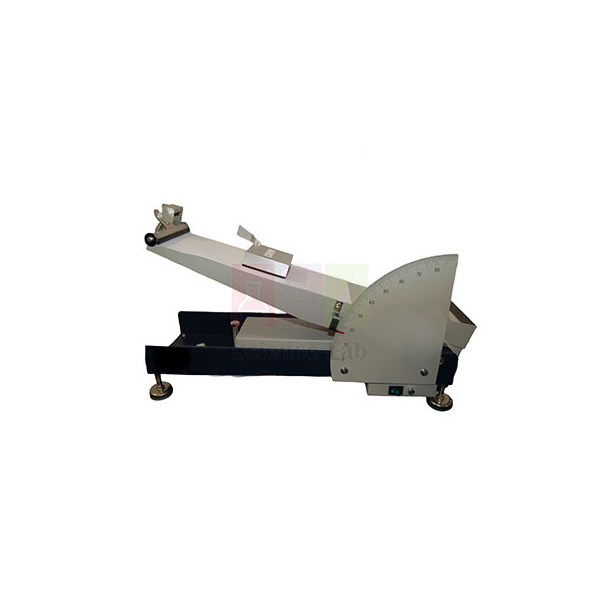
Inclined Plane Tester
Inclined Plane Tester (Product Code: SLE/ET/07) is a tilting-plane friction instrument used to determine the coefficient of friction between film and film, film and metal, and film and glass in packaging and plastics laboratories. The plane rises at 1.5° to 2.0° per second beneath a 750 gram sled measuring 4 inch × 2 inch, and two stainless steel templates are included. It is supplied by Jain Scientific Equipments Pvt Ltd (ScienceLab), Ambala, India, a laboratory equipment exporter from India serving domestic and overseas buyers.
Specifications
| Parameter | Detail |
|---|---|
| Purpose | Coefficients of friction: film to film, film to metal, film to glass |
| Speed (plane tilt) | 1.5° to 2.0° per second |
| Sled weight | 750 g |
| Sled size | 4 inch × 2 inch |
| Accessories | 2 stainless steel (S.S) templates |
| Power supply | 230 V, 50 Hz, single phase |
| Product code | SLE/ET/07 |
| Supplied by | Jain Scientific Equipments Pvt Ltd (ScienceLab), Ambala, India |
What Is the Inclined Plane Tester Used For?
The inclined plane method finds static friction without a force gauge. The sled, faced with the sample, rests on the plane, which tilts steadily at 1.5° to 2.0° per second until the sled starts to slide; the tangent of that angle is the static coefficient of friction between the two surfaces. Because the instrument is intended for film-to-film, film-to-metal and film-to-glass pairs, one set-up compares a packaging film against itself and against the surfaces it meets on machines and shelves.
Film converters use it to set slip specifications and check production batches, while physics and engineering courses use it to show the angle of friction on real materials. Fit the film smoothly to the 750 gram sled without creases, clean metal or glass surfaces before each run, and repeat on fresh sample areas before averaging the slip angle. Laboratories that also own the horizontal-pull Static and Kinetic Friction Tester can compare the two methods directly.
What to Specify When Ordering
- The material pairs you will test: film to film, film to metal and/or film to glass
- Extra stainless steel templates or a spare sled, if needed (ask us)
- Site supply (listed: 230 V, 50 Hz, single phase)
- Quantity and delivery location
Supplier
ScienceLab is the trading name of Jain Scientific Equipments Private Limited, based in Ambala, Haryana. It supplies the Inclined Plane Tester to flexible-packaging firms, film extruders, polytechnics and university laboratories in India and international markets, often together with other friction and packaging test instruments.
Ask us about spare templates when you send an enquiry. The ScienceLab profile page describes the company.
Related Testing Equipment
Instruments and teaching apparatus that pair well with this tester:
- Static and Kinetic Friction Tester — pulls a sled horizontally and also reports kinetic friction.
- Heat Sealer — seals film samples for other packaging tests in the same lab.
- Friction Slide Apparatus — a teaching apparatus on sliding friction.
- Inclined Plane With Accessories — a physics-lab inclined plane for teaching forces on a slope.
Explore the Testing Equipments category for more instruments.
Frequently Asked Questions
Which material combinations can the Inclined Plane Tester measure?
The Inclined Plane Tester is intended to determine the coefficient of friction between film and film, film and metal, and film and glass, so a packaging film can be checked against itself and against common contact surfaces.
How fast does the plane tilt?
The plane of the Inclined Plane Tester tilts at 1.5° to 2.0° per second. A slow, steady rise lets the sled start sliding at a well-defined angle, which is then used to work out the static coefficient of friction.
What are the sled weight and size?
The Inclined Plane Tester uses a 750 gram sled measuring 4 inch × 2 inch. The film sample is fitted smoothly to the sled face before each test so that contact with the counter-surface is even.
How is the coefficient of friction worked out?
On the Inclined Plane Tester, the static coefficient of friction equals the tangent of the plane angle at the moment the sled begins to slide, so a steeper slip angle indicates a higher-friction pair of surfaces.
How does it differ from the Static and Kinetic Friction Tester?
The Inclined Plane Tester finds static friction from the angle at which a sled slips, while the Static and Kinetic Friction Tester pulls a sled horizontally and reports both static and kinetic values. Many packaging laboratories use both methods.
Who supplies the Inclined Plane Tester?
The Inclined Plane Tester is supplied by Jain Scientific Equipments Pvt Ltd (ScienceLab), Ambala, Haryana, India, to packaging, plastics and teaching laboratories in India and international markets.
What does a quotation request need?
For an Inclined Plane Tester quotation, list the quantity, delivery location and the material pairs you plan to test, plus any extra templates. Send the request through the contact page or add the instrument to the enquiry cart.
Request a Quote
For pricing on the Inclined Plane Tester, use the contact page or add it to the enquiry cart; ScienceLab replies with a quotation and delivery details for your location.
Last updated: 24 September 2026
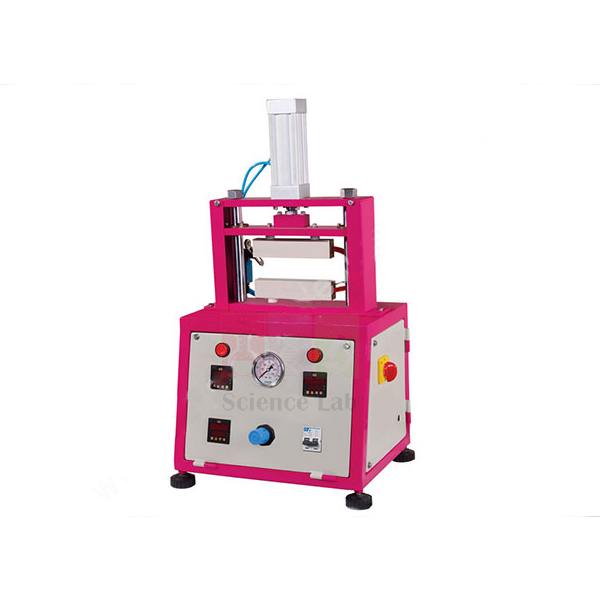
Heat Sealer
Heat Sealer (Product Code: SLE/ET/08) is a table-top laboratory sealing instrument used to make controlled heat seals on plastic films and flexible packaging samples for seal and package testing. Two temperature zones are held by an auto-tuned PID controller up to 200 °C with 0.1 °C resolution, and a pneumatically moved jaw closes against a fixed jaw to form a 150 mm × 20 mm seal. It is supplied by Jain Scientific Equipments Pvt Ltd (ScienceLab), Ambala, India, to packaging laboratories and colleges looking for laboratory instruments in India.
Specifications
| Parameter | Detail |
|---|---|
| Temperature zones | Two |
| Controller | Auto-tuned PID; temperature range up to 200 °C; resolution 0.1 °C |
| Sealing dimensions | Length 150 mm × width 20 mm |
| Clamping jaws | One fixed; the second moved by pneumatic action |
| Speed | 300 mm/minute |
| Daylight | 50 mm |
| Mounting | Table top |
| Power supply | 230 V, 60 Hz, single phase, 15 A (as listed; confirm your site supply with us) |
| Product code | SLE/ET/08 |
| Supplied by | Jain Scientific Equipments Pvt Ltd (ScienceLab), Ambala, India |
What Is the Heat Sealer Used For?
Seal quality depends on temperature, pressure and contact time, and a laboratory heat sealer lets each of these be repeated from one sample to the next. The operator places two layers of film between the jaws, the pneumatic jaw closes against the fixed jaw, and the heated zones fuse a strip 150 mm long and 20 mm wide. Because the PID controller works to 0.1 °C resolution, seals made on different days can be compared with confidence.
Packaging developers use it to find the lowest temperature that gives a sound seal on a new laminate, and quality laboratories prepare seal strips that are later pulled apart on a tensile tester to judge seal strength. Start low and raise the temperature in small steps, keep the jaw faces free of melted residue, and let the zones stabilise after every change. It also suits film and pouch exercises in engineering and packaging courses.
What to Specify When Ordering
- Mains supply at your site (listed supply: 230 V, 60 Hz, single phase, 15 A)
- Compressed-air availability for the pneumatic jaw (discuss with us)
- Whether the 150 mm × 20 mm seal size suits your sample format
- Quantity and delivery location
Supplier
Jain Scientific Equipments Private Limited, trading as ScienceLab in Ambala, Haryana, supplies this heat sealer to flexible-packaging developers, film converters, packaging test laboratories and engineering institutes in India and international markets.
Questions about jaw faces, controller settings or site services such as compressed air can be raised with us before ordering. The ScienceLab company profile has more about the business.
Related Testing Equipment
Instruments often used with sealed film samples:
- Computerised Tensile Tester — can pull sealed strips apart when seal strength is checked.
- Static and Kinetic Friction Tester — checks the slip of the same packaging films.
- Inclined Plane Tester — measures film friction from the slip angle.
- Melt Flow Index Tester — characterises the melt flow of sealant polymer grades.
All instruments in this group are on the Testing Equipments page.
Frequently Asked Questions
What seal size does the Heat Sealer produce?
The Heat Sealer produces a seal 150 mm long and 20 mm wide between one fixed jaw and one pneumatically moved jaw, which suits strip samples for peel and seal-strength testing of films and laminates.
What temperature control does the Heat Sealer have?
The Heat Sealer uses an auto-tuned PID controller with a temperature range up to 200 °C and a resolution of 0.1 °C, serving two temperature zones so that sealing conditions can be repeated closely.
How are the jaws operated?
On the Heat Sealer one clamping jaw is fixed and the second is moved by pneumatic action to close on the film. Confirm compressed-air availability at your laboratory with us when you request a quotation.
What power supply does the Heat Sealer need?
The Heat Sealer is listed for a 230 volt, 60 Hz, single-phase supply rated at 15 amperes. Confirm your site’s voltage and frequency with us before ordering so any difference can be resolved before dispatch.
Is the Heat Sealer a bench unit?
Yes. The Heat Sealer is table-top mounted with a daylight of 50 mm, so it sits on a laboratory bench beside other packaging test instruments rather than needing floor space.
Who supplies the Heat Sealer?
The Heat Sealer is supplied by Jain Scientific Equipments Pvt Ltd (ScienceLab), Ambala, Haryana, India, to packaging, film and engineering laboratories in India and international markets.
What does a quotation request need?
For a Heat Sealer quotation, state the quantity, delivery location, your mains supply and whether compressed air is available on site. Send these details through the contact page or add the product to the enquiry cart.
Request a Quote
To price the Heat Sealer for your laboratory, contact us through the contact page or add it to the enquiry cart, and ScienceLab will respond with a quotation.
Last updated: 24 September 2026