- Physics Lab Equipment
- Chemistry Lab Equipment
- Biology Lab Equipment
- Anatomical Lab Equipment
- Learning
- Educational Lab Equipment
- Magnets
- Agriculture
- Astronomy
- Earth Science
- Geography Lab Equipment
- Safety Lab Coat
- Laboratory
- Meteorological
- Electricity & Magnetism
- Heat
- School Lab Equipment
- Lab Glassware
- Science Lab Equipment
- Tvet Lab Equipment
- Robotics Kits Supplier and Manufacturer for Schools India
- Math Lab Equipment Manufacturers and Exporters in Ambala
- STEM Kits Manufacturers and Supplier India
- Engineering Lab Equipment
- Hospital Lab Equipment
- Water, Sanitation & Hygiene Supplies
- Cold Chain, Solar & Communication Equipment
- Nutrition
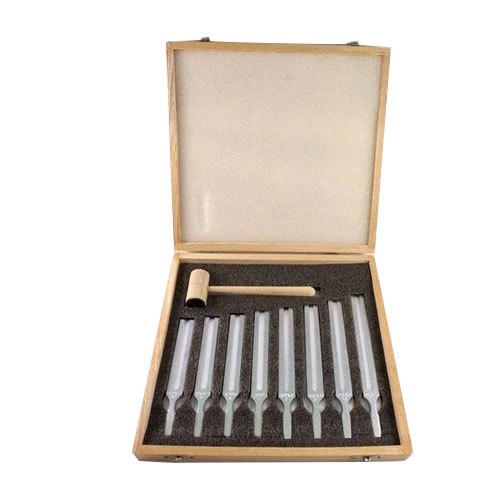
Tuning Fork
Tuning Fork (Product Code: SCL1531/019) is an adjustable sound source: a U-shaped vibrator fixed on a wooden resonator box, with two slidable bodies on the vibrator that change its oscillation frequency across the instrument’s range. It is calibrated to 7 frequencies, so one instrument can do much of the work that usually needs a tuning fork set in an Indian school physics room. Physics teachers use it to demonstrate pitch, resonance and the link between mass and frequency. It is made by Jain Scientific Equipments Pvt Ltd (ScienceLab), Ambala, and supplied with a rubber-tipped metal hammer.
Specifications
| Parameter | Detail |
|---|---|
| Vibrator | U-shaped, fixed on the resonator box |
| Resonator | Wooden box |
| Frequency adjustment | Two slidable bodies on the vibrator modify the oscillation frequency within its range |
| Calibration | 7 frequencies |
| Hammer | Metal, with handle and rubber-coated impact element |
Typical Use
Strike one prong with the rubber-coated hammer and the wooden box amplifies the note so a whole class can hear it. Moving the two sliding bodies along the U-shaped vibrator shifts the pitch, which lets students hear directly how adding mass towards the prong tips lowers the frequency of a vibrating body. Setting the fork to each of its calibrated positions in turn gives a series of known notes for listening tests, for comparing with a second fork, or for tuning a string on a sonometer by ear.
Placed near the open end of a resonance tube, the fork also serves as the source in speed-of-sound experiments, making it a useful companion to a resonance tube experiment kit. Hold the instrument by its box rather than the prongs, strike firmly but never against the bench or a hard object, and damp the sound by touching the prongs lightly when the demonstration ends.
Manufacturer
ScienceLab is the trading name of Jain Scientific Equipments Private Limited, an Ambala, Haryana manufacturer of acoustics, mechanics and electricity apparatus for teaching laboratories. Buyers who want to know more about the organisation behind the brand can read the company profile.
Related Lab Equipment
Sound and wave practicals often combine this fork with the apparatus below:
- Tuning Fork on Resonance Box — a second source for resonance and beat demonstrations.
- Tuning Fork Set, Steel — fixed-pitch forks for individual student practicals.
- Resonance Tube Apparatus — for measuring the speed of sound with the fork as the source.
- Sonometer, Simple Pattern — for matching a vibrating string to the fork’s note.
- Long Cylindrical Spring (Resort) — shows the wave motion that underlies sound.
More teaching apparatus is listed in the Lab Equipment category.
Frequently Asked Questions
How many frequencies can this tuning fork be set to?
It is calibrated to 7 frequencies. The individual frequency values are not given in the product listing, so ask us through the contact page if you need them for lesson planning.
How is the pitch changed?
By sliding the two bodies attached to the U-shaped vibrator. Their position changes the vibrating mass distribution and therefore the oscillation frequency.
Is a hammer included?
Yes. A metal hammer with a handle and a rubber-coated impact element comes with the instrument, so the prongs are struck without metal-on-metal contact.
Why is the fork mounted on a wooden box?
The box acts as a resonator: it vibrates with the fork and radiates the sound more strongly, so the note carries across a classroom.
Can it be used to demonstrate beats?
Yes, when paired with a second sound source of nearly the same pitch, such as another fork. Detuning one of them slightly with its sliding bodies produces audible beats.
How should the instrument be stored?
Keep it in a dry cupboard, away from damp walls, because moisture can affect the wooden box; store the hammer with it so it is not replaced by a hard striker.
Can you quote for several units or for export?
Yes. Share the quantity and destination; ScienceLab supplies schools and distributors in India and international markets.
Request a Quote
To price this Tuning Fork for your lab, write to us with the quantity, or collect it with other items in the enquiry cart and send a single request.
Last updated: 24 September 2026