- Physics Lab Equipment
- Chemistry Lab Equipment
- Biology Lab Equipment
- Anatomical Lab Equipment
- Learning
- Educational Lab Equipment
- Magnets
- Agriculture
- Astronomy
- Earth Science
- Geography Lab Equipment
- Safety Lab Coat
- Laboratory
- Meteorological
- Electricity & Magnetism
- Heat
- School Lab Equipment
- Lab Glassware
- Science Lab Equipment
- Tvet Lab Equipment
- Robotics Kits Supplier and Manufacturer for Schools India
- Math Lab Equipment Manufacturers and Exporters in Ambala
- STEM Kits Manufacturers and Supplier India
- Engineering Lab Equipment
- Hospital Lab Equipment
- Water, Sanitation & Hygiene Supplies
- Cold Chain, Solar & Communication Equipment
- Nutrition
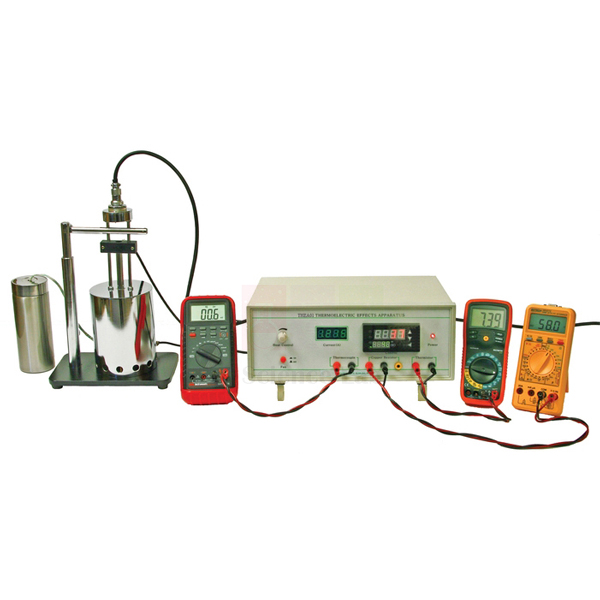
Thermoelectric Effects Apparatus
Thermoelectric Effects Apparatus (Product Code: SLE/H/14) is a bench apparatus for studying how temperature is measured and controlled in industrial practice. It combines an oven with a brass heating block, a regulated heater supply, a configurable P/PI/PD/PID digital controller and a K-type (Chromel-Alumel) thermocouple, and it is designed for two types of investigation, including the thermal characteristics and measuring techniques of three devices commonly used in industrial and technical thermometry. College physics, instrumentation and engineering departments use it for advanced heat practicals. It is made by Jain Scientific Equipments Pvt Ltd (ScienceLab), Ambala, as a thermometry apparatus for laboratories in India and international markets.
Specifications
| Parameter | Detail |
|---|---|
| Investigations | 2 types, including the thermal characteristics and measuring techniques of 3 devices used for industrial and technical thermometry |
| Heater supply | Regulated voltage source, 0 to 36 V DC, 10-turn potentiometer control |
| Current display | Digital, 0.000 to 1.999 A |
| Cooling fan | 12 V DC, 0.14 A, on/off switch control |
| Digital controller | Configurable for P, PI, PD or PID mode |
| Process value (PV) range | 0 to 400 °C (factory default, settable) |
| PV temperature display | 4-digit, resolution 1 °C or 0.1 °C |
| SV temperature display | 4-digit, resolution matches PV |
| Controller parameters | 24 settable parameters; 2 parameters determined by apparatus configuration |
| Power input | 110 V AC, 60 Hz, 65 W |
| Fuse | Miniature type, 5 x 20 mm, F1.5 A, 250 V |
| Oven dimensions | 13 cm H x 35 cm W x 31 cm D |
| Brass heating block | 40 mm diameter x 67 mm H |
| Weight | 5.2 kg (11-1/2 lb) |
| Thermocouple | K-type (Chromel-Alumel) |
| Chromel composition | Ni 90%, Cr 10% |
| Alumel composition | Ni 95%, Mn 2%, Al 2%, Si 1% |
| Thermocouple output | Approximately 4 mV for a 100 °C difference between hot and cold junctions |
| Documentation | Instruction manual with sample activities and sample data |
Typical Use
A typical session places the thermocouple's cold junction in ice water and its hot junction in the brass heating block. Students set a target on the controller, let the block settle, and record the thermocouple voltage at each step. Between room temperature and 100 °C the output is conveniently read with a digital multimeter of 0.01 mV resolution or a suitable data logger, and plotting voltage against temperature difference shows the roughly 4 mV per 100 °C behaviour of a K-type junction. The ice-water temperature should be checked before and after the run with an independent thermometer or temperature probe so the cold-junction reference is known.
The same bench also teaches process control: switching the controller between P, PI, PD and PID modes lets students watch overshoot and settling change, while the heater current display and the 10-turn potentiometer show how supply voltage drives heating. The fan speeds up cool-down between runs. The sample activities in the manual make it straightforward to plan a lab sequence, which suits it to engineering lab equipment lists for instrumentation and thermal-science courses.
Manufacturer
This apparatus is manufactured by Jain Scientific Equipments Private Limited, which sells its laboratory range under the ScienceLab name and operates from Ambala in Haryana, India. Our company profile covers the firm's background and the departments it supplies.
Related Laboratory Equipment
Instruments and apparatus that fit the same thermometry workflow:
- Digital Multimeter — for reading the thermocouple's millivolt output; check its resolution against the 0.01 mV the manual recommends
- Micro Voltmeter — an option for measuring very small thermoelectric voltages
- Digital Thermometer — an independent check of the ice-water reference before and after a run
- Glass Beaker — to hold the ice-water bath for the cold junction
- Measuring Vapor Apparatus — a companion apparatus for advanced thermodynamics practicals
See the complete Heat apparatus range for further thermal experiments.
Frequently Asked Questions
Which thermocouple does the apparatus use?
A K-type Chromel-Alumel thermocouple: Chromel is Ni 90% and Cr 10%; Alumel is Ni 95%, Mn 2%, Al 2% and Si 1%.
What output voltage should students expect?
About 4 mV for a 100 °C difference between the hot and cold junctions, so a meter with 0.01 mV resolution or a data logger is recommended.
Is a multimeter supplied?
A multimeter is not listed among the items supplied. You can use one you already have or ask us to include one in the quotation.
What mains supply does it need?
The listed power input is 110 V AC, 60 Hz, 65 W. If your laboratory uses a different mains supply, contact us to confirm the power configuration before ordering.
Which control modes and ranges are available?
The controller can be set to P, PI, PD or PID mode, with a factory-default process range of 0 to 400 °C that can be changed and 24 settable parameters.
Can you provide calibration documents?
Calibration paperwork is not part of the standard listing; please raise any requirement with us through the contact page so it can be discussed.
Do you supply colleges in quantity or abroad?
Yes, we supply institutions and distributors in India and international markets; include quantity, destination and warranty questions in your enquiry.
Request a Quote
To receive a quotation for the Thermoelectric Effects Apparatus, write to us via the contact page or add the item to your enquiry cart.
Last updated: 24 September 2026