- Physics Lab Equipment
- Chemistry Lab Equipment
- Biology Lab Equipment
- Anatomical Lab Equipment
- Learning
- Educational Lab Equipment
- Magnets
- Agriculture
- Astronomy
- Earth Science
- Geography Lab Equipment
- Safety Lab Coat
- Laboratory
- Meteorological
- Electricity & Magnetism
- Heat
- School Lab Equipment
- Lab Glassware
- Science Lab Equipment
- Tvet Lab Equipment
- Robotics Kits Supplier and Manufacturer for Schools India
- Math Lab Equipment Manufacturers and Exporters in Ambala
- STEM Kits Manufacturers and Supplier India
- Engineering Lab Equipment
- Hospital Lab Equipment
- Water, Sanitation & Hygiene Supplies
- Cold Chain, Solar & Communication Equipment
- Nutrition
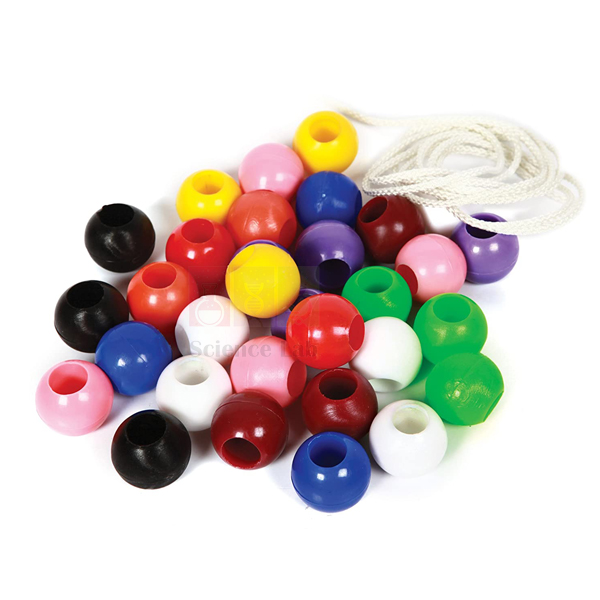
Stringing Beads
Stringing Beads (Product Code: SLE/PP/01) is a threading activity set used to build colour sorting, counting, pattern making and fine motor control in nursery, kindergarten and early primary classrooms. One set holds beads in 7 colours and 3 threads, and is stated for 4 children aged 3 to 9 years, so it suits small-group corners. It is supplied by Jain Scientific Equipments Pvt Ltd (ScienceLab), Ambala, India, as a hands-on preschool kit for schools in India and abroad.
Key Details
| Parameter | Detail |
|---|---|
| Contents | Beads in 7 colours; a set of 3 threads for stringing activities |
| Teacher support | Write-up with details of activities |
| Group size | For 4 children |
| Age range | 3 to 9 years |
| Concepts | Classifying by colour; counting and quantity sense; patterns and number sense; eye-hand coordination and fine motor skills; one-to-one correspondence; making different patterns |
| Product code | SLE/PP/01 |
| Supplied by | Jain Scientific Equipments Pvt Ltd (ScienceLab), Ambala, India |
What Are Stringing Beads Used For?
Pushing a thread through each bead trains the pincer grip and eye-hand coordination that children later need for holding a pencil. The same beads carry early maths: children sort them into colour groups, string one colour and count the result, or say one number word for each bead to practise one-to-one correspondence. Repeating patterns such as red-blue-red-blue lead naturally into predicting what comes next.
With 3 threads for a group of 4, one child can act as the pattern checker while the others thread, and roles then rotate. The activity write-up gives teachers ready tasks, which helps the set fit alongside other mathematics lab kits in India's pre-primary sections. Keep an adult close to the youngest children, as with any small loose pieces, and store the beads in a closed container after use.
What to Specify When Ordering
- Number of sets: each set serves 4 children, so divide the class size by 4.
- The age group using it (the set is stated for ages 3 to 9).
- Any other Pre-Primary aids to be quoted in the same order.
Supplier
ScienceLab is the trading name of Jain Scientific Equipments Private Limited, which supplies Stringing Beads and other early-years learning aids from Ambala, Haryana, to nurseries, kindergartens, schools and early-childhood programmes in India and international markets. For export paperwork and vendor forms, the company holds Importer-Exporter Code AAECJ8618A (DGFT) and GSTIN 06AAECJ8618A1ZT. Company details are on the ScienceLab profile.
Related Pre-Primary Learning Aids
These aids continue the same colour, counting and fine-motor work:
- Mathmat 5X5 — colour patterns with plugs on rubber mats.
- Flexi Wire — another fine-motor activity for small hands.
- Beads, Wood — wooden beads for further threading and counting.
- Beads – Bobbles & Laces — lacing beads used in maths activities.
- Rack Single Rod (Student) — moves counting on to beads grouped in fives.
See every item in the Pre-Primary range.
Frequently Asked Questions
What is included in Stringing Beads?
Stringing Beads includes beads in 7 colours, a set of 3 threads for stringing activities and a write-up describing the activities. The write-up helps teachers plan sorting, counting and pattern tasks without preparing their own worksheets.
What age group is Stringing Beads for?
Stringing Beads is stated for children aged 3 to 9 years. Younger children use it for colour sorting and threading practice, while older ones use it for counting, one-to-one correspondence and building longer repeating patterns.
How many children can use one Stringing Beads set?
One Stringing Beads set is intended for 4 children working together. With 3 threads in the set, teachers often rotate roles so that one child sorts beads or checks patterns while the others thread.
Which concepts does Stringing Beads develop?
Stringing Beads develops classifying by colour, counting and quantity sense, pattern and number sense, one-to-one correspondence, and eye-hand coordination with fine motor skills. Making different patterns also builds early reasoning about what comes next.
Who supplies Stringing Beads?
Stringing Beads is supplied by Jain Scientific Equipments Pvt Ltd (ScienceLab), Ambala, Haryana, India. The company provides it to nurseries, kindergartens, schools and early-childhood programmes in India and international markets, along with other pre-primary aids.
How should I order Stringing Beads for a whole class?
To order Stringing Beads for a whole class, divide the number of children by 4 to find the number of sets needed, then send that quantity and your delivery location through the contact page for a quotation.
Request a Quote
Send the number of Stringing Beads sets you need through the contact page, or add them to the enquiry cart with other classroom aids for one quotation.
Last updated: 24 September 2026