- Physics Lab Equipment
- Chemistry Lab Equipment
- Biology Lab Equipment
- Anatomical Lab Equipment
- Learning
- Educational Lab Equipment
- Magnets
- Agriculture
- Astronomy
- Earth Science
- Geography Lab Equipment
- Safety Lab Coat
- Laboratory
- Meteorological
- Electricity & Magnetism
- Heat
- School Lab Equipment
- Lab Glassware
- Science Lab Equipment
- Tvet Lab Equipment
- Robotics Kits Supplier and Manufacturer for Schools India
- Math Lab Equipment Manufacturers and Exporters in Ambala
- STEM Kits Manufacturers and Supplier India
- Engineering Lab Equipment
- Hospital Lab Equipment
- Water, Sanitation & Hygiene Supplies
- Cold Chain, Solar & Communication Equipment
- Nutrition
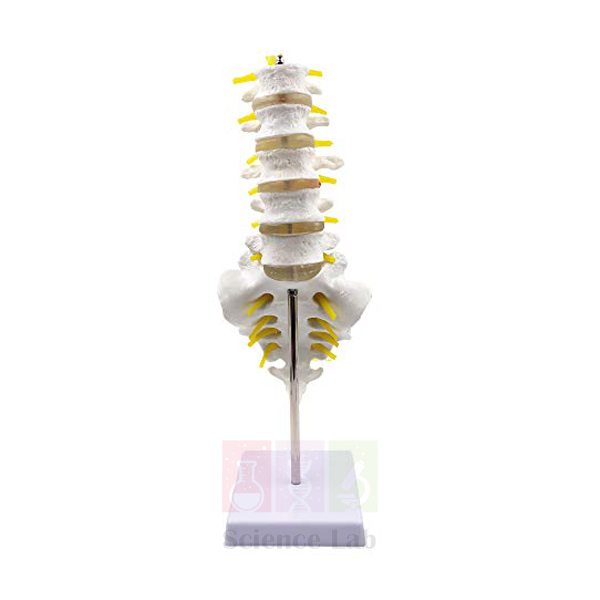
Human Lumbar Set Model
Human Lumbar Set Model (Product Code: SLE/BL/67) is a life-size set of lumbar vertebrae on a sturdy metal rod used to teach lower-back anatomy in medical, nursing, physiotherapy and chiropractic training. It shows the vertebrae with normal intervertebral discs and the spinal cord with its nerve roots, so tutors can explain where nerves leave the spinal canal and why back pain can spread to the leg. It is made by Jain Scientific Equipments Pvt Ltd (ScienceLab), an OEM of educational laboratory equipment, at its own factory in Ambala, India.
Specifications
| Parameter | Detail |
|---|---|
| Region represented | Lumbar spine |
| Structures shown | Lumbar vertebrae, intervertebral discs, spinal cord with nerve roots |
| Disc condition | Normal (healthy) |
| Scale | Life size |
| Mounting | Sturdy metal rod |
| Product code | SLE/BL/67 |
| Manufacturer | Jain Scientific Equipments Pvt Ltd (ScienceLab) — OEM |
| Country of origin | India (made in Ambala, Haryana) |
What Is the Lumbar Set Model Used For?
Because the discs on this set are shown in their normal state, it is a good baseline for teaching. Students first learn the healthy relationship between vertebral bodies, discs and nerve roots, and the tutor then explains how a disc bulge or narrowed space could press on a nerve root and cause leg pain. Physiotherapists and doctors use the same model to show patients why posture and lifting technique matter.
Institutions buying a human skeleton model in India often add a lumbar set like this one, since a whole skeleton is too small in scale to show disc and nerve detail clearly. The metal rod keeps the vertebrae aligned, so the set can be passed around a class; hold it by the rod rather than by the nerve roots.
OEM Manufacturer
ScienceLab is the brand of Jain Scientific Equipments Private Limited, the original equipment manufacturer of this lumbar set, which is made at the company’s own licensed factory at Saha, Ambala, Haryana, India. Spine clinics, colleges, dealers and importers are supplied factory-direct, and quotations and repeat orders are handled by the manufacturer without a middleman. See the company profile for details.
Related Bone Models
Spine models used alongside the lumbar set:
- Human Lumbar Spinal Column Model — adds the sacrum and coccyx below the lumbar vertebrae
- Human Pelvis Structural Model With 5 Pcs Lumbar Vertebraes — shows how the lumbar spine sits on the pelvis
- Human Thoracic Spinal Column Model — the section of spine directly above the lumbar region
- Human Cervical Spinal Column Model — completes a set covering the neck region
More spinal and skeletal models are in the Bone Model category.
Frequently Asked Questions
What does the Human Lumbar Set Model show?
The Human Lumbar Set Model shows life-size lumbar vertebrae with normal intervertebral discs and the spinal cord with its nerve roots. Together these let a tutor explain how the lower spine carries load and where each nerve root leaves the spinal canal.
How is the Human Lumbar Set Model mounted?
The Human Lumbar Set Model is mounted on a sturdy metal rod, which keeps the vertebrae aligned. That lets it be passed around a class; students should hold it by the rod rather than by the nerve roots to avoid bending them.
Does the lumbar set show a herniated or damaged disc?
No. The Human Lumbar Set Model shows the intervertebral discs in their normal condition, which makes it suitable for teaching healthy anatomy first. Tutors then use it as a baseline when describing how a bulging disc could press on a nerve root.
How many vertebrae are included, and does the lumbar set have a sacrum?
The description of the Human Lumbar Set Model does not list the number of vertebrae or a sacrum. If you need the sacrum and coccyx, see the Human Lumbar Spinal Column Model, or confirm the details through our contact page before ordering.
Who manufactures the Human Lumbar Set Model?
Jain Scientific Equipments Pvt Ltd (ScienceLab) manufactures the Human Lumbar Set Model as the OEM at its own licensed factory at Saha, Ambala, Haryana, India. Skills labs, colleges and dealers receive quotations directly from the manufacturer rather than through a trading house.
Can we buy several lumbar sets for a skills lab?
Yes. The Human Lumbar Set Model is quoted for single units and larger quantities for institutions in India and international markets. Share the quantity and delivery location, and warranty terms will be confirmed in the quotation along with packing details.
Request a Quote
For a quotation from the manufacturer, add the lumbar set to the enquiry cart or send us the quantity and delivery location through the contact page.
Last updated: 24 September 2026