- Physics Lab Equipment
- Chemistry Lab Equipment
- Biology Lab Equipment
- Anatomical Lab Equipment
- Learning
- Educational Lab Equipment
- Magnets
- Agriculture
- Astronomy
- Earth Science
- Geography Lab Equipment
- Safety Lab Coat
- Laboratory
- Meteorological
- Electricity & Magnetism
- Heat
- School Lab Equipment
- Lab Glassware
- Science Lab Equipment
- Tvet Lab Equipment
- Robotics Kits Supplier and Manufacturer for Schools India
- Math Lab Equipment Manufacturers and Exporters in Ambala
- STEM Kits Manufacturers and Supplier India
- Engineering Lab Equipment
- Hospital Lab Equipment
- Water, Sanitation & Hygiene Supplies
- Cold Chain, Solar & Communication Equipment
- Nutrition
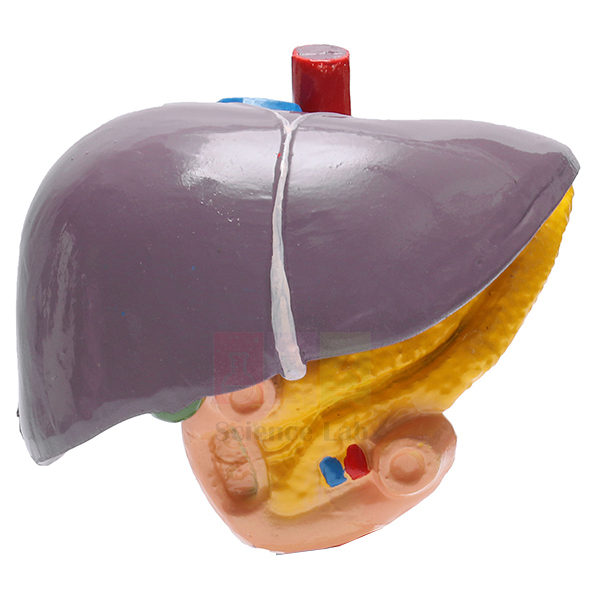
Human Liver Model
Human Liver Model (Product Code: SLE/BL/65) shows the liver together with the ducts and neighbouring organs that carry bile and pancreatic juice into the gut: the gall bladder, right and left hepatic ducts, cystic duct, duodenum, pancreatic duct and pancreas. Every structure is coloured to aid recognition and numbered against a key card, and the model is mounted on a base for display on a bench or in a cabinet. It is one of the practical biology teaching aids India's schools, nursing colleges and medical departments use to explain how the liver connects to the rest of the digestive system. It is manufactured by Jain Scientific Equipments Pvt Ltd (ScienceLab), Ambala.
Key Details
| Parameter | Detail |
|---|---|
| Type | Anatomical model of the liver with biliary and pancreatic structures |
| Structures shown | Liver, gall bladder, right hepatic duct, left hepatic duct, cystic duct, duodenum, pancreatic duct, pancreas |
| Finish | Appropriately coloured |
| Identification | Numbered structures with key card |
| Mounting | Mounted on a base |
| Suitable for | School biology, nursing, pharmacy and medical anatomy teaching |
Typical Use
The model is built around the route bile takes. Teachers can start at the liver, follow the right and left hepatic ducts, show how bile is diverted along the cystic duct for storage in the gall bladder, and then trace it onward into the duodenum, where the pancreatic duct from the pancreas also delivers its enzymes. This single view helps students understand fat digestion, why a blocked duct causes jaundice, and how gallstones or pancreatic disease produce the symptoms they read about in physiology and pathology. Placed alongside heart, lung and kidney pieces, it rounds out a human biology model set in India's secondary and higher-secondary labs.
For revision, cover the key card and ask students to name each numbered structure, or have them point out the path of bile in sequence. Keep the model on its base in a closed cabinet between lessons, dust it with a soft dry cloth and avoid solvents or strong cleaners that could affect the painted surface.
Manufacturer
Jain Scientific Equipments Private Limited produces anatomical and biology teaching models under its ScienceLab trading name in Ambala, Haryana, and supplies them to schools, colleges and distributors. To know more about the company and its manufacturing base, see our company profile.
Related Digestive System Models
Teachers building a lesson on the liver and biliary system often add these models:
- Human Liver With Gall Bladder Model — focuses on the lobes of the liver and the hilus vessels.
- Human Liver Pathology Model — compares healthy tissue with disease changes.
- Gallstone Model — shows where stones form and block the biliary tract.
- Rear Organs of the Upper Abdomen — places the pancreas and duodenum in their wider setting.
- Digestive System Model 2 part — the full digestive tract for overview lessons.
The complete range is in our Digestive System category.
Frequently Asked Questions
Which structures does the model show?
The liver, gall bladder, right and left hepatic ducts, cystic duct, duodenum, pancreatic duct and pancreas, each coloured and numbered.
Does it come with a key?
Yes. The numbered structures are identified on a key card supplied with the model.
What size and material is the model?
The listing does not state dimensions or material. Please ask us through the contact page and we will confirm them before you order.
Can parts be removed?
The description covers a mounted display model and does not mention removable parts. Check with us if your syllabus needs a dissectible version.
Is it suitable for school-level biology?
Yes. The coloured, numbered layout suits secondary students, and the level of detail on the duct system is also useful for nursing and pharmacy courses.
Can you supply several models for a college or export order?
Yes, we supply institutions, tenders and distributors in India and international markets. Include product code SLE/BL/65 and the quantity in your enquiry.
Request a Quote
For a quotation on the Human Liver Model, reach us via the contact page or add it to the enquiry cart with other anatomy models.
Last updated: 24 September 2026