- Physics Lab Equipment
- Chemistry Lab Equipment
- Biology Lab Equipment
- Anatomical Lab Equipment
- Learning
- Educational Lab Equipment
- Magnets
- Agriculture
- Astronomy
- Earth Science
- Geography Lab Equipment
- Safety Lab Coat
- Laboratory
- Meteorological
- Electricity & Magnetism
- Heat
- School Lab Equipment
- Lab Glassware
- Science Lab Equipment
- Tvet Lab Equipment
- Robotics Kits Supplier and Manufacturer for Schools India
- Math Lab Equipment Manufacturers and Exporters in Ambala
- STEM Kits Manufacturers and Supplier India
- Engineering Lab Equipment
- Hospital Lab Equipment
- Water, Sanitation & Hygiene Supplies
- Cold Chain, Solar & Communication Equipment
- Nutrition
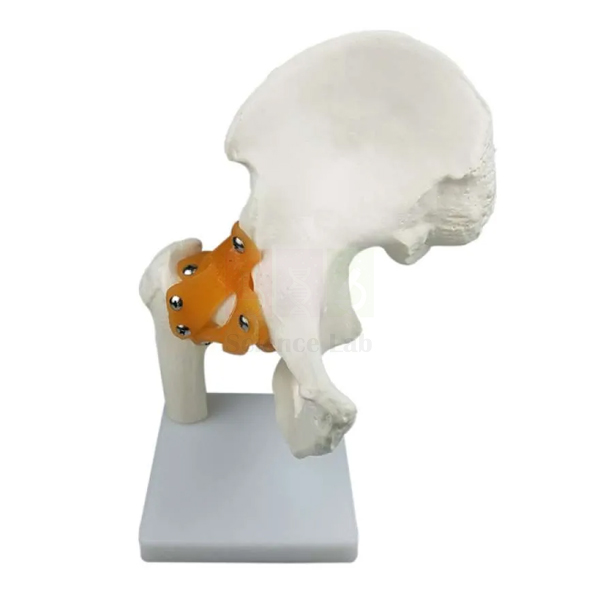
Hip Joint Model
Hip Joint Model (Product Code: SLE/A/05) is an approximately life-sized plastic model of the human hip used to teach the bones and ligaments of this weight-bearing joint in biology and allied-health courses. Ten bone structures and three ligaments are labelled on a laminated key, and the joint sits on a base, 23 × 13 × 15 cm overall — a compact piece of high school biology lab equipment. It is made by Jain Scientific Equipments Pvt Ltd (ScienceLab), an OEM manufacturer, at its own factory in Ambala, India.
Specifications
| Parameter | Detail |
|---|---|
| Material | Plastic |
| Scale | Approximately life-sized |
| Size (with base) | 23 × 13 × 15 cm |
| Labelled bone structures | 10 |
| Labelled ligaments | 3 |
| Key | Laminated key included |
| Mounting | Mounted on a base |
| Product code | SLE/A/05 |
| Manufacturer | Jain Scientific Equipments Pvt Ltd (ScienceLab) — OEM |
| Country of origin | India (made in Ambala, Haryana) |
What Is the Hip Joint Model Used For?
The hip is the classic example of a deep ball-and-socket joint, and this model lets students see how the rounded head of the femur sits within the socket of the pelvis. Working from the laminated key, learners identify the ten labelled bone structures and then the three labelled ligaments, and discuss how those strong ligaments make the hip far more stable than the shoulder — at the cost of some range of movement. It is also a helpful reference when talking about why hip fractures in older people usually involve the neck of the femur.
In physiotherapy and orthopaedic nursing teaching, the model supports explanations of hip replacement and post-operative precautions, while school classes use it within the chapter on joints and locomotion as part of a human biology model set. Its compact base makes it easy to store and to include in orders for several labs.
OEM Manufacturer
Jain Scientific Equipments Private Limited manufactures the Hip Joint Model as its OEM (original equipment manufacturer) and sells it under the ScienceLab brand. Production takes place at the company's own licensed factory at Saha, Ambala, Haryana, India.
Schools, colleges, dealers and importers are therefore quoted by the maker rather than by a middleman, and additional units for matching lab sets can be ordered from the same source. See our company profile for details.
Related Bone Models
Models that extend a lesson on the hip and lower limb:
- Human Hip Joint Model — an alternative hip joint model for comparison or additional group sets
- Human Femur Bone Model — the thigh bone whose head forms the ball of the hip joint
- Male Skeletal Pelvis — the pelvis that provides the hip socket, with its own labelled key
- Human Knee Joint Model, Life Size — the joint at the lower end of the femur
The Bone Model category lists all our joint, pelvis and skeleton models.
Frequently Asked Questions
How many structures are labelled on the Hip Joint Model?
The Hip Joint Model has ten labelled bone structures and three labelled ligaments, all identified on the included laminated key, so students can work through the joint without needing a separate chart.
What size is the Hip Joint Model?
The Hip Joint Model measures 23 × 13 × 15 cm including its base, and the joint itself is approximately life-sized, which keeps it easy to store and to set out on a bench.
Is the Hip Joint Model a left or right hip?
The side is not specified in our current product information for the Hip Joint Model (SLE/A/05). Please contact us if you need a particular side and the manufacturer will confirm before quoting.
What is the Hip Joint Model made of?
The Hip Joint Model is made of plastic and mounted on a base, so it stands securely on a desk while students compare the labelled bones and ligaments against the laminated key.
How do I keep the Hip Joint Model clean?
Remove dust from the Hip Joint Model with a soft brush and wipe the base with a lightly damp cloth. Keep the laminated key with the model so the labels can always be checked.
Who manufactures the Hip Joint Model?
Jain Scientific Equipments Pvt Ltd (ScienceLab) is the OEM of the Hip Joint Model and makes it at its own factory at Saha, Ambala, Haryana, India; institutions and dealers receive quotations straight from the manufacturer.
Can the Hip Joint Model be supplied for export?
Yes. ScienceLab supplies the Hip Joint Model to institutions and distributors in India and international markets. Share the destination country and quantity, and the manufacturer will prepare a quotation.
Request a Quote
Get a manufacturer's quotation for the Hip Joint Model through our contact form, or add it to your enquiry cart.
Last updated: 24 September 2026