- Physics Lab Equipment
- Chemistry Lab Equipment
- Biology Lab Equipment
- Anatomical Lab Equipment
- Learning
- Educational Lab Equipment
- Magnets
- Agriculture
- Astronomy
- Earth Science
- Geography Lab Equipment
- Safety Lab Coat
- Laboratory
- Meteorological
- Electricity & Magnetism
- Heat
- School Lab Equipment
- Lab Glassware
- Science Lab Equipment
- Tvet Lab Equipment
- Robotics Kits Supplier and Manufacturer for Schools India
- Math Lab Equipment Manufacturers and Exporters in Ambala
- STEM Kits Manufacturers and Supplier India
- Engineering Lab Equipment
- Hospital Lab Equipment
- Water, Sanitation & Hygiene Supplies
- Cold Chain, Solar & Communication Equipment
- Nutrition
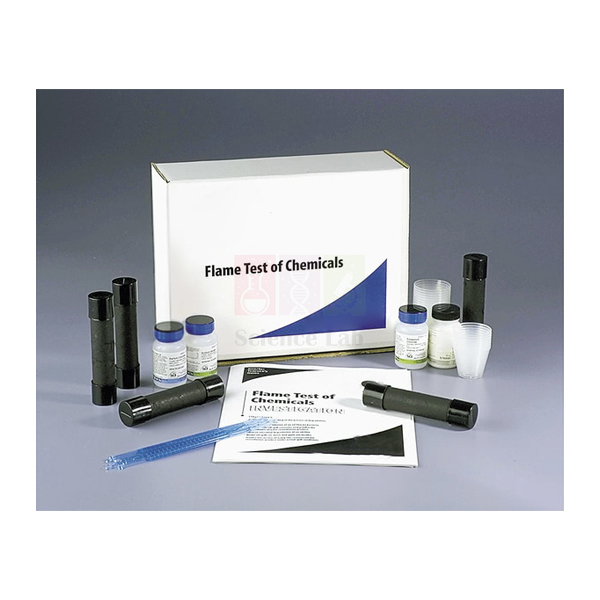
Flame Test Of Chemicals Lab Investigation
Flame Test Of Chemicals Lab Investigation (Product Code: SLE/CH/133) is a classroom investigation, sized for a class of 40 students, in which learners discover how elements can be identified by the colour they give to a flame. Students observe and record the colours emitted by metallic elements on heating, compare them with known standards to identify unknown samples, and use the results to explore the electronic structure of the atom. Supplied by Jain Scientific Equipments Pvt Ltd (ScienceLab), Ambala, India, it serves as a ready-to-run flame test kit for schools in India teaching atomic structure and qualitative analysis.
Key Details
| Parameter | Detail |
|---|---|
| Type | Flame test lab investigation |
| Class size | 40 students |
| Student tasks | Observe and record flame colours of metallic elements; relate results to known standards; identify unknown samples |
| Concepts | Electronic structure of the atom; relationship between colour and energy in the electromagnetic spectrum |
| Component list | Not detailed in this listing – available on request |
Typical Use
When a metal compound is heated in a hot, non-luminous flame, some of its electrons absorb energy and jump to higher energy levels; as they fall back they release light of particular wavelengths, which the eye sees as a characteristic colour. Sodium compounds, for instance, give an intense yellow-orange flame. Students first test the known standards and build a colour reference table, then use that table to name the unknowns, and finally discuss why a red flame corresponds to lower-energy light than a violet one.
Clean the sampling loop or splint thoroughly between samples, because a trace of sodium can mask fainter colours, and let students view the flames against a dark background. Viewing the same flames through a spectroscope turns a colour observation into a set of spectral lines, which is an effective extension for senior classes. Teachers looking for a chemistry teaching kit in India that connects practical work to atomic theory will find this investigation covers both in a single session.
Supplier
This lab investigation is supplied by Jain Scientific Equipments Private Limited, trading as ScienceLab from Ambala, Haryana, India, a supplier of practical kits and apparatus to schools and colleges. Visit our company profile to learn more.
Related Chemistry Lab Equipment
Equipment that supports a flame test lesson:
- Bunsen Burner — provides the hot, non-luminous flame the test depends on
- Spectroscope, Direct Vision — resolves each flame colour into its emission lines
- Safety Goggles — eye protection when working close to the flame
- Rust Race Lab Investigation — another investigation in the same series, on corrosion
Explore more investigations in Chemistry Lab Equipment.
Frequently Asked Questions
How many students is it designed for?
A class size of 40 students.
What will students learn?
How elements can be identified using flames, how flame colour relates to the electronic structure of the atom, and how colour relates to energy in the electromagnetic spectrum.
What exactly is in the kit?
The component list is not detailed on this page. Request it through our contact page so you can check what your laboratory needs to add.
Do we need a burner?
A hot, non-luminous flame is required, usually from a Bunsen burner. If your laboratory does not have enough burners, we can quote them with the kit.
Why do some colours look alike?
Faint colours can be hidden by sodium contamination or confused by eye. Careful cleaning between samples and a spectroscope both help students tell similar flames apart.
What safety precautions apply?
Goggles, tied-back hair, a clear bench and supervision near open flames. Allow hot loops or splints to cool before handling.
Can you supply several classes or export orders?
Yes. We supply institutions in India and international markets; include code SLE/CH/133 and the number of kits you need.
Request a Quote
Ask for pricing on the flame test investigation through the contact page, or add it to the enquiry cart along with burners and goggles.
Last updated: 24 September 2026