- Physics Lab Equipment
- Chemistry Lab Equipment
- Biology Lab Equipment
- Anatomical Lab Equipment
- Learning
- Educational Lab Equipment
- Magnets
- Agriculture
- Astronomy
- Earth Science
- Geography Lab Equipment
- Safety Lab Coat
- Laboratory
- Meteorological
- Electricity & Magnetism
- Heat
- School Lab Equipment
- Lab Glassware
- Science Lab Equipment
- Tvet Lab Equipment
- Robotics Kits Supplier and Manufacturer for Schools India
- Math Lab Equipment Manufacturers and Exporters in Ambala
- STEM Kits Manufacturers and Supplier India
- Engineering Lab Equipment
- Hospital Lab Equipment
- Water, Sanitation & Hygiene Supplies
- Cold Chain, Solar & Communication Equipment
- Nutrition
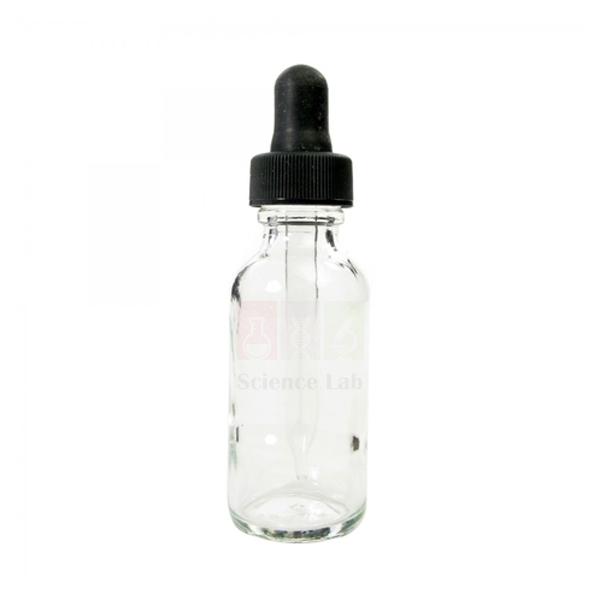
Dropping Bottles
Dropping Bottles (Product Code: SLE/GBO/07) are clear glass bottles closed with a screw cap that carries a glass dropper, so a reagent can be stored and released a few drops at a time from the same container. Chemistry teachers, laboratory assistants and analysts keep them on the bench for indicators and test solutions that are used in small quantities, and the four capacities let a lab match each bottle to how quickly its solution is consumed. They are made by Jain Scientific Equipments Pvt Ltd (ScienceLab), Ambala, as part of its range of borosilicate laboratory glassware in India.
Specifications
| Parameter | Detail |
|---|---|
| Type | Dropping bottle |
| Closure | Screw cap with glass dropper |
| Material | Borosilicate glass |
| Colour | Clear (flint) |
| Heat resistance | Heat resistant |
| Chemical resistance | Chemical resistant |
| Glass surface | Non-porous, allowing easy cleaning or autoclaving |
| Capacities | 30 ml, 60 ml, 120 ml, 250 ml |
Typical Use
In school and college practicals, dropping bottles hold the indicators and test reagents that students add dropwise — phenolphthalein or methyl orange during acid–base titrations, for example, or the reagents used in qualitative tests. Because the glass is clear, a teacher can check the liquid level and colour at a glance and spot a contaminated or exhausted solution before the class begins. The 30 ml and 60 ml sizes suit a student reagent shelf where many different solutions are needed in small amounts, while the 120 ml and 250 ml sizes suit a preparation room or a shared teaching bench.
Label every bottle with the reagent name and preparation date, and return each dropper to its own bottle so that solutions are never cross-contaminated. Do not lay the dropper on the bench between uses. When refilling, rinse the bottle and dropper with distilled water first; the non-porous glass makes this quick. Clear bottles are not the right choice for light-sensitive solutions — use the amber version for those. A labelled row of dropping bottles is one of the simplest ways to organise school chemistry lab equipment in India so that practicals run smoothly.
Manufacturer
These bottles are produced by Jain Scientific Equipments Private Limited, the Ambala, Haryana company that trades under the ScienceLab name and supplies teaching and laboratory glassware to institutions in India and international markets. The company is a registered MSME enterprise (Udyam UDYAM-HR-01-0003714), and its export consignments are handled under Importer-Exporter Code AAECJ8618A issued by the DGFT. Background on the business is available on the company profile page.
Related Glassware Bottles
Items usually ordered alongside dropping bottles when a reagent shelf is being set up or restocked:
- Amber Dropping Bottle — the same screw-cap dropper design in amber glass for light-sensitive reagents.
- Dropper Bottle Tray — keeps rows of small bottles upright and grouped on the bench.
- Reagent Bottle, Narrow Mouth — holds the larger stock solution from which dropping bottles are refilled.
- Wash Bottle LDPE with Narrow Mouth — for rinsing droppers and bottles with distilled water between refills.
- Bottle Brush — for scrubbing out residues before a bottle is reused.
See the full range in our Glassware Bottles category.
Frequently Asked Questions
Which capacities can I order?
Four sizes are listed: 30 ml, 60 ml, 120 ml and 250 ml. Mention the quantity required for each size in your enquiry.
Does each bottle come with its dropper?
Yes. The screw cap carries a glass dropper, so the bottle is ready to fill and dispense as delivered.
Can the bottles be autoclaved?
The glass is non-porous and is described as suitable for easy cleaning or autoclaving. Before sterilising the complete assembly, please contact us to confirm that the cap suits your cycle.
Are these suitable for light-sensitive solutions?
Not ideally, because the glass is clear. For solutions that degrade in light, choose the Amber Dropping Bottle, which has the same capacities and closure.
What should an institutional quotation request include?
List the sizes and quantities, the delivery location, and any other glassware you want quoted at the same time, so that one consolidated quotation can be prepared.
Do you supply in bulk and for export?
Yes. Bulk orders for schools, colleges and laboratories in India and international markets are handled through our contact page.
Request a Quote
To price Dropping Bottles for your laboratory, send the sizes and quantities through our contact page, or add the item to the enquiry cart together with the other glassware you need.
Last updated: 24 September 2026