- Physics Lab Equipment
- Chemistry Lab Equipment
- Biology Lab Equipment
- Anatomical Lab Equipment
- Learning
- Educational Lab Equipment
- Magnets
- Agriculture
- Astronomy
- Earth Science
- Geography Lab Equipment
- Safety Lab Coat
- Laboratory
- Meteorological
- Electricity & Magnetism
- Heat
- School Lab Equipment
- Lab Glassware
- Science Lab Equipment
- Tvet Lab Equipment
- Robotics Kits Supplier and Manufacturer for Schools India
- Math Lab Equipment Manufacturers and Exporters in Ambala
- STEM Kits Manufacturers and Supplier India
- Engineering Lab Equipment
- Hospital Lab Equipment
- Water, Sanitation & Hygiene Supplies
- Cold Chain, Solar & Communication Equipment
- Nutrition
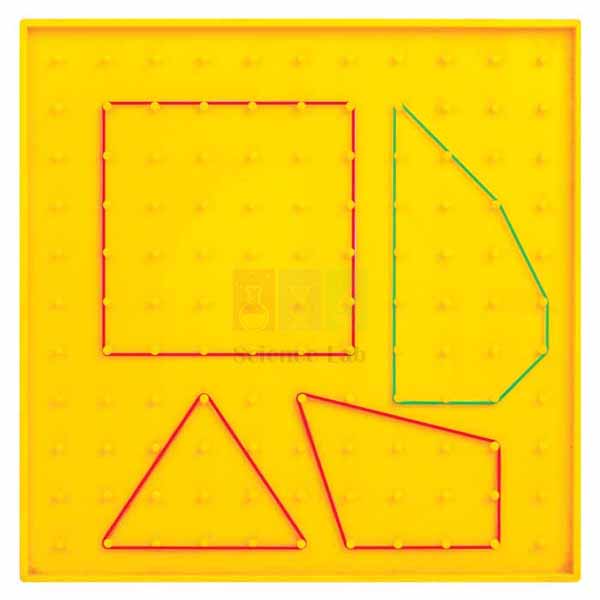
Double Sided Geoboard
Double Sided Geoboard is a plastic pin board with two layouts: an 11 x 11 pin grid on one face and a 24-pin circular pattern on the other. Pupils stretch rubber bands between pins to make shapes they can change at once, then work on area, perimeter, symmetry, coordinates, angles and fractions of a circle.
Geoboard layouts and material
| Parameter | Detail |
|---|---|
| Material | Plastic |
| Side one | 11 x 11 pin grid |
| Side two | 24-pin circular pattern |
| Used with | Rubber bands (inclusion not stated in the listing) |
| Topics | Shapes, designs, spatial relationships, angles, fractions, area, perimeter, symmetry, coordinates |
| Product code | SLE/MAT/77 |
| Minimum order | 10 units |
| Dispatch | Usually within 7 to 10 working days |
| Manufacturer | ScienceLab (Jain Scientific Equipments Pvt Ltd), Ambala, India |
Geoboard activities for the maths lab
Area of a triangle on the grid side. Pupils stretch a rubber band around a right triangle with its two shorter sides along the lines of pins, then add a second band to complete the rectangle around it. They count the squares, see that the triangle is half the rectangle, and check with half base times height.
Coordinates and transformations. Take one corner pin as the origin and name every pin by an ordered pair. Pupils build a triangle, then its reflection in a marked line, a translation and a rotation about a pin, and record the new coordinates. A coordinate board carries the same work onto labelled axes.
Angle in a semicircle. On the circular side, stretch a band between two pins directly opposite each other to form a diameter, then join both ends to a third pin. Pupils measure the angle there with a protractor and find a right angle wherever the third pin is placed.
Regular polygons. Joining every fourth pin of the circle gives a regular hexagon, and every sixth pin gives a square. Pupils compare interior angles and side counts, then move on to triangle-based shapes on the isometric grid geoboard.
Frequently Asked Questions About the Double Sided Geoboard
How is Pick's theorem checked on the grid side?
Make a polygon whose corners sit on pins. Count the pins inside the band and the pins the band touches. The area in unit squares equals the inside count plus half the boundary count, minus one. Then confirm it by splitting the shape into rectangles and right triangles.
Why do pupils often get Pick's theorem wrong on a geoboard?
Most errors come from counting. Pupils miss boundary pins that lie along a slanted side, count a corner pin twice, or include pins just outside the band. The formula also needs a simple polygon, so shapes that cross themselves or meet at a single pin must be split first.
Can an area on the pin grid be a fraction of a square?
Yes. A slanted side cuts the squares it crosses into pieces that are often unequal. Even so, any shape with its corners on pins has an area that is a whole number of squares or ends in a half, such as two and a half. To see where the halves come from, enclose the shape in a rectangle and subtract the corner triangles.
Which regular polygons can be built on the circular side?
Joining pins at equal steps around the 24-pin circle gives regular polygons whose number of sides divides the pin count: an equilateral triangle, a square, a hexagon, an octagon and a twelve-sided polygon. Pupils compare their angles and watch the shape approach the circle as sides are added.
Is the board suitable for both younger and older pupils?
Yes. Younger pupils copy and invent shapes, count sides and find lines of symmetry. Older pupils use the same board for area by counting, coordinates, Pick's theorem and circle theorems. Switching between the grid and the circle needs only a turn of the board.
Boards, kits and bands for geometry lessons
- 10 Isometric Grid Pattern Geoboard
- 5 Assorted Geoboards
- Geoboard
- Coordinate Board
- Circle Kit
- Rubber Bands (Good Quality)
To request a quotation, send the product name, code and quantity through our contact page or add the item to your enquiry cart.
Last updated: 14 November 2026