- Physics Lab Equipment
- Chemistry Lab Equipment
- Biology Lab Equipment
- Anatomical Lab Equipment
- Learning
- Educational Lab Equipment
- Magnets
- Agriculture
- Astronomy
- Earth Science
- Geography Lab Equipment
- Safety Lab Coat
- Laboratory
- Meteorological
- Electricity & Magnetism
- Heat
- School Lab Equipment
- Lab Glassware
- Science Lab Equipment
- Tvet Lab Equipment
- Robotics Kits Supplier and Manufacturer for Schools India
- Math Lab Equipment Manufacturers and Exporters in Ambala
- STEM Kits Manufacturers and Supplier India
- Engineering Lab Equipment
- Hospital Lab Equipment
- Water, Sanitation & Hygiene Supplies
- Cold Chain, Solar & Communication Equipment
- Nutrition
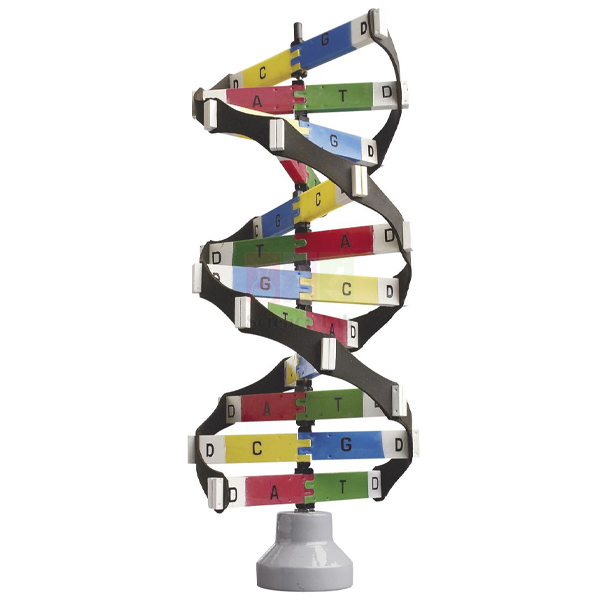
DNA Activity Model
DNA Activity Model (Product Code: SLE/Mo/01) is a build-it-yourself plastic double helix kit used to teach DNA structure, base pairing and replication in school and college biology. Students assemble colour-coded cytosine, adenine, guanine and thymine bases on phosphate strands around a centre rod representing hydrogen bonds, then display the model on a metal base that rotates. This DNA model kit for Indian classrooms is made by Jain Scientific Equipments Pvt Ltd (ScienceLab), an OEM manufacturer, at its own factory in Ambala, India.
Specifications
| Parameter | Detail |
|---|---|
| Model type | Three-dimensional double helix, assembled by students |
| Components | Cytosine, adenine, guanine and thymine bases; connecting phosphate strands; centre rod representing hydrogen bonds |
| Material | Durable plastic components |
| Base | Sturdy metal base for easy rotation and classroom display |
| Base pairing | Colour-coded parts with specially shaped ends for correct base-pair alignment |
| Replication demonstration | Can be unzipped to demonstrate DNA replication |
| Weight | 250 g approx. |
| Dimensions | 130 x 130 x 450 mm approx. |
| Product code | SLE/Mo/01 |
| Manufacturer | Jain Scientific Equipments Pvt Ltd (ScienceLab) — OEM |
| Country of origin | India (made in Ambala, Haryana) |
What Is the DNA Activity Model Used For?
Building the helix themselves helps students remember what a textbook diagram rarely conveys: adenine always pairs with thymine and cytosine with guanine, the two strands wind around a common axis, and the bases sit inside the helix like the rungs of a twisted ladder. Because the shaped ends of the colour-coded parts only align with the correct partner, mistakes show up straight away and students correct them as they build.
Once assembled, the model can be unzipped down the middle to show how each separated strand serves as a template for a new partner strand during replication. At roughly 130 x 130 x 450 mm on its metal base, it suits the teacher's desk for whole-class discussion and turns easily so everyone can follow the helix. Keeping the parts sorted by base type between lessons makes the next assembly much quicker.
OEM Manufacturer
ScienceLab is the trading name of Jain Scientific Equipments Private Limited, the OEM (original equipment manufacturer) of the DNA Activity Model, which it produces at its licensed factory at Saha, Ambala, Haryana. Schools, colleges, teacher-training institutes, dealers and importers in India and international markets buy it factory-direct, with quotations and repeat orders handled by the manufacturer. Ask us if you need replacement parts for models already in use. See our company profile for more.
Related Molecule Models
Models and kits that extend DNA and nucleic acid lessons:
- Molecular Model, RNA 12 Base — to contrast RNA with DNA
- Molecular Model Kit, Ten Layer DNA — a longer DNA build for group projects
- Mini DNA 22 layer base pair Molecular Model — a compact alternative model
- DNA extraction lab kit — a practical to pair with model work
See all models in the Molecule category.
Frequently Asked Questions
What parts are included in the DNA Activity Model?
The DNA Activity Model (SLE/Mo/01) includes colour-coded cytosine, adenine, guanine and thymine bases, connecting phosphate strands, a centre rod representing hydrogen bonds and a metal display base. Students assemble the plastic components into a three-dimensional double helix.
Can the DNA Activity Model show replication?
Yes. The DNA Activity Model can be unzipped between the base pairs to demonstrate DNA replication. Separating the two strands shows how each one carries the information needed to build a new complementary partner strand.
How big is the DNA Activity Model?
The assembled DNA Activity Model measures approximately 130 x 130 x 450 mm and weighs about 250 g. It is sized for classroom display on its metal base, which lets the helix be rotated so the whole class can see it.
How do students know the bases are paired correctly?
Parts of the DNA Activity Model are colour-coded and have specially shaped ends that ensure proper base-pair alignment. Students get immediate feedback while building, which reinforces the adenine-thymine and cytosine-guanine pairing rules.
Who manufactures the DNA Activity Model?
Jain Scientific Equipments Pvt Ltd (ScienceLab) manufactures the DNA Activity Model as the OEM at its licensed factory at Saha, Ambala, Haryana, India. Schools, colleges, dealers and importers in India and international markets can order it direct from the manufacturer.
What should a quotation request for the DNA model include?
A quotation request for the DNA Activity Model should give product code SLE/Mo/01, the number of models (for example one per student group), your delivery location and any other molecule models or DNA practical kits you want quoted with it.
Request a Quote
Quotations for the DNA Activity Model come direct from the manufacturer: send the quantity and delivery details through our contact page, or add it to the enquiry cart with other biology models.
Last updated: 24 September 2026