- Physics Lab Equipment
- Chemistry Lab Equipment
- Biology Lab Equipment
- Anatomical Lab Equipment
- Learning
- Educational Lab Equipment
- Magnets
- Agriculture
- Astronomy
- Earth Science
- Geography Lab Equipment
- Safety Lab Coat
- Laboratory
- Meteorological
- Electricity & Magnetism
- Heat
- School Lab Equipment
- Lab Glassware
- Science Lab Equipment
- Tvet Lab Equipment
- Robotics Kits Supplier and Manufacturer for Schools India
- Math Lab Equipment Manufacturers and Exporters in Ambala
- STEM Kits Manufacturers and Supplier India
- Engineering Lab Equipment
- Hospital Lab Equipment
- Water, Sanitation & Hygiene Supplies
- Cold Chain, Solar & Communication Equipment
- Nutrition
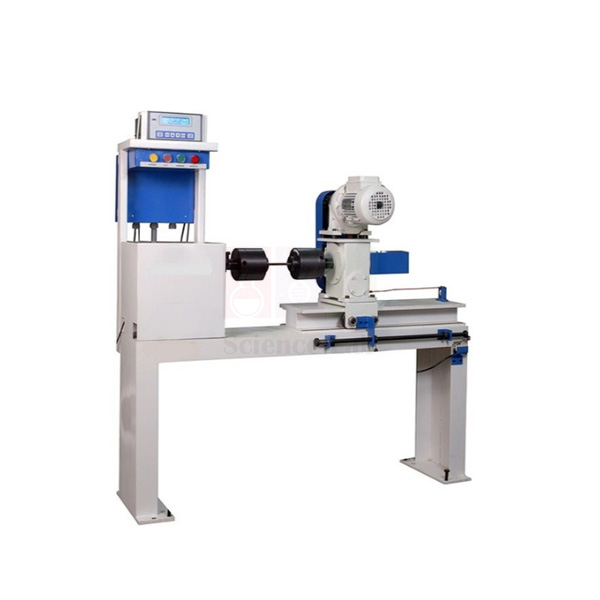
Digital Torsion Testing Machine
Digital Torsion Testing Machine (Product Code: SLE/CE/110) is a motorised test machine used to twist round and flat bar specimens while recording torque and angle of twist, in strength of materials and civil engineering laboratories. Engineering colleges use it to study torsional strength and shear behaviour, and it is listed in five capacities from 100 Nm to 2000 Nm with ± 1% torque accuracy. It is made by Jain Scientific Equipments Pvt Ltd (ScienceLab), an OEM producing lab equipment for technical institutes, at its own factory in Ambala, India.
Specifications
| Parameter | Detail |
|---|---|
| Torque measurement | Torque cell; one range with high resolution throughout |
| Angle of twist measurement | Rotary encoder, read to 0.1 degree |
| Drive | Geared motor applying torque to the specimen through a gear box |
| Display | Torque and angle of twist on the LCD of the Data Acquisition System (DAS) |
| PC connection | Facility to connect the DAS panel to a PC |
| Torque accuracy | ± 1% from 4% to 100% of machine capacity |
| Maximum torque capacity | 100, 200, 500, 1000 or 2000 Nm |
| Torque resolution | 0.01, 0.02, 0.05, 0.1 or 0.2 Nm (same model order) |
| Distance between grips | 0–400, 0–450, 0–500, 0–600 or 0–1000 mm (same model order) |
| Torsion speed and direction | 1.5 RPM, with reverse |
| Grips for round bars | 4–50 mm diameter |
| Grips for flat bars | 2–60 mm (thickness and width, as listed) |
| Power supply | 3 phase, 440 V, 50 Hz, AC motor (rating to be confirmed at quotation) |
| Product code | SLE/CE/110 |
| Manufacturer | Jain Scientific Equipments Pvt Ltd (ScienceLab) — OEM |
| Country of origin | India (made in Ambala, Haryana) |
What Is the Torsion Testing Machine Used For?
In a torsion test the specimen is clamped at both ends and one grip is turned slowly by the geared motor while the torque cell measures the resisting torque and the encoder tracks the angle of twist. Plotting torque against angle shows the elastic region, the onset of yielding and the maximum torque before fracture, from which students work out the modulus of rigidity and torsional strength. It connects classroom theory on shafts and twisting members with real material behaviour.
Choose a capacity so that the expected failure torque falls between 4% and 100% of the machine rating, the band in which the ± 1% accuracy applies. Measure specimen diameter or thickness before clamping, set the grip spacing to suit the specimen length, and connect the DAS panel to a PC when you want to keep torque-angle records for reports. The machine needs a 3 phase, 440 V supply, so check the laboratory wiring in advance.
What to Specify When Ordering
- Maximum torque capacity: 100, 200, 500, 1000 or 2000 Nm, matched to your strongest specimen.
- Specimen types: round bars of 4–50 mm diameter and/or flat bars in the 2–60 mm range.
- Grip spacing you need (up to 1000 mm on the largest listed model).
- Whether you will connect the DAS panel to a PC, and that a 3 phase, 440 V supply is available.
OEM Manufacturer
ScienceLab is the trading name of Jain Scientific Equipments Private Limited, the OEM (original equipment manufacturer) of the Digital Torsion Testing Machine. The machine is built at the company's own licensed factory at Saha, Ambala, Haryana, India, so colleges deal directly with the maker rather than a reseller.
Universities, polytechnics, testing laboratories, dealers and importers in India and international markets are supplied factory-direct, and questions about grips, spare parts or additional machines go straight to the manufacturer — just ask us. The ScienceLab company profile explains more about the company.
Related Civil Engineering Lab Equipment
A strength of materials laboratory usually runs torsion tests alongside these machines and tools:
- Tensile strength testing machine — measures tensile strength and elongation of the same bar materials.
- Impact Testing Machine-Digital — adds toughness results to the materials comparison.
- Flexure Testing Machine Digital — covers bending strength of beam and prism specimens.
- Caliper Vernier (Metal) — for measuring specimen diameter and thickness before each test.
Find more apparatus in Civil Engineering Lab Equipment and in Materials Testing and Properties.
Frequently Asked Questions
What torque capacities does the Digital Torsion Testing Machine come in?
The Digital Torsion Testing Machine is listed with maximum torque capacities of 100, 200, 500, 1000 and 2000 Nm, with torque resolution from 0.01 Nm on the smallest model to 0.2 Nm on the largest. Choose the capacity that suits your strongest specimens.
How accurate is the Digital Torsion Testing Machine?
The Digital Torsion Testing Machine measures torque with a torque cell to ± 1% accuracy between 4% and 100% of machine capacity, and reads the angle of twist through a rotary encoder to 0.1 degree, both shown on the DAS display.
What specimens can the Digital Torsion Testing Machine grip?
The Digital Torsion Testing Machine has grips for round bars of 4–50 mm diameter and for flat bars in the 2–60 mm range, with a distance between grips of up to 400 mm on the smallest model and up to 1000 mm on the largest.
Can torsion test data be saved to a computer?
Yes. The Digital Torsion Testing Machine has a facility for connecting its Data Acquisition System panel to a PC, while the LCD on the panel shows torque and angle of twist live during the test. Tell us your PC setup when you request a quote.
What power supply does the Digital Torsion Testing Machine need?
The Digital Torsion Testing Machine runs on a 3 phase, 440 V, 50 Hz supply through an AC motor. The motor rating is not stated in the current listing, so ask us to confirm it for the capacity you choose before planning the installation.
Who manufactures the Digital Torsion Testing Machine?
The Digital Torsion Testing Machine is manufactured by Jain Scientific Equipments Pvt Ltd (ScienceLab), the OEM, at its own licensed factory at Saha, Ambala, Haryana, India, and supplied factory-direct to colleges, laboratories, dealers and importers.
Is a calibration certificate available with the torsion testing machine?
Calibration-certificate availability for the Digital Torsion Testing Machine should be discussed with us before ordering. Send your documentation requirement through the contact page and we will confirm what can be supplied with the quotation.
Request a Quote
Request a quotation for the Digital Torsion Testing Machine through our contact page or the enquiry cart, stating the capacity and specimen sizes you need. The quotation comes straight from the manufacturer.
Last updated: 24 September 2026