- Physics Lab Equipment
- Chemistry Lab Equipment
- Biology Lab Equipment
- Anatomical Lab Equipment
- Learning
- Educational Lab Equipment
- Magnets
- Agriculture
- Astronomy
- Earth Science
- Geography Lab Equipment
- Safety Lab Coat
- Laboratory
- Meteorological
- Electricity & Magnetism
- Heat
- School Lab Equipment
- Lab Glassware
- Science Lab Equipment
- Tvet Lab Equipment
- Robotics Kits Supplier and Manufacturer for Schools India
- Math Lab Equipment Manufacturers and Exporters in Ambala
- STEM Kits Manufacturers and Supplier India
- Engineering Lab Equipment
- Hospital Lab Equipment
- Water, Sanitation & Hygiene Supplies
- Cold Chain, Solar & Communication Equipment
- Nutrition
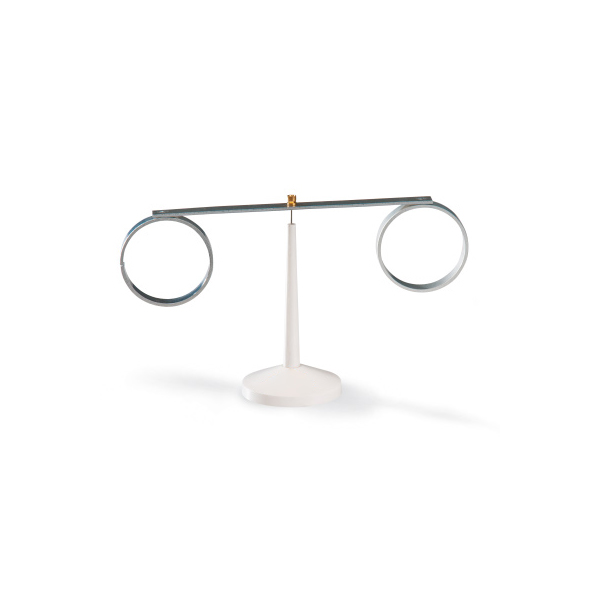
Device to Verify The Lenz's Law (for high school)
Device to Verify The Lenz's Law (for high school) (Product Code: SCL239/038) is a balanced rocker carrying two aluminium rings, used to show that an induced current opposes the change that produces it in school physics lessons on electromagnetic induction. A magnet pushed into the closed ring makes the arm swing away, while the slotted ring does not respond at all. It is manufactured by Jain Scientific Equipments Pvt Ltd (ScienceLab), an OEM manufacturer, at its own factory in Ambala, India, as physics practical equipment for schools.
Specifications
| Parameter | Detail |
|---|---|
| Construction | Two identical aluminium rings fixed to the ends of an aluminium rocker arm, a tripod with a needle, and a stand |
| Ring arrangement | One ring with a slot, the other closed |
| Ring diameter | 25 mm |
| Rocker arm length | In the range of 130 to 180 mm |
| Pivot | Beam mounted on the tripod needle |
| Product code | SCL239/038 |
| Manufacturer | Jain Scientific Equipments Pvt Ltd (ScienceLab) — OEM |
| Country of origin | India (made in Ambala, Haryana) |
What Is the Lenz's Law Device Used For?
Set the stand on a level bench, balance the arm on the needle and wait for it to settle. Push one pole of a strong bar magnet quickly into the closed ring: the changing magnetic field induces a current in the ring, and the field of that current repels the magnet, so the arm turns away. Withdraw the magnet and the ring is drawn after it. Repeat with the slotted ring and nothing happens, because the slot breaks the conducting loop and no current can circulate.
That side-by-side comparison lets students reason out Lenz's law for themselves before it is written on the board, and it links naturally to energy conservation and eddy current braking. Move the magnet briskly, keep the room free of draughts, and avoid knocking the arm off its needle between trials. It fits well into an electromagnetic kit for school physics in India alongside coils, magnets and galvanometers.
OEM Manufacturer
The Lenz's law rocker is made by Jain Scientific Equipments Private Limited, trading as ScienceLab, which is its OEM (original equipment manufacturer) and builds it at its own licensed factory at Saha, Ambala, Haryana, India. Physics departments, dealers and importers buy it factory-direct, and a quotation, repeat order or replacement tripod needle comes from the maker rather than a middleman — ask us. Learn more on the company profile.
Related Lab Equipment
These items support induction lessons alongside this device:
- Magnet Set of 4 — provides the magnets needed to move in and out of the rings.
- Lenz’s Law – Open & closed loop — an alternative open and closed loop version of the same experiment.
- Eddy Current Unit — extends the lesson to eddy current damping.
- Faraday's Law Apparatus — measures the induced pulse that Lenz's law gives a direction to.
- Device for Demonstrating Magnetic Field Lines — shows the field shape around the magnet first.
Visit our Lab Equipment category for more.
Frequently Asked Questions
Is a magnet included?
No magnet is listed with the Device to Verify The Lenz's Law (for high school). A strong bar magnet works well; the Magnet Set of 4 linked above can be added, or ask us to include a magnet in your quotation.
Why does one ring have a slot?
On the Device to Verify The Lenz's Law, the slot breaks the conducting loop so no induced current can flow round that ring. It acts as a control, proving the closed ring moves because of induced current, not simple attraction.
How big are the rings and the arm?
Each aluminium ring of the Device to Verify The Lenz's Law (for high school) is 25 mm in diameter, and the aluminium rocker arm carrying them has a length in the range of 130 to 180 mm.
Do aluminium rings stick to the magnet?
No. Aluminium is not attracted to a magnet in the ordinary way, so any movement of the closed ring on the Device to Verify The Lenz's Law must come from the current induced in it by the moving magnet.
Who manufactures the Device to Verify The Lenz's Law?
The Device to Verify The Lenz's Law (for high school) is manufactured by Jain Scientific Equipments Pvt Ltd (ScienceLab), the OEM, at its own licensed factory at Saha, Ambala, Haryana, India. Quotations and repeat orders come directly from the manufacturer.
How should the device be stored?
Before moving or storing the Device to Verify The Lenz's Law, lift the rocker arm off the tripod needle so the pivot is not damaged, and keep the aluminium rings free of dents so the arm stays balanced.
Request a Quote
Send an enquiry for the Device to Verify The Lenz's Law (for high school) to the manufacturer through our contact page, or add it to the enquiry cart together with a suitable magnet.
Last updated: 24 September 2026