- Physics Lab Equipment
- Chemistry Lab Equipment
- Biology Lab Equipment
- Anatomical Lab Equipment
- Learning
- Educational Lab Equipment
- Magnets
- Agriculture
- Astronomy
- Earth Science
- Geography Lab Equipment
- Safety Lab Coat
- Laboratory
- Meteorological
- Electricity & Magnetism
- Heat
- School Lab Equipment
- Lab Glassware
- Science Lab Equipment
- Tvet Lab Equipment
- Robotics Kits Supplier and Manufacturer for Schools India
- Math Lab Equipment Manufacturers and Exporters in Ambala
- STEM Kits Manufacturers and Supplier India
- Engineering Lab Equipment
- Hospital Lab Equipment
- Water, Sanitation & Hygiene Supplies
- Cold Chain, Solar & Communication Equipment
- Nutrition
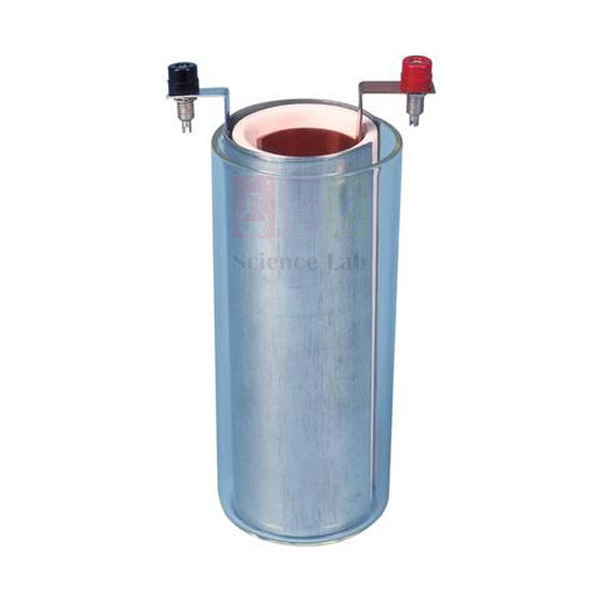
Daniell Cell
Daniell Cell (Product Code: SLE/CH/98) is a classic zinc–copper electrochemical cell for studying how a redox reaction between two metals and their salt solutions produces a voltage. It consists of a cylindrical zinc electrode and a copper electrode, a clay vessel and a battery glass; filled with electrolyte it supplies approx. 1.1 volts, and 4 mm jacks make connection to a meter straightforward. Chemistry and physics teachers in schools and colleges use it to introduce galvanic cells, electrode potentials and the origin of battery voltage. It is made by Jain Scientific Equipments Pvt Ltd (ScienceLab), Ambala, as an electrochemical cell kit for school and college labs.
Specifications
| Parameter | Detail |
|---|---|
| Purpose | Studying the properties of an electrochemical cell |
| Electrodes | Cylindrical zinc electrode and copper electrode |
| Vessels | Clay vessel and battery glass |
| Output voltage | Approx. 1.1 V when filled with cell electrolyte |
| Connections | Via 4 mm jacks |
| Dimensions | 105 mm in height, 65 mm diameter |
| Suitable filling | Copper sulphate solution (CuSO4), 10% concentration; zinc sulphate solution (ZnSO4), 10% concentration |
| Supplied | Without filling (electrolytes not included) |
Typical Use
Prepare 10% copper sulphate and 10% zinc sulphate solutions, place each electrode in the solution of its own metal with the clay vessel keeping the two liquids apart, and connect a voltmeter to the 4 mm jacks. Students should read close to 1.1 V, and can then discuss which electrode is oxidised, which way electrons flow through the external circuit, and why the clay vessel must let ions pass while stopping the solutions from mixing freely.
After the lesson, pour out both electrolytes, rinse the clay vessel and electrodes with clean water, and let everything dry so crystals do not build up in the clay. The zinc electrode is gradually consumed as the cell works, so inspect it before each class. As part of a school chemistry lab equipment set in India, the cell links electrochemistry theory to a reading students can take themselves.
Manufacturer
Jain Scientific Equipments Private Limited, known by its brand name ScienceLab, makes this cell and other teaching apparatus in Ambala, Haryana, India. You can read more about us in the company profile.
Related Chemistry Lab Equipment
What you need to fill, connect and measure the cell:
- Cupric Sulphate (Copper Sulphate) — for preparing the 10% copper sulphate electrolyte
- Zinc Sulfate 100 g — for preparing the 10% zinc sulphate electrolyte
- Digital Voltmeter — to read the approx. 1.1 V output
- Banana Plug Connectors Leads — plug leads for wiring the jacks to a meter; check plug size against the 4 mm jacks
- Student Voltaic Cell Set — for comparing other metal pairs in follow-up work
More electrochemistry and bench apparatus is available in our Chemistry Lab Equipment category.
Frequently Asked Questions
Are the electrolytes included with the Daniell Cell?
No. The cell is delivered without a filling. Copper sulphate and zinc sulphate solutions, each at 10% concentration, are the suitable fillings.
What voltage does it produce?
Approximately 1.1 volts when filled with the cell electrolyte.
How do I connect it to a meter?
Through its 4 mm jacks, using leads fitted with matching plugs.
How big is it?
It stands 105 mm high with a diameter of 65 mm, small enough for student benches.
Can it power a bulb or motor?
It is intended for studying cell properties rather than as a power source, and its current capacity is not specified. Contact us if you plan a load experiment.
How should it be stored between classes?
Empty both solutions, rinse all parts with water and let them dry fully before storing.
Do you supply sets for a whole class?
Yes. Tell us how many cells you need and whether the electrolytes should be quoted too; we supply institutions in India and international markets.
Request a Quote
Put the Daniell Cell in our enquiry cart or get in touch for a quotation covering quantity and delivery.
Last updated: 24 September 2026