- Physics Lab Equipment
- Chemistry Lab Equipment
- Biology Lab Equipment
- Anatomical Lab Equipment
- Learning
- Educational Lab Equipment
- Magnets
- Agriculture
- Astronomy
- Earth Science
- Geography Lab Equipment
- Safety Lab Coat
- Laboratory
- Meteorological
- Electricity & Magnetism
- Heat
- School Lab Equipment
- Lab Glassware
- Science Lab Equipment
- Tvet Lab Equipment
- Robotics Kits Supplier and Manufacturer for Schools India
- Math Lab Equipment Manufacturers and Exporters in Ambala
- STEM Kits Manufacturers and Supplier India
- Engineering Lab Equipment
- Hospital Lab Equipment
- Water, Sanitation & Hygiene Supplies
- Cold Chain, Solar & Communication Equipment
- Nutrition
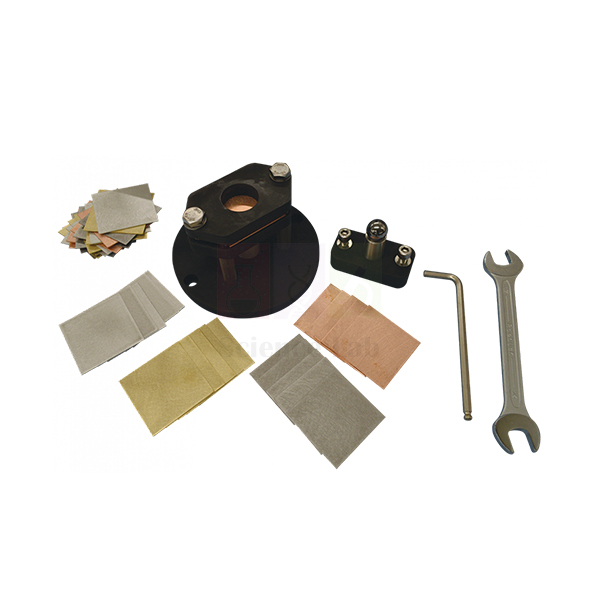
Cupping Experiment
Cupping Experiment (Product Code: SLE/ETP/08) is a sheet-metal forming accessory used to judge the ductility of thin metal specimens by pressing a lubricated steel sphere into them until they rupture, in strength-of-materials laboratories. Engineering students load it through a universal testing machine and watch the cup form and split in an angled mirror below the die plate. It is made by Jain Scientific Equipments Pvt Ltd (ScienceLab), an OEM manufacturer of engineering lab equipment in India, at its own factory in Ambala.
Key Details
| Parameter | Detail |
|---|---|
| Penetrator | Hardened steel sphere, lubricated before it is pressed into the specimen |
| Specimen holding | Cupping specimen clamped between the clamping plate and the die plate |
| Viewing arrangement | Angled mirror placed below the die plate for easy viewing of the specimen as it ruptures |
| Loading | Penetrator pressed into the specimen using the Universal Testing Machine |
| Test result | A cup-shaped indentation that deepens as pressure rises until the specimen ruptures |
| Product code | SLE/ETP/08 |
| Manufacturer | Jain Scientific Equipments Pvt Ltd (ScienceLab) — OEM |
| Country of origin | India (made in Ambala, Haryana) |
What Is the Cupping Experiment Used For?
A cupping test tells students how well a sheet metal will cope with stretch-forming work such as pressing and drawing. The sheet is clamped between the clamping plate and the die plate, the hardened steel sphere is lubricated, and the testing machine pushes the sphere into the sheet. The specimen bulges into a cup and eventually splits, and the angled mirror lets the whole group see the underside at the moment of rupture.
Repeating the test on different sheet materials, or on the same material before and after heat treatment, gives a clear practical ranking of formability that complements tensile data. Lubricate the sphere the same way for every specimen so friction does not vary, tighten the clamping plate evenly, and record the machine reading at the instant the crack appears in the mirror.
OEM Manufacturer
The Cupping Experiment is an OEM (original equipment manufacturer) product of Jain Scientific Equipments Private Limited, which trades as ScienceLab. It is produced at the company's own licensed factory at Saha, Ambala, Haryana, India, rather than bought from a trader and resold. Engineering colleges, polytechnics, dealers and importers therefore deal with the maker itself for technical questions and repeat orders. Read more on the ScienceLab company profile.
Related Materials Testing and Properties Equipment
Apparatus that fits alongside a cupping test in a materials laboratory:
- Tensile strength testing machine — adds strength and elongation figures for the same sheet material.
- Compression Cage — another testing-machine ancillary, for experiments that need a compressive load.
- Brinell Indenter — a ball-indentation accessory that measures hardness instead of formability.
- Muffle Furnace — anneals sheet specimens so students can compare cupping before and after heat treatment.
Browse the full Materials Testing and Properties range for more strength-of-materials apparatus.
Frequently Asked Questions
What does the Cupping Experiment show students?
The Cupping Experiment shows how much stretch-forming a thin metal sheet can take before it splits. A lubricated hardened steel sphere is pressed into the clamped specimen until a cup forms and ruptures, giving a visual comparison of ductility between materials.
Which machine loads the Cupping Experiment?
The Cupping Experiment is loaded by a universal testing machine, which presses the penetrator sphere into the specimen. Tell us which testing machine your laboratory already has, so the fit can be discussed before a quotation is prepared.
How do students see the specimen rupture?
The Cupping Experiment has an angled mirror placed below the die plate. As pressure rises and the cup deepens, students watch the underside of the specimen in the mirror and see the moment it ruptures without leaning under the loaded machine.
Why is the penetrator sphere lubricated?
Lubricating the penetrator sphere of the Cupping Experiment reduces friction between the steel ball and the sheet, so the metal stretches over the sphere instead of tearing early at the contact point. Applying the lubricant the same way each time keeps results comparable.
Who manufactures the Cupping Experiment?
The Cupping Experiment is manufactured by Jain Scientific Equipments Pvt Ltd (ScienceLab) as the OEM, at its own licensed factory at Saha, Ambala, Haryana, India. Replacement parts and repeat orders are handled by the manufacturer directly, so ask us about spares when you enquire.
What should a quotation request for the Cupping Experiment include?
For a Cupping Experiment quotation, give the product code SLE/ETP/08, the number of sets, the testing machine it will be used with and the delivery destination in India or abroad. Send these details through our contact page or the enquiry cart.
Request a Quote
To request a quotation for the Cupping Experiment, send your requirement through the contact page or add it to the enquiry cart. Quotations come direct from the manufacturer, for institutions, dealers and importers in India and international markets.
Last updated: 24 September 2026