- Physics Lab Equipment
- Chemistry Lab Equipment
- Biology Lab Equipment
- Anatomical Lab Equipment
- Learning
- Educational Lab Equipment
- Magnets
- Agriculture
- Astronomy
- Earth Science
- Geography Lab Equipment
- Safety Lab Coat
- Laboratory
- Meteorological
- Electricity & Magnetism
- Heat
- School Lab Equipment
- Lab Glassware
- Science Lab Equipment
- Tvet Lab Equipment
- Robotics Kits Supplier and Manufacturer for Schools India
- Math Lab Equipment Manufacturers and Exporters in Ambala
- STEM Kits Manufacturers and Supplier India
- Engineering Lab Equipment
- Hospital Lab Equipment
- Water, Sanitation & Hygiene Supplies
- Cold Chain, Solar & Communication Equipment
- Nutrition
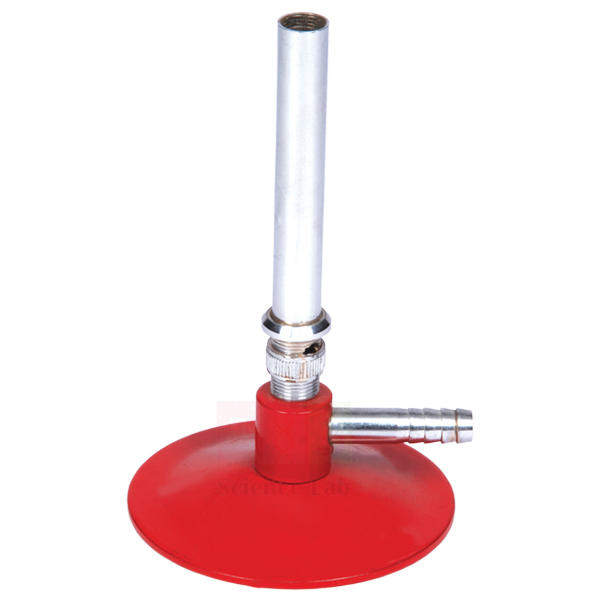
Bunsen Burners
Bunsen Burners (Product Code: SLE/B/10) are standard laboratory gas burners used for general heating, sterilising and flame tests in school, college and teaching labs. Each burner has a 100 x 12 mm nickel-plated tube with an adjustable screwed air regulator, stands 125 mm tall on an 80 mm stove-enamelled pressed steel base, and comes with one spare jet. These Bunsen burners for schools in India and abroad are made by Jain Scientific Equipments Pvt Ltd (ScienceLab), an OEM manufacturer, at its own factory in Ambala, India.
Specifications
| Parameter | Detail |
|---|---|
| Overall height | 125 mm |
| Burner tube | Nickel plated, 100 x 12 mm |
| Air control | Adjustable screwed air regulator |
| Gas inlet | Riffled connector |
| Base | Stove-enamelled pressed steel, wide base of 80 mm diameter |
| Supplied with | One spare jet |
| Product code | SLE/B/10 |
| Manufacturer | Jain Scientific Equipments Pvt Ltd (ScienceLab) — OEM |
| Country of origin | India (made in Ambala, Haryana) |
What Are Bunsen Burners Used For?
The Bunsen burner is the workhorse of chemistry and biology practicals. Students use it to heat test tubes held in a holder, boil water in beakers, evaporate solutions to dryness, sterilise wire loops and carry out flame tests for metal ions. Push burner tubing onto the riffled connector, light the gas with the air regulator closed, then screw the regulator open until the yellow luminous flame turns into a steady blue cone.
For beakers and flasks, place the burner under a tripod stand and wire gauze so the flame spreads beneath the vessel. The 80 mm pressed steel base keeps the burner steady on the bench; even so, turn the gas off at the tap after each session and let the nickel-plated tube cool before the burner is put away.
OEM Manufacturer
Jain Scientific Equipments Private Limited, the company behind the ScienceLab name, is the OEM (original equipment manufacturer) of these Bunsen burners. They are produced at its own licensed factory at Saha, Ambala, Haryana, India, and supplied factory-direct to schools, colleges, dealers and importers, so class sets and top-up orders come from the maker rather than a trader. If you need further spare jets for burners already in use, ask us. See the company profile for an overview.
Related Laboratory Equipment
Equipment used with this burner in a typical heating practical:
- Burner Tubing — connects the riffled inlet to the bench gas tap.
- Tripod Stand 200mm — holds vessels above the flame.
- Gauze Wire — spreads the heat under beakers and flasks.
- Test Tube Holder — for heating test tubes directly in the flame.
- Bunsen Burner with Stopcock — the same burner design with gas shut-off at the inlet.
Compare other burner types on the Burners category page.
Frequently Asked Questions
What comes with each of the SLE/B/10 Bunsen Burners?
Each of the Bunsen Burners (SLE/B/10) is supplied with one spare jet. Gas tubing is not part of the burner and is listed separately as Burner Tubing, so add it to your enquiry if the bench taps need new hoses.
What is the spare jet on these Bunsen Burners for?
Jets on Bunsen Burners can become blocked or damaged over years of classroom use. The spare jet supplied with each SLE/B/10 burner lets the lab swap it in and keep the burner working without waiting for a replacement part.
How do I switch the Bunsen burner between a yellow and a blue flame?
Turn the screwed air regulator on the Bunsen Burners. Closed, it gives the yellow luminous flame used as a visible standby; opened, it admits air for the hotter blue flame used for heating test tubes, beakers and flame tests.
How tall are the Bunsen Burners and how big is the base?
The Bunsen Burners (SLE/B/10) stand 125 mm tall overall, with a 100 x 12 mm nickel-plated burner tube mounted on a wide stove-enamelled pressed steel base of 80 mm diameter for steadiness on the bench.
Do these Bunsen Burners run on natural gas or LPG?
The gas type is not stated in our product details for the Bunsen Burners (SLE/B/10). Tell us which gas your laboratory uses through the contact page so we can confirm the right set-up before dispatch.
Who manufactures the SLE/B/10 Bunsen Burners?
Jain Scientific Equipments Pvt Ltd, trading as ScienceLab, is the OEM manufacturer of the Bunsen Burners (SLE/B/10). They are made at the company's own licensed factory at Saha, Ambala, Haryana, India, and quoted directly for class sets and export orders.
Request a Quote
Request pricing for Bunsen Burners through our contact page, or add them to the enquiry cart with tubing and stands. Share the quantity, gas type and delivery location, and the quotation will come straight from the manufacturer.
Last updated: 24 September 2026