- Physics Lab Equipment
- Chemistry Lab Equipment
- Biology Lab Equipment
- Anatomical Lab Equipment
- Learning
- Educational Lab Equipment
- Magnets
- Agriculture
- Astronomy
- Earth Science
- Geography Lab Equipment
- Safety Lab Coat
- Laboratory
- Meteorological
- Electricity & Magnetism
- Heat
- School Lab Equipment
- Lab Glassware
- Science Lab Equipment
- Tvet Lab Equipment
- Robotics Kits Supplier and Manufacturer for Schools India
- Math Lab Equipment Manufacturers and Exporters in Ambala
- STEM Kits Manufacturers and Supplier India
- Engineering Lab Equipment
- Hospital Lab Equipment
- Water, Sanitation & Hygiene Supplies
- Cold Chain, Solar & Communication Equipment
- Nutrition
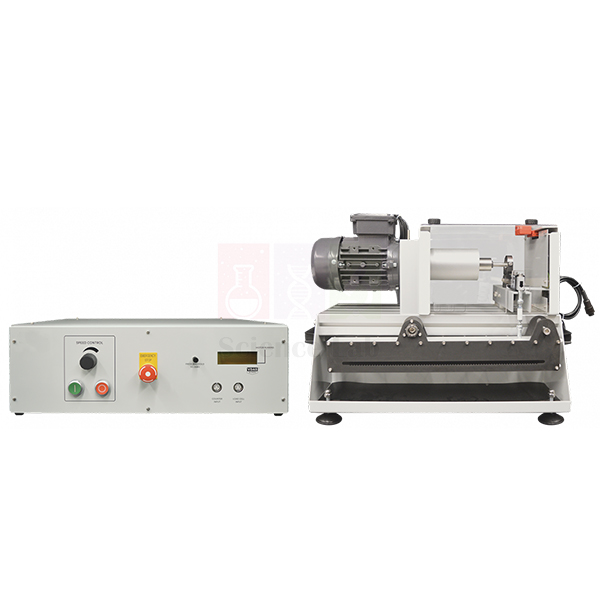
Rotating Fatigue Machine
Rotating Fatigue Machine (Product Code: SLE/ETP/05) is a bench-mounted rotating-bending fatigue tester used to show how materials fail under alternating stress, covering both low- and high-cycle fatigue, in engineering and materials science laboratories. A variable speed motor spins the specimen in a collet chuck while a dead weight on a load arm bends it, and a separate unit displays the load, cycle rate and number of cycles. It is made by Jain Scientific Equipments Pvt Ltd (ScienceLab), an OEM manufacturer, at its own factory in Ambala, India.
Key Details
| Parameter | Detail |
|---|---|
| Mounting | Bench-mounted machine |
| Test | Failure under alternating stress; low-cycle and high-cycle fatigue |
| Drive | Motor with variable speed drive for a safe, gradual increase in cycle rate; compliant coupling; precision shaft in sturdy bearings |
| Specimen holding | Collet-type chuck for accurate concentricity; gimbal-mounted self-aligning bearing at the free end |
| Loading | Short load arm linked by a load cell to a longer load arm with an integral moveable dead weight; applies a purely vertical load even as the specimen deflects |
| Sensors | Load cell for load; electronic sensor for shaft rotation |
| Control and display | Separate control and instrumentation unit showing load, speed (cycle rate) and number of cycles |
| Specimens | Special design that puts the point of maximum stress at the midpoint rather than the end |
| Product code | SLE/ETP/05 |
| Manufacturer | Jain Scientific Equipments Pvt Ltd (ScienceLab) — OEM |
| Country of origin | India (made in Ambala, Haryana) |
What Is the Rotating Fatigue Machine Used For?
Parts such as axles and shafts rarely fail from one heavy load; they crack after thousands or millions of smaller ones. This machine recreates that in a lesson. The specimen is gripped in the chuck and loaded at its free end, so as it spins every point on its surface moves from tension to compression and back once per revolution — one complete stress cycle. Students set the load by sliding the dead weight along the arm, raise the speed gradually and let the counter log cycles until the specimen breaks.
Running specimens at several loads and plotting stress against cycles to failure builds the classic fatigue (S–N) curve: heavy loads give low-cycle failures, lighter loads high-cycle ones. Because the specimens concentrate stress at their midpoint, the crack starts away from the chuck, and the broken faces are well worth examining for the smooth fatigue zone and the rough final fracture.
What to Specify When Ordering
- The number of test specimens and the materials you plan to test — ask us about suitable specimens
- The mains supply at your laboratory for the motor and control unit
- Whether a calibration certificate for the load cell is required — discuss this with us
OEM Manufacturer
ScienceLab, the trading name of Jain Scientific Equipments Private Limited, is the OEM manufacturer of the Rotating Fatigue Machine and builds it at the company's own licensed factory at Saha, Ambala, Haryana, India. Engineering colleges, universities, polytechnics, dealers and importers buy the machine factory-direct.
Specimen supply, spare parts and follow-up orders are handled by the manufacturer itself, so ask us whenever you need them. Our company profile has more about the business.
Related Materials Testing and Properties Equipment
Other machines for studying how materials fail:
- Creep Testing Machine — failure under steady load over time.
- Energy Absorbed At Fracture — failure under a sudden impact.
- Bench Top Tensile Testing Machine — failure under a single, steadily rising pull.
- Tensile strength testing machine — for measuring the static strength that fatigue results are compared with.
Browse the Materials Testing and Properties category for more mechanics lab equipment.
Frequently Asked Questions
What does the Rotating Fatigue Machine demonstrate?
The Rotating Fatigue Machine (SLE/ETP/05) demonstrates how materials fail when subjected to an alternating stress, showing both low-cycle and high-cycle fatigue as a loaded specimen rotates until it breaks.
How is the load applied and measured?
On the Rotating Fatigue Machine, an integral moveable dead weight on the longer load arm sets the load. A load cell linking the short and long load arms measures it, and the linkage applies a purely vertical load even when the specimen deflects.
What does the control unit display?
The separate control and instrumentation unit of the Rotating Fatigue Machine shows the applied load, the speed or cycle rate, and the number of cycles, with an electronic sensor measuring shaft rotation.
Why do the specimens have a special design?
Specimens for the Rotating Fatigue Machine are designed so the point of maximum stress falls at their midpoint rather than at their end. The failure therefore happens away from the chuck, giving cleaner and more meaningful results.
Are test specimens supplied with the machine?
The specimen supply for the Rotating Fatigue Machine is not detailed on this page. Tell us the materials and quantity you plan to test through the contact page and we will advise on specimens.
Who manufactures the Rotating Fatigue Machine?
The Rotating Fatigue Machine is manufactured by Jain Scientific Equipments Pvt Ltd (ScienceLab) as the OEM, at its own licensed factory in Saha, Ambala, Haryana, India, and supplied factory-direct to colleges, dealers and importers.
Can ScienceLab quote the machine for export?
Yes. ScienceLab quotes the Rotating Fatigue Machine direct from the manufacturer for institutions and dealers in India and international markets. Share your quantity, mains supply and delivery city or port through the contact page.
Request a Quote
Quotations for the Rotating Fatigue Machine come straight from the manufacturer. Send your requirements through our contact page, or add the machine to the enquiry cart with other testing apparatus.
Last updated: 24 September 2026