- Physics Lab Equipment
- Chemistry Lab Equipment
- Biology Lab Equipment
- Anatomical Lab Equipment
- Learning
- Educational Lab Equipment
- Magnets
- Agriculture
- Astronomy
- Earth Science
- Geography Lab Equipment
- Safety Lab Coat
- Laboratory
- Meteorological
- Electricity & Magnetism
- Heat
- School Lab Equipment
- Lab Glassware
- Science Lab Equipment
- Tvet Lab Equipment
- Robotics Kits Supplier and Manufacturer for Schools India
- Math Lab Equipment Manufacturers and Exporters in Ambala
- STEM Kits Manufacturers and Supplier India
- Engineering Lab Equipment
- Hospital Lab Equipment
- Water, Sanitation & Hygiene Supplies
- Cold Chain, Solar & Communication Equipment
- Nutrition
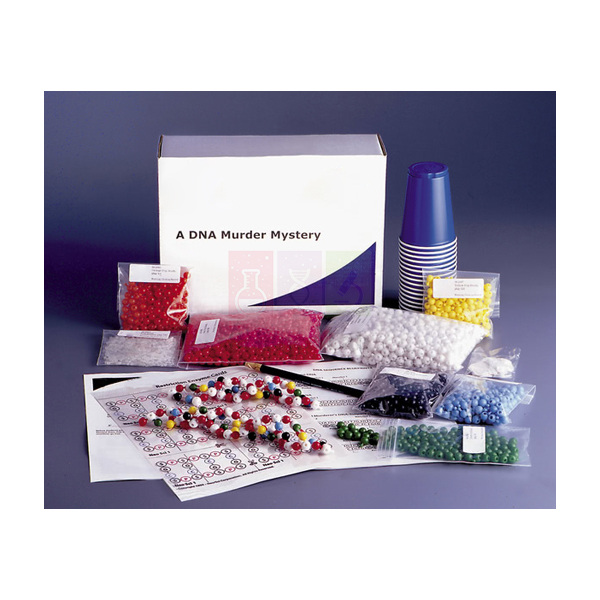
DNA Murder Mystery Lab Investigation
The DNA Murder Mystery Lab Investigation (Product Code: SLE/CH/121) is a completely reusable kit that challenges a class to solve a murder by simulating every step of the DNA fingerprinting protocol. Instead of biological samples, students work with “pop bead” DNA fingerprints, matching those of the suspects against samples collected at the scene of the crime. It supports up to 40 students and works as an engaging DNA model kit India schools can use year after year to introduce forensic applications of DNA technology. It is manufactured by Jain Scientific Equipments Pvt Ltd (ScienceLab), Ambala.
Key Details
| Parameter | Detail |
|---|---|
| Kit type | Completely reusable simulation kit |
| DNA representation | Pop-bead DNA fingerprints |
| Scenario | Solving a murder by matching suspects’ DNA fingerprints with samples from the crime scene |
| Class size | Materials for up to 40 students |
| Student activities | Simulate the DNA fingerprinting procedure; construct and interpret an autoradiogram; compare and evaluate DNA fingerprint patterns; compare the strengths and limitations of DNA profiling |
| Concepts covered | Basics of DNA fingerprinting, DNA structure and extraction, gel electrophoresis and autoradiography |
Typical Use
The simulation turns an abstract laboratory protocol into something students can hold. Working in teams, they assemble bead strands that stand for DNA from the crime scene and from each suspect, then move through the stages of the fingerprinting procedure in model form: cutting the strands into fragments, arranging the fragments by size as a gel would separate them, and recording the result as an autoradiogram. Comparing these patterns side by side lets them decide which suspect matches, and the final discussion asks them to weigh up where DNA profiling is powerful and where its limitations lie.
Because the fingerprints are built from pop beads rather than real samples, the activity fits an ordinary classroom as well as a laboratory and is ideal for introducing the topic before a wet-lab electrophoresis practical. At the end of the lesson, have each team break down its strands, count the beads back into labelled containers and return them to the kit so it is complete for the next class. It sits comfortably among the biology teaching aids India schools use to link genetics with real-world forensic science.
Manufacturer
This kit is manufactured by Jain Scientific Equipments Private Limited, which trades under the ScienceLab name from Ambala, Haryana, India, producing models, kits and apparatus for science education. You can learn more on our company profile.
Related Chemistry Lab Equipment
Models and kits that fit before or after this simulation:
- DNA Activity Model — introduces the double helix before fingerprinting is discussed
- DNA-RNA Model — compares DNA with RNA structure for extension lessons
- DNA Forensics Lab Investigation — moves students on to comparing electrophoretic results
- DNA Fingerprinting Electrophoresis Lab Activity — a wet-lab follow-up with real gels and stain
- Crime Scene Tape — adds atmosphere when the murder scenario is introduced
Browse all items in our Chemistry Lab Equipment category.
Frequently Asked Questions
Can the kit be used again with other classes?
Yes. It is completely reusable; the pop beads are simply taken apart and returned to the kit after each lesson.
How many students can work with one kit?
It contains materials for up to 40 students.
Does it require chemicals or electrophoresis equipment?
The DNA fingerprints are pop-bead models, so the core activity is a simulation rather than a wet-lab procedure. If you would like the full contents list, ask through our contact page.
What will students be able to do after the activity?
Construct and interpret an autoradiogram, compare and evaluate DNA fingerprint patterns, describe the fingerprinting procedure and discuss the strengths and limitations of DNA profiling.
How should the beads be looked after?
Count them back into labelled containers at the end of each session and wipe them clean if needed, so no pieces go missing between classes.
What information do you need for a school or tender quotation?
Include the product code SLE/CH/121, the number of kits, the delivery address and any purchase format your institution uses.
Is supply available for school chains and export buyers?
Yes. We quote multiple kits for schools and distributors in India and international markets.
Request a Quote
Request a quotation for the DNA Murder Mystery Lab Investigation via our contact page, or add it to the enquiry cart along with any DNA models you need.
Last updated: 24 September 2026